Modern Silver Pendant with Ancient Roman Hadrian As (No reserve price)


03
days
10
hours
58
minutes
16
seconds
Current bid
€ 55
No reserve price

Expert
Selected by Ruth Garrido Vila
Directed the Ifergan Collection Museum, specialising in Phoenician and Mediterranean archaeology.
Estimate € 250 - € 300
14 other people are watching this object
 Bidder 3716 Bidder 3716 | €55 | |
|---|---|---|
 Bidder 2806 Bidder 2806 | €50 | |
| Bidder 4935 | €6 | |
Catawiki Buyer Protection
Your payment’s safe with us until you receive your object.View details
Trustpilot 4.4 | 123759 reviews
Rated Excellent on Trustpilot.
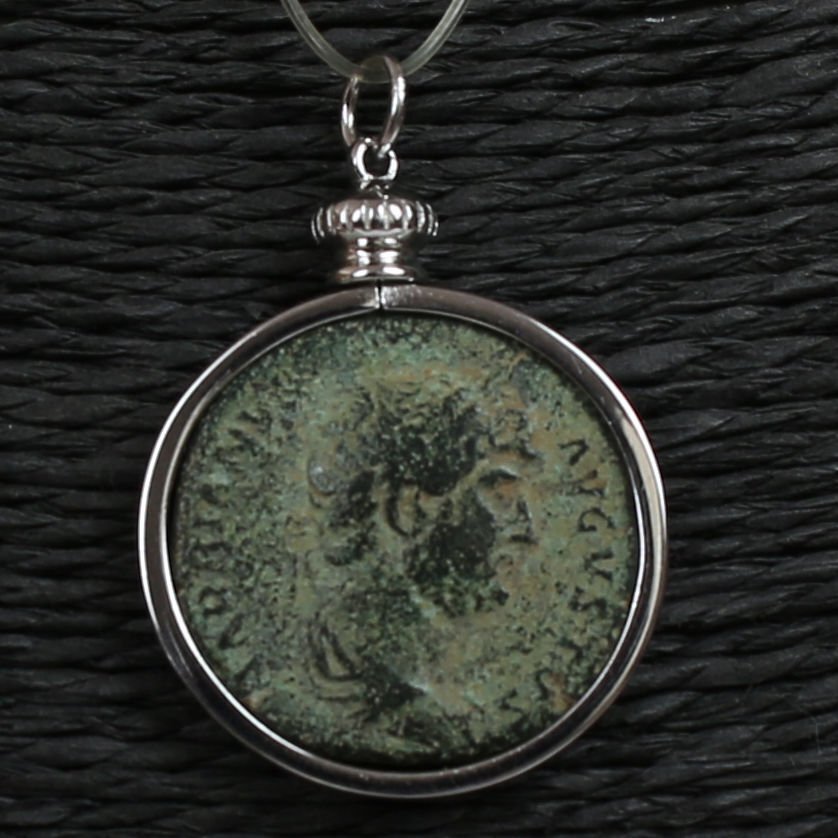
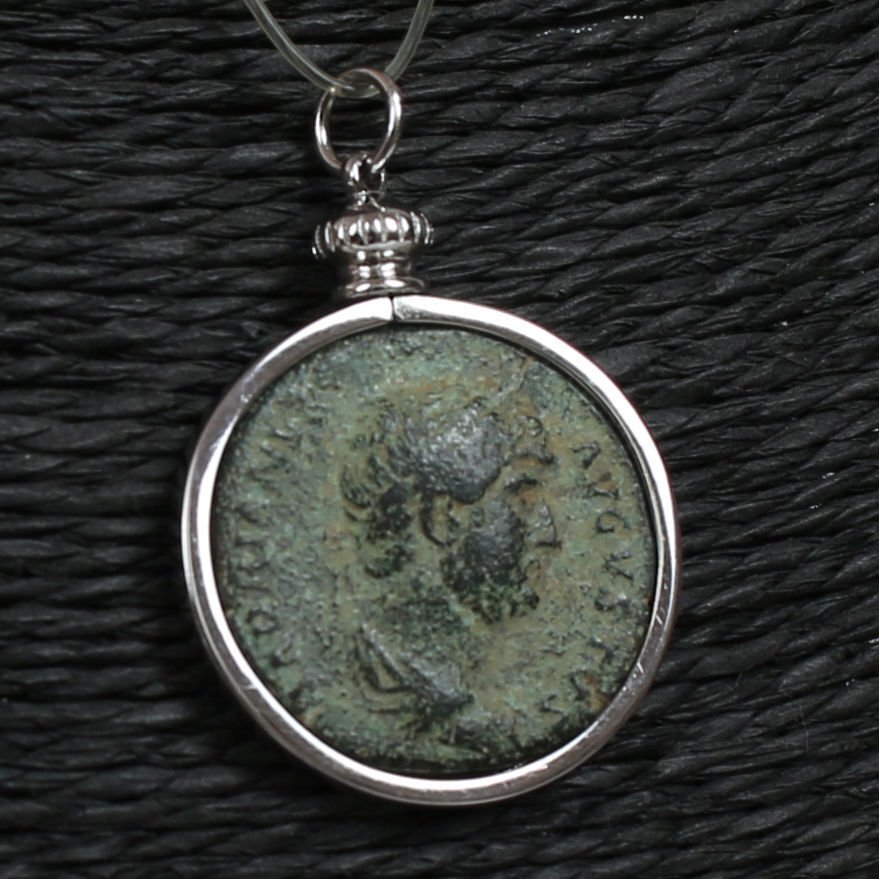
Modern silver pendant with a Hadrian AE As coin (Rome mint, AD 125–128, 24 mm, 8.19 g) set in a circular handmade silver setting; 25 mm diameter, good condition, includes Certificate of Authenticity, provenance from a Belgian private collection (acquired in the 1990s).
AI-assisted summary
Description from the seller
ITEM: Modern pendant with Hadrian As
MATERIAL: Silver and bronze
CULTURE: Roman
PERIOD: 2nd Century A.D
DIMENSIONS: 25 mm diameter
CONDITION: Good condition. Original coin within a modern handmade circular silver setting.
PROVENANCE: Ex Belgian private collection, acquired in the 1990s (Coin)
Comes with Certificate of Authenticity.
COIN DESCRIPTION: Hadrian AE As 24 mm 8,19 gr., Rome mint. AD 125-128. HADRIANVS AVGVSTVS, laureate and draped bust right, seen from the back / COS III around, S-C across fields, Tyche of Antioch seated left on rock, holding corn-ears, river-god Orontes swimming left below. RIC II 680; BMCRE 1350; McAlee 544.
The Roman Emperor Publius Aelius Hadrianus (reigned: 117–138 CE) was the third of the "Five Good Emperors" and is remembered as an exceptionally cultured, well-traveled, and reforming ruler. Born likely in Italica (Hispania, near modern Seville) in 76 CE, he received a distinguished education and developed a profound affinity for Greek culture, earning him the nickname Graeculus (the little Greek). His ascent to power was solidified following the death of his relative and mentor, Emperor Trajan, whom he succeeded in 117 CE, although his formal adoption was an event that generated some controversy and distrust within the Roman Senate. Hadrian, a skilled strategist and jurist, dedicated his early years to consolidating his authority and implementing his vision for a strong and clearly defined empire.
The most defining characteristic of Hadrian's reign was his policy of frontier consolidation rather than territorial expansion. He immediately relinquished Trajan's conquests in Mesopotamia, marking a turning point in Roman foreign policy. To secure and defend the vast Empire, Hadrian spent more than half of his reign traveling through the provinces, personally inspecting the legions and the administration. The most famous architectural symbol of this defensive strategy is Hadrian's Wall (Vallum Aelium) in Britannia, a massive stone and turf fortification intended to mark the northern limit of the Empire and control tribal movements. This obsession with stability translated into significant military and legal reforms that enhanced the efficiency of the state apparatus.
Beyond being a strategist, Hadrian was a great patron of the arts and architecture. His love for Hellenic culture directly influenced his vast construction projects, both in Rome and Greece. In the capital, he ordered the reconstruction of the Pantheon, which today stands as a masterpiece of Roman architecture. Outside Rome, he built the spectacular Hadrian's Villa in Tivoli, a palatial complex that recreated and celebrated the monuments and landscapes he had admired during his travels across the Mediterranean, from Egypt to Greece. At the end of his life, his legacy was completed with the construction of his own mausoleum, the Mole Adrianorum, now known as Castel Sant'Angelo. By adopting Antoninus Pius as his successor (on the condition that the latter in turn adopt Marcus Aurelius), Hadrian ensured the continuity of the "Good Emperors."
Seller's Story
Your Antiquarian offers ancient art and ancient coins. Our main objective is to offer the highest quality at the best price respecting and strictly complying with the laws of heritage protection and UNESCO heritage norms. Therefore, all the pieces that are published come from private collections in which the provenance can be checked or international auctions. All our antiquities and coins are accompanied by their Certificate of Authenticity. We have a no quibble 90 day return policy. At Your Antiquarian we are committed to helping disadvantaged groups and for this reason a portion of each purchase is donated to charities to help people in need.
Translated by Google TranslateITEM: Modern pendant with Hadrian As
MATERIAL: Silver and bronze
CULTURE: Roman
PERIOD: 2nd Century A.D
DIMENSIONS: 25 mm diameter
CONDITION: Good condition. Original coin within a modern handmade circular silver setting.
PROVENANCE: Ex Belgian private collection, acquired in the 1990s (Coin)
Comes with Certificate of Authenticity.
COIN DESCRIPTION: Hadrian AE As 24 mm 8,19 gr., Rome mint. AD 125-128. HADRIANVS AVGVSTVS, laureate and draped bust right, seen from the back / COS III around, S-C across fields, Tyche of Antioch seated left on rock, holding corn-ears, river-god Orontes swimming left below. RIC II 680; BMCRE 1350; McAlee 544.
The Roman Emperor Publius Aelius Hadrianus (reigned: 117–138 CE) was the third of the "Five Good Emperors" and is remembered as an exceptionally cultured, well-traveled, and reforming ruler. Born likely in Italica (Hispania, near modern Seville) in 76 CE, he received a distinguished education and developed a profound affinity for Greek culture, earning him the nickname Graeculus (the little Greek). His ascent to power was solidified following the death of his relative and mentor, Emperor Trajan, whom he succeeded in 117 CE, although his formal adoption was an event that generated some controversy and distrust within the Roman Senate. Hadrian, a skilled strategist and jurist, dedicated his early years to consolidating his authority and implementing his vision for a strong and clearly defined empire.
The most defining characteristic of Hadrian's reign was his policy of frontier consolidation rather than territorial expansion. He immediately relinquished Trajan's conquests in Mesopotamia, marking a turning point in Roman foreign policy. To secure and defend the vast Empire, Hadrian spent more than half of his reign traveling through the provinces, personally inspecting the legions and the administration. The most famous architectural symbol of this defensive strategy is Hadrian's Wall (Vallum Aelium) in Britannia, a massive stone and turf fortification intended to mark the northern limit of the Empire and control tribal movements. This obsession with stability translated into significant military and legal reforms that enhanced the efficiency of the state apparatus.
Beyond being a strategist, Hadrian was a great patron of the arts and architecture. His love for Hellenic culture directly influenced his vast construction projects, both in Rome and Greece. In the capital, he ordered the reconstruction of the Pantheon, which today stands as a masterpiece of Roman architecture. Outside Rome, he built the spectacular Hadrian's Villa in Tivoli, a palatial complex that recreated and celebrated the monuments and landscapes he had admired during his travels across the Mediterranean, from Egypt to Greece. At the end of his life, his legacy was completed with the construction of his own mausoleum, the Mole Adrianorum, now known as Castel Sant'Angelo. By adopting Antoninus Pius as his successor (on the condition that the latter in turn adopt Marcus Aurelius), Hadrian ensured the continuity of the "Good Emperors."
Seller's Story
Your Antiquarian offers ancient art and ancient coins. Our main objective is to offer the highest quality at the best price respecting and strictly complying with the laws of heritage protection and UNESCO heritage norms. Therefore, all the pieces that are published come from private collections in which the provenance can be checked or international auctions. All our antiquities and coins are accompanied by their Certificate of Authenticity. We have a no quibble 90 day return policy. At Your Antiquarian we are committed to helping disadvantaged groups and for this reason a portion of each purchase is donated to charities to help people in need.
Translated by Google TranslateDetails
Culture
Modern Silver
Century/ Timeframe
2nd Century A.D
Name of object
Pendant with Ancient Roman Hadrian As
Acquired from
Private collection
Year acquired
2025
Country acquired from
Belgium
Condition
Good
Previous owner acquired from
Antique market
Previous owner - year acquired
1990
Previous owner - country acquired from
Belgium
I verify that I have obtained this object legally and that I am allowed to sell it
Yes
Sold by
Disclaimer
The seller was informed by Catawiki about documentation requirements and guarantees the following: - the object was legally obtained, - the seller has the right to sell and/or export the object, as relevant, - the seller will provide the necessary provenance information and arrange required documentation and permits/licenses, as applicable and as per local laws, - the seller will notify the buyer of any delays in obtaining permits/licenses. By bidding, you acknowledge that import documentation may be required depending on your country of residence and that obtaining permits/licenses may cause delays in the delivery of your object.
The seller was informed by Catawiki about documentation requirements and guarantees the following: - the object was legally obtained, - the seller has the right to sell and/or export the object, as relevant, - the seller will provide the necessary provenance information and arrange required documentation and permits/licenses, as applicable and as per local laws, - the seller will notify the buyer of any delays in obtaining permits/licenses. By bidding, you acknowledge that import documentation may be required depending on your country of residence and that obtaining permits/licenses may cause delays in the delivery of your object.
