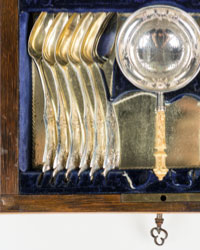
Wiskemann - Cutlery set for 12 (24) - Régence - Silverplated - Regence


02
days
01
hour
34
minutes
03
seconds

6 other people are watching this object
 Bidder 4511 Bidder 4511 | €123 | |
|---|---|---|
 Bidder 5565 Bidder 5565 | €103 | |
| Bidder 4511 | €98 |
Catawiki Buyer Protection
Your payment’s safe with us until you receive your object.View details
Trustpilot 4.4 | 124246 reviews
Rated Excellent on Trustpilot.
Description from the seller
Wiskemann silver-plated cutlery
24 pieces
Regency Model
Belgian manufacture
In new condition, unused.
12 menu levers 21 cm
12 menu work 21 cm
Beautiful motif with elegant garlands that are prominently placed on top.
Very high quality
Stamp 100 present on the back side of each piece.
Compared to the quality of Christofle or Ercuis.
The Silverware Wiskemann
Otto-Léonard Wiskemann (1852–1909) settled in the heart of Brussels in 1872 and specialized in the production of silver-plated white metal for the hospitality sector. Around 1890, he built a new workshop in the impasse du Val des Roses. After his death, his sons Otto (†1946) and Albin (†1950) took over the company. The business was experiencing rapid expansion, with new branches in Zurich and Milan, and sales outlets in Antwerp, Brussels, Ghent, and Nice, later also in Bruges, Liège, and Paris. In the 1920s, they commissioned a new factory in Vorst. From 1924, Wiskemann became the first in the world to produce kitchen and tableware in stainless steel 18/8 (18% chromium and 8% nickel). Bruno Wiskemann (†1955), a brother of Albin and Otto, decided around 1923 to start his own business, which in 1924 led to the founding of Etablissements Bruno Wiskemann SA, with the Wolfers family as the main shareholder.
The production of Wiskemann Silverware
After Otto Wiskemann's death in 1946, the daily management of the company was taken over by Roger Soin. Regarding the production of goldsmith's work, there is not much new to report compared to the offerings during the interwar period. The focus is primarily on a conservative clientele, and in the 'uni' category, simple tableware and cutlery, such as Hellade N° 32, are marketed, which can hardly be called art deco.
Wiskemann silver-plated cutlery
24 pieces
Regency Model
Belgian manufacture
In new condition, unused.
12 menu levers 21 cm
12 menu work 21 cm
Beautiful motif with elegant garlands that are prominently placed on top.
Very high quality
Stamp 100 present on the back side of each piece.
Compared to the quality of Christofle or Ercuis.
The Silverware Wiskemann
Otto-Léonard Wiskemann (1852–1909) settled in the heart of Brussels in 1872 and specialized in the production of silver-plated white metal for the hospitality sector. Around 1890, he built a new workshop in the impasse du Val des Roses. After his death, his sons Otto (†1946) and Albin (†1950) took over the company. The business was experiencing rapid expansion, with new branches in Zurich and Milan, and sales outlets in Antwerp, Brussels, Ghent, and Nice, later also in Bruges, Liège, and Paris. In the 1920s, they commissioned a new factory in Vorst. From 1924, Wiskemann became the first in the world to produce kitchen and tableware in stainless steel 18/8 (18% chromium and 8% nickel). Bruno Wiskemann (†1955), a brother of Albin and Otto, decided around 1923 to start his own business, which in 1924 led to the founding of Etablissements Bruno Wiskemann SA, with the Wolfers family as the main shareholder.
The production of Wiskemann Silverware
After Otto Wiskemann's death in 1946, the daily management of the company was taken over by Roger Soin. Regarding the production of goldsmith's work, there is not much new to report compared to the offerings during the interwar period. The focus is primarily on a conservative clientele, and in the 'uni' category, simple tableware and cutlery, such as Hellade N° 32, are marketed, which can hardly be called art deco.
Details
Era
1900-2000
Title additional information
Regence
No. of items
24
Country of Origin
Belgium
Manufacturer/ Brand
Wiskemann
Material
Silverplated
Model
Régence
Style
Antique inspired
Condition
As new - unused
Height
0 cm
Width
0 cm
Depth
21 cm
Estimated Period
1970-1980