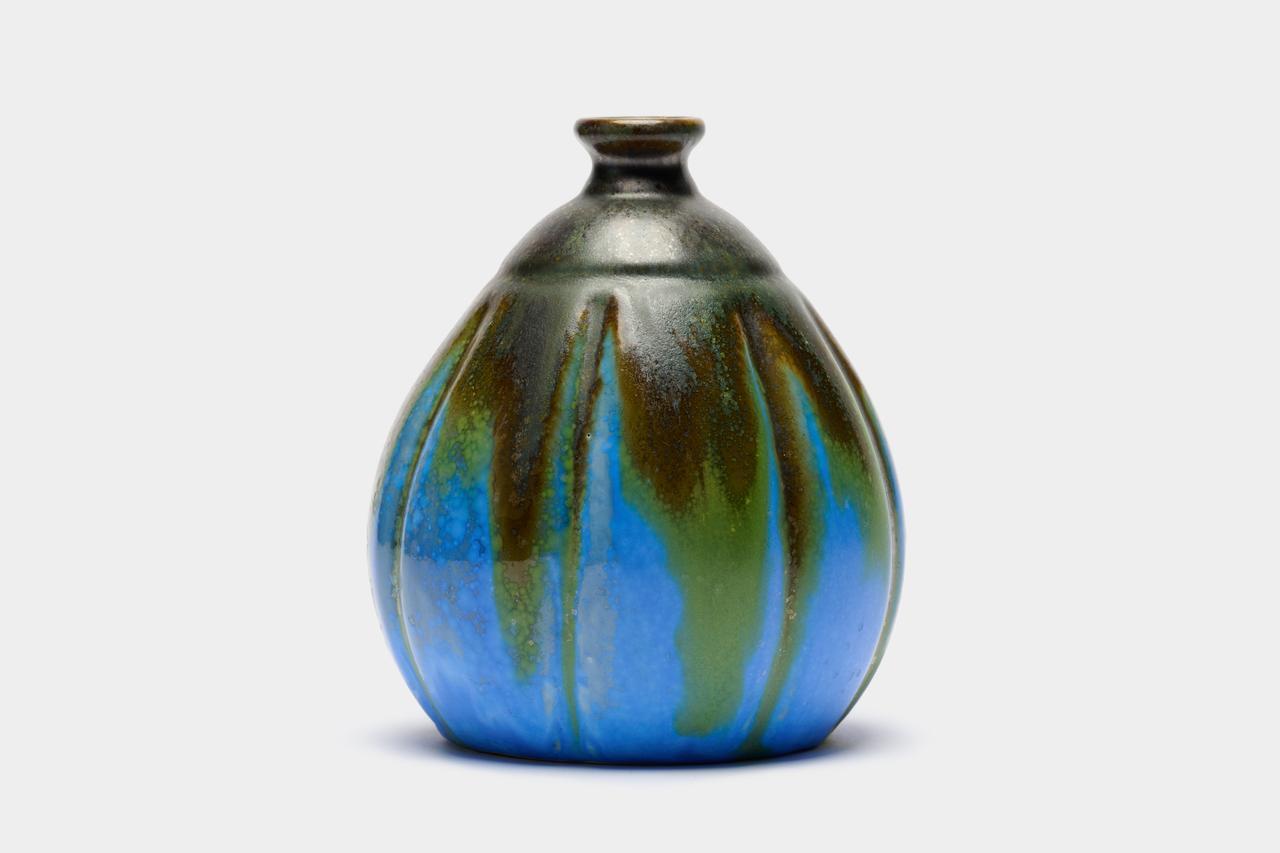
Vase - running glaze - Jugendstil


Art historian with extensive experience working at various auction houses in antiques.
| €2 | ||
|---|---|---|
| €1 |
Catawiki Buyer Protection
Your payment’s safe with us until you receive your object.View details
Trustpilot 4.4 | 124329 reviews
Rated Excellent on Trustpilot.
A narrow Art Nouveau ceramic vase with blue-red-brown salt glaze, about 17 cm high, top diameter about 7 cm, base diameter about 10 cm, weight around 360 g, made in Germany, circa 1910–1920, in good used condition with minor signs of aging and flaws, with a chip on the outer base foot and the underside marked 903 B.
Description from the seller
Narrow, organically flowing Jugendstil vase in blue-red-brown running glaze. The designer of the vase is unknown. The piece, with its clear, geometric decorations and colored overlay glaze, strongly resembles the Jugendstil vases by Henry van der Velde. However, it is also likely that the vase is a student work from the pottery Kunstkeramische Werkstätten Bürgel Carl Fischer.
Carl Fischer (1891-1969) studied at the Royal Ceramic Technical School in Bunzlau, Silesia. During his studies, he came into contact with the ceramics of Bauhaus designer and architect Henry van der Velde.
After the First World War, he took over an existing pottery factory and named it Töpferei Kunstkeramische Werkstätten Bürgel Carl Fischer.
The vase has a height of approximately 17 cm, an upper diameter of about 7 cm, a base diameter of approximately 10 cm, and weighs around 360 grams.
For a student project, the three traces of the Brennhilfen on the underside of the vase could also be relevant. A small, barely visible chip is located on the outer stand foot. These are not visible from the outside. Additionally, the underside bears the number 903 B.
The vase is a display case object from family ownership.
Narrow, organically flowing Jugendstil vase in blue-red-brown running glaze. The designer of the vase is unknown. The piece, with its clear, geometric decorations and colored overlay glaze, strongly resembles the Jugendstil vases by Henry van der Velde. However, it is also likely that the vase is a student work from the pottery Kunstkeramische Werkstätten Bürgel Carl Fischer.
Carl Fischer (1891-1969) studied at the Royal Ceramic Technical School in Bunzlau, Silesia. During his studies, he came into contact with the ceramics of Bauhaus designer and architect Henry van der Velde.
After the First World War, he took over an existing pottery factory and named it Töpferei Kunstkeramische Werkstätten Bürgel Carl Fischer.
The vase has a height of approximately 17 cm, an upper diameter of about 7 cm, a base diameter of approximately 10 cm, and weighs around 360 grams.
For a student project, the three traces of the Brennhilfen on the underside of the vase could also be relevant. A small, barely visible chip is located on the outer stand foot. These are not visible from the outside. Additionally, the underside bears the number 903 B.
The vase is a display case object from family ownership.