Icon - Quadripartite icon - Wood




04
days
19
hours
51
minutes
54
seconds
Current bid
€ 25
Reserve price not met

Expert
Selected by Justus Heutink
Holds broad knowledge of religious icons with six years of collecting experience.
Estimate € 150 - € 200
8 other people are watching this object
 Bidder 3760 Bidder 3760 | €25 |
|---|
Catawiki Buyer Protection
Your payment’s safe with us until you receive your object.View details
Trustpilot 4.4 | 124985 reviews
Rated Excellent on Trustpilot.
Description from the seller
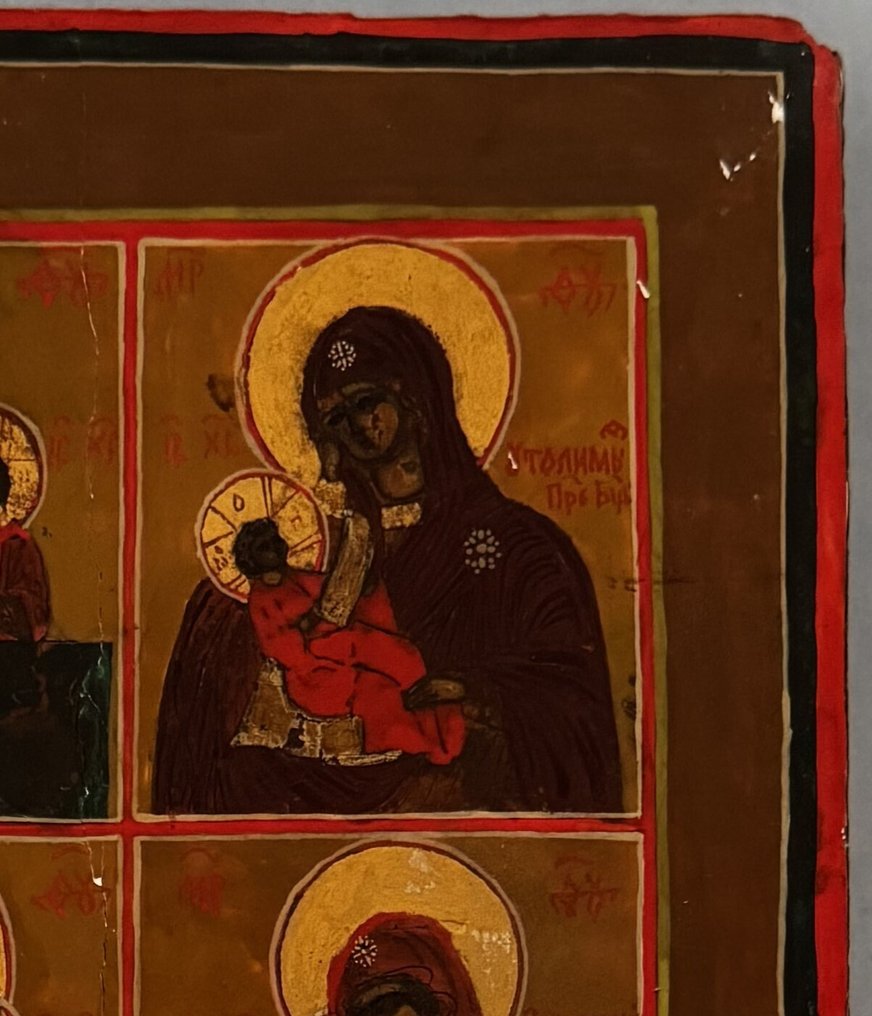
It is a four-part icon (chetyrekhchasny ikon), very typical of Russia between the 19th and early 20th centuries, where four miraculous advocations of the Mother of God were assembled for devotional use at home.
Each painting presents a different representation of the Virgin with the Child, each with a proper name.
Top left – Crowned Virgin with the Child
Probably a version of the 'Virgen de Kazán' or the 'Virgen de Smolensk' (Hodigitria) with crowns added in the Western style.
These crowns often appear in 19th-century icons influenced by Catholic models.
Hodigitria type: the Virgin points to Christ.
Both wear large crowns added at a later time.
Highly revered in Russian households.
Top right – Virgin of Tenderness (Eleousa)
This is the clearest type of icon: an Eleousa, where the Virgin tilts her face towards Christ Child, who embraces the Mother’s neck.
Probably a variant of:
The Virgin of Vladimir
o
The Virgin of Tikhvin in a tender style.
Visible features
Faces in contact.
Child supported against cheek and chest.
Letters ΜΡ ΘΥ (Mother of God).
Bottom left – Virgin crowned in the Hodigitria type.
Very similar to the upper left image, but with more colorful clothing and a child blessing.
Could represent
The Virgin of Smolensk, or
The Virgin of Kazan (another variant).
Features
Front view.
Child slightly turned, hand in a blessing gesture.
Typical 19th-century Imperial Crown.
Bottom right – Virgin of Tenderness with Child standing
Very recognizable as a variant of the Virgin of Feodorov (Feodorovskaya), where the Child appears standing and embraced around the neck of the Mother.
Features
Older boy, standing, hugging her.
A warm and affectionate gesture.
Highly revered as a protector of family and motherhood.
Russian icon, second half of the 19th century
Likely made in popular workshops in the Volga, Viatka, or Moscow.
It is a four-part icon (chetyrekhchasny ikon), very typical of Russia between the 19th and early 20th centuries, where four miraculous advocations of the Mother of God were assembled for devotional use at home.
Each painting presents a different representation of the Virgin with the Child, each with a proper name.
Top left – Crowned Virgin with the Child
Probably a version of the 'Virgen de Kazán' or the 'Virgen de Smolensk' (Hodigitria) with crowns added in the Western style.
These crowns often appear in 19th-century icons influenced by Catholic models.
Hodigitria type: the Virgin points to Christ.
Both wear large crowns added at a later time.
Highly revered in Russian households.
Top right – Virgin of Tenderness (Eleousa)
This is the clearest type of icon: an Eleousa, where the Virgin tilts her face towards Christ Child, who embraces the Mother’s neck.
Probably a variant of:
The Virgin of Vladimir
o
The Virgin of Tikhvin in a tender style.
Visible features
Faces in contact.
Child supported against cheek and chest.
Letters ΜΡ ΘΥ (Mother of God).
Bottom left – Virgin crowned in the Hodigitria type.
Very similar to the upper left image, but with more colorful clothing and a child blessing.
Could represent
The Virgin of Smolensk, or
The Virgin of Kazan (another variant).
Features
Front view.
Child slightly turned, hand in a blessing gesture.
Typical 19th-century Imperial Crown.
Bottom right – Virgin of Tenderness with Child standing
Very recognizable as a variant of the Virgin of Feodorov (Feodorovskaya), where the Child appears standing and embraced around the neck of the Mother.
Features
Older boy, standing, hugging her.
A warm and affectionate gesture.
Highly revered as a protector of family and motherhood.
Russian icon, second half of the 19th century
Likely made in popular workshops in the Volga, Viatka, or Moscow.
Details
Era
1400-1900
Iconography
Quadripartite icon
Weight
500 g
Material
Wood
Country of Origin
Russia
Height
21.6 cm
Width
18.5 cm
Depth
2.2 cm
Condition
Good condition - used with small signs of aging & blemishes
Estimated period
1850-1900
Sold by