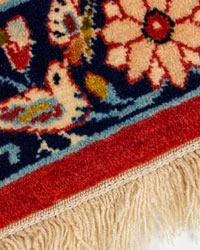
Rug - 118 cm - 85 cm


02
days
05
hours
17
minutes
20
seconds
Current bid
€ 55
Reserve price not met

Expert
Selected by Richard Ebbers
Certified appraiser at Federation TMV with 30 years' professional antiques experience.
Estimate € 280 - € 350
10 other people are watching this object
 Bidder 6296 Bidder 6296 | €55 | |
|---|---|---|
 Bidder 6924 Bidder 6924 | €50 | |
| Bidder 5563 | €3 | |
Catawiki Buyer Protection
Your payment’s safe with us until you receive your object.View details
Trustpilot 4.4 | 125472 reviews
Rated Excellent on Trustpilot.
Türkiye Heybe Panel, a late-19th-century handwoven cicim/soumak wool-on-wool textile measuring 118 × 85 cm, in very good condition.
AI-assisted summary
Description from the seller
Rare Anatolian Tribal Ceremonial Textile (Heybe Panel) – Cicim / Soumak Technique – Second Half of the 19th Century
⸻
Description
A rare and highly accomplished Anatolian tribal ceremonial textile, handwoven in the second half of the 19th century, most likely originating from Central or Eastern Anatolia and associated with Yörük or Kurdish tribal traditions.
This object is not a pile carpet, but an important tribal textile panel from a heybe (saddlebag) or a ceremonial wall hanging, executed in the sophisticated cicim / soumak technique. Such textiles were traditionally produced for dowry, ceremonial use, or interior decoration of tribal tents, rather than everyday utilitarian purposes.
The composition demonstrates an exceptionally high level of craftsmanship:
• a dense all-over geometric lattice field,
• a complex and well-balanced border design,
• and most notably, rare three-dimensional tufted wool rosettes (raised floral elements), carefully handmade and standing proud of the surface.
These raised floral decorations are extremely uncommon and indicate a prestige textile, requiring significantly more time, skill, and material than standard tribal weavings. Their presence strongly suggests a ceremonial or high-status function.
The textile is woven from hand-spun natural wool, using traditional tribal methods.
The reverse side shows the characteristic loose weft floats and thread ends, which are a normal and authentic feature of the cicim/soumak technique and confirm its handwoven origin.
Original braided carrying loops/handles are preserved, supporting the identification as a heybe panel and reinforcing the authenticity and functionality of the piece.
⸻
Period
Second half of the 19th century (circa 1850–1900)
⸻
Origin
Anatolia (present-day Turkey), tribal production
⸻
Material & Technique
• Hand-spun wool
• Handwoven
• Cicim / Soumak tribal technique
• Rare raised tufted wool rosettes
⸻
Dimensions
118 × 85 cm
⸻
Condition
Good antique condition, consistent with age and traditional use.
The textile shows:
• natural wear and patina,
• minor losses and slight distortions,
• visible thread floats on the reverse side, inherent to the weaving technique.
No modern restorations. All elements are original and authentic.
⸻
Rarity & Collectibility
Comparable ceremonial Anatolian tribal textiles from the 19th century, especially those featuring three-dimensional tufted decoration, are rarely encountered on the market and are highly sought after by collectors of tribal and ethnographic textiles.
Pieces of this quality and complexity are often found in museum and advanced private collections.
⸻
Summary
A museum-quality 19th-century Anatolian tribal heybe textile, distinguished by its rare raised floral decoration, complex geometric design, and outstanding craftsmanship. A unique collector’s piece with strong decorative and historical appeal.
Rare Anatolian Tribal Ceremonial Textile (Heybe Panel) – Cicim / Soumak Technique – Second Half of the 19th Century
⸻
Description
A rare and highly accomplished Anatolian tribal ceremonial textile, handwoven in the second half of the 19th century, most likely originating from Central or Eastern Anatolia and associated with Yörük or Kurdish tribal traditions.
This object is not a pile carpet, but an important tribal textile panel from a heybe (saddlebag) or a ceremonial wall hanging, executed in the sophisticated cicim / soumak technique. Such textiles were traditionally produced for dowry, ceremonial use, or interior decoration of tribal tents, rather than everyday utilitarian purposes.
The composition demonstrates an exceptionally high level of craftsmanship:
• a dense all-over geometric lattice field,
• a complex and well-balanced border design,
• and most notably, rare three-dimensional tufted wool rosettes (raised floral elements), carefully handmade and standing proud of the surface.
These raised floral decorations are extremely uncommon and indicate a prestige textile, requiring significantly more time, skill, and material than standard tribal weavings. Their presence strongly suggests a ceremonial or high-status function.
The textile is woven from hand-spun natural wool, using traditional tribal methods.
The reverse side shows the characteristic loose weft floats and thread ends, which are a normal and authentic feature of the cicim/soumak technique and confirm its handwoven origin.
Original braided carrying loops/handles are preserved, supporting the identification as a heybe panel and reinforcing the authenticity and functionality of the piece.
⸻
Period
Second half of the 19th century (circa 1850–1900)
⸻
Origin
Anatolia (present-day Turkey), tribal production
⸻
Material & Technique
• Hand-spun wool
• Handwoven
• Cicim / Soumak tribal technique
• Rare raised tufted wool rosettes
⸻
Dimensions
118 × 85 cm
⸻
Condition
Good antique condition, consistent with age and traditional use.
The textile shows:
• natural wear and patina,
• minor losses and slight distortions,
• visible thread floats on the reverse side, inherent to the weaving technique.
No modern restorations. All elements are original and authentic.
⸻
Rarity & Collectibility
Comparable ceremonial Anatolian tribal textiles from the 19th century, especially those featuring three-dimensional tufted decoration, are rarely encountered on the market and are highly sought after by collectors of tribal and ethnographic textiles.
Pieces of this quality and complexity are often found in museum and advanced private collections.
⸻
Summary
A museum-quality 19th-century Anatolian tribal heybe textile, distinguished by its rare raised floral decoration, complex geometric design, and outstanding craftsmanship. A unique collector’s piece with strong decorative and historical appeal.
Details
Era
1400-1900
Length
118 cm
Width
85 cm
Material
Wool on wool
Country of Origin
Türkiye
Condition
In very good condition
Professionally Cleaned
Yes
Manufacturing Period
Late 19th century
Sold by