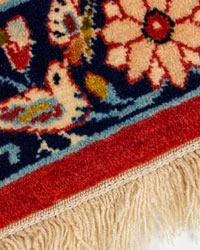
Buchara - Rug - 265 cm - 185 cm - Kizil-Ayak


06
days
16
hours
56
minutes
14
seconds
Starting bid
€ 1
Reserve price not met

Expert
Selected by Richard Ebbers
Certified appraiser at Federation TMV with 30 years' professional antiques experience.
Estimate € 1,400 - € 1,600
No bids placed
Catawiki Buyer Protection
Your payment’s safe with us until you receive your object.View details
Trustpilot 4.4 | 126446 reviews
Rated Excellent on Trustpilot.
Turkmenistan origin wool-on-wool Kizil-Ayak carpet, 2.65 by 1.85 metres, mid‑20th century, generally in good condition.
AI-assisted summary
Description from the seller
Turkmen Rug from Bukhara Kizil-Ayak
Fully handmade, in very good condition, wool warp and weft, impeccable pile, no wear. -Shade variation on one border-
Dimensions: 2.65 x 1.85 meters. (285 with the fringes)
Technical characteristics: Wool pile on a wool foundation. The field of this raspberry rug is covered with a scatter of curious gühls "Tchemtche" crocheted and surrounded by a "crown." They are interspersed by gühls "Dyrnak", multicolored, more classically in fern-like patterns. The main ivory border is a stylized, wavy vegetal garland, flanked by two contrasting borders with polychrome floral motifs. Accents "coursing dogs".
In the 19th century, the Tekke tribe was among the most important of the Turkmen tribes and occupied the largest part of the area stretching between the Caspian Sea and the Amu Darya River. The motifs that decorate the surface of Turkmen rugs are geometric patterns called gühls. Each Turkmen tribe has its own way of defining and stylizing this motif, which characterizes them. The main tribes are the Tekke, the Yomud, the Kizil-Ayak, the Djafarbay, the Göklan, and others. These Turkmen rugs, woven in the first part of the 20th century, have a very fine knot and a silky patinated wool.
Turkmen Rug from Bukhara Kizil-Ayak
Fully handmade, in very good condition, wool warp and weft, impeccable pile, no wear. -Shade variation on one border-
Dimensions: 2.65 x 1.85 meters. (285 with the fringes)
Technical characteristics: Wool pile on a wool foundation. The field of this raspberry rug is covered with a scatter of curious gühls "Tchemtche" crocheted and surrounded by a "crown." They are interspersed by gühls "Dyrnak", multicolored, more classically in fern-like patterns. The main ivory border is a stylized, wavy vegetal garland, flanked by two contrasting borders with polychrome floral motifs. Accents "coursing dogs".
In the 19th century, the Tekke tribe was among the most important of the Turkmen tribes and occupied the largest part of the area stretching between the Caspian Sea and the Amu Darya River. The motifs that decorate the surface of Turkmen rugs are geometric patterns called gühls. Each Turkmen tribe has its own way of defining and stylizing this motif, which characterizes them. The main tribes are the Tekke, the Yomud, the Kizil-Ayak, the Djafarbay, the Göklan, and others. These Turkmen rugs, woven in the first part of the 20th century, have a very fine knot and a silky patinated wool.
Details
Era
1900-2000
Title additional information
Kizil-Ayak
Nr of items
1
Model
Buchara
Length
265 cm
Width
185 cm
Material
Wool on wool
Country of Origin
Turkmenistan
Condition
Overall in good condition
Professionally Cleaned
No
Manufacturing period
Mid 20th century
Sold by