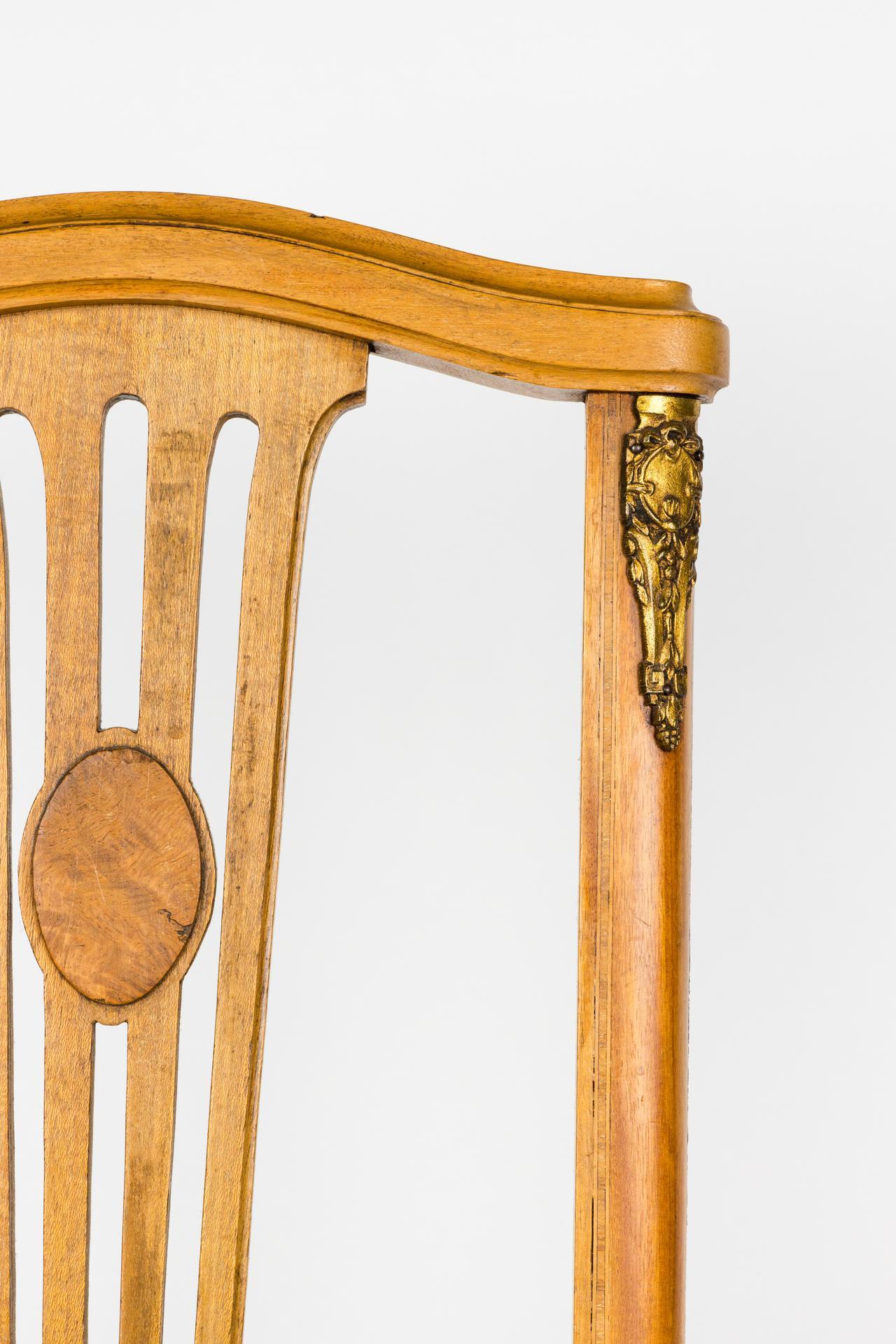
Chair - Oak, Bies - Breistoel


02
days
22
hours
48
minutes
45
seconds

19 other people are watching this object
 Bidder 2310 Bidder 2310 | €15 | |
|---|---|---|
 Bidder 4682 Bidder 4682 | €10 | |
| Bidder 5721 | €7 | |
Catawiki Buyer Protection
Your payment’s safe with us until you receive your object.View details
Trustpilot 4.4 | 125991 reviews
Rated Excellent on Trustpilot.
Edwardian-style Dutch breistoel in oak with a wicker seat, dating to 1900–1910, with three legs, 80 cm high, 54 cm wide, seat depth 46 cm, seating height 50 cm, and approximately 5.5 kg, in reasonable heavily used condition with possible missing small parts.
AI-assisted summary
Description from the seller
In original condition, wooden Edwardian style Dutch armchair. Other names include tripartite or corner chair.
Fair condition noted, with the seating area shortened at the front.
And a crack in a support, reinforced with a nail. Furthermore, the chair is everywhere reinforced with nails and screws. Restoration for sturdiness has taken place by replacing flat-head screws with cross-head screws, I suspect due to aging. Primarily a very decorative object; the chair's age will not be able to withstand heavy, intensive use. Nevertheless, a very beautiful antique.
A natural patina has developed on the chair due to stains and wear, most noticeable on the lower parts of the armrests. This old woven chair has lowered armrests.
The armrests run from high to low to prevent problems with the wrists or elbows. The chair also has a high seat height of 48 centimeters. This allowed for as natural a posture as possible while knitting. Ergonomic working was already regarded as an important principle for the knitters at that time, and physical complaints such as neck, shoulder, and back pain were prevented by this chair. Today we know that ergonomic work also increases productivity. Nowadays knitting has a more recreational side, but around 1900, of course, it was different. A task that occurred very frequently and could even be considered time-consuming. From socks to underwear, many garments were knitted.
This chair does not have reed but a woven seat, which is characteristic of these early, 1850 to 1920, crafted weaving chairs.
The chair has three legs.
50 centimeter seat height,
Width of the front of the chair: 54 centimeters.
Seat depth 41 centimeters
Complete height: 80 centimeters.
The twisted railings, both on the armrests and the back, make this chair a very decorative piece.
Even the back of the chair, with clearly visible connection points, is worth seeing.
There's no need to put the chair in the corner; it can be placed anywhere in the house as a decorative piece.
The photos are part of the description. Please examine the photos carefully so that you can be assured of the beauty of this magnificent object. The chair will be shipped well-packaged.
In original condition, wooden Edwardian style Dutch armchair. Other names include tripartite or corner chair.
Fair condition noted, with the seating area shortened at the front.
And a crack in a support, reinforced with a nail. Furthermore, the chair is everywhere reinforced with nails and screws. Restoration for sturdiness has taken place by replacing flat-head screws with cross-head screws, I suspect due to aging. Primarily a very decorative object; the chair's age will not be able to withstand heavy, intensive use. Nevertheless, a very beautiful antique.
A natural patina has developed on the chair due to stains and wear, most noticeable on the lower parts of the armrests. This old woven chair has lowered armrests.
The armrests run from high to low to prevent problems with the wrists or elbows. The chair also has a high seat height of 48 centimeters. This allowed for as natural a posture as possible while knitting. Ergonomic working was already regarded as an important principle for the knitters at that time, and physical complaints such as neck, shoulder, and back pain were prevented by this chair. Today we know that ergonomic work also increases productivity. Nowadays knitting has a more recreational side, but around 1900, of course, it was different. A task that occurred very frequently and could even be considered time-consuming. From socks to underwear, many garments were knitted.
This chair does not have reed but a woven seat, which is characteristic of these early, 1850 to 1920, crafted weaving chairs.
The chair has three legs.
50 centimeter seat height,
Width of the front of the chair: 54 centimeters.
Seat depth 41 centimeters
Complete height: 80 centimeters.
The twisted railings, both on the armrests and the back, make this chair a very decorative piece.
Even the back of the chair, with clearly visible connection points, is worth seeing.
There's no need to put the chair in the corner; it can be placed anywhere in the house as a decorative piece.
The photos are part of the description. Please examine the photos carefully so that you can be assured of the beauty of this magnificent object. The chair will be shipped well-packaged.
Details
Era
1900-2000
Weight
5.5 kg
Title additional information
Breistoel
No. of items
1
Country of Origin
Netherlands
Material
Bies, Oak
Colour
Brown
Condition
Fair condition - heavily used & with possibly minor parts missing
Height
80 cm
Width
54 cm
Depth
46 cm
Estimated Period
1900-1910
Seating Height
50 cm
Sold by