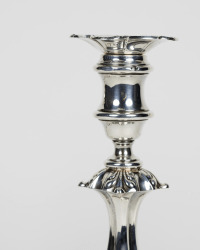
Champagne cooler - .925 silver - Antique Sheffield


03
days
12
hours
10
minutes
22
seconds
Current bid
€ 250
Reserve price not met

Expert
Selected by Jeroen Zoetmulder
Has over 30 years of experience in archaeology and is an appraiser specialising in archaeological objects.
Estimate € 4,000 - € 4,400
17 other people are watching this object
 Bidder 4800 Bidder 4800 | €250 | |
|---|---|---|
 Bidder 1975 Bidder 1975 | €170 | |
 Bidder 5447 Bidder 5447 | €160 | |
Catawiki Buyer Protection
Your payment’s safe with us until you receive your object.View details
Trustpilot 4.4 | 126253 reviews
Rated Excellent on Trustpilot.
Antique Sheffield silver bottle cooler in solid 925 Sterling silver, fire-gilded exterior, dating to 1918, with a heraldic coat of arms, two cast side handles, a broad foot, and weighing 504 g with dimensions about 17 cm high and 10.5 cm inner diameter; good condition with minor rim distortion and two small dents.
AI-assisted summary
Description from the seller
Exceptional and highly important antique English sterling silver (925) champagne or wine bottle cooler / serving vessel, crafted in Sheffield, United Kingdom, in the year 1918, during the reign of King George V.
This is a substantial, heavy-gauge silver object with a strong architectural presence, executed in a classic and ceremonial British style. The vessel features a scalloped, undulating rim, two solid cast side handles, and a broad, stable foot. The exterior surface is entirely fire-gilt (vermeil), a luxurious and technically demanding period technique, intentionally applied to enhance both visual impact and long-term surface protection. This gilding is original and period-correct, not a later addition or restoration.
The body is adorned with a finely engraved and deeply worked heraldic coat of arms of exceptional quality. The composition consists of a central shield supported by two rampant lions, surmounted by a crowned helmet and a mythological bird crest resembling a pelican. In traditional heraldry, this motif symbolises family unity, guardianship, sacrifice, and protection — the pelican is classically depicted as feeding its young with its own blood. This is not a generic decorative pattern but a personalised heraldic achievement, indicating private commission or ownership by a family of status.
⸻
AUTHENTICITY & CERTIFICATION
Inside the base, multiple original and fully matching English hallmarks are clearly visible and legible:
• Sterling silver standard mark (925)
• Assay Office mark for Sheffield
• Date letter “B” corresponding to the year 1918
• British manufacture confirmation
All hallmarks are original, period-correct, and professionally verified. They are not later re-strikes or secondary punches. The accompanying handwritten certification is the result of documented specialist research and fully corresponds with the physical evidence present on the object.
⸻
MATERIAL & TECHNIQUE
Material: Solid sterling silver (925)
Finish: Original fire-gilded exterior (vermeil)
Manufacturing technique: Hand-raised body, engraved decoration, cast handles, applied gilding
Origin: Sheffield, England
Fire-gilding was reserved for higher-end silverware and ceremonial objects. Its presence here elevates the piece beyond standard table silver into the category of luxury presentation and representative objects.
⸻
DIMENSIONS & WEIGHT
Height: approx. 17 cm
Inner diameter: approx. 10.5 cm
Total weight: 504 grams
This weight clearly confirms the object as a heavy, solid silver construction, not a thin-walled or decorative-grade item.
⸻
CONDITION REPORT
The condition is honest, original, and fully consistent with an antique silver object over 100 years old:
• One minor, gently ovalised section along the rim (not visually dominant)
• Two small dents on the body, visible upon close inspection
• Light surface wear and patina from age and careful historical use
• No structural instability, cracks, or repairs
• Fully functional and display-ready
These characteristics are considered acceptable and expected for genuine antique silver and do not detract from the historical or artistic value of the piece.
⸻
PROVENANCE
From a European private collection. The object has been preserved as a functional yet representative silver artefact rather than treated as scrap or decorative metal, which has ensured the survival of both its material and heraldic integrity.
⸻
SUMMARY
This is not a piece of silver intended for melting or secondary use. It is a documented, heraldic, fire-gilt sterling silver vessel from one of England’s most important silver-producing centres, dating precisely to 1918. Its weight, craftsmanship, personalised heraldry, and original gilded surface place it firmly in the category of collectible British antique silver of higher calibre.
Suitable for advanced collectors of English silver, heraldic objects, or early 20th-century ceremonial tableware.
Exceptional and highly important antique English sterling silver (925) champagne or wine bottle cooler / serving vessel, crafted in Sheffield, United Kingdom, in the year 1918, during the reign of King George V.
This is a substantial, heavy-gauge silver object with a strong architectural presence, executed in a classic and ceremonial British style. The vessel features a scalloped, undulating rim, two solid cast side handles, and a broad, stable foot. The exterior surface is entirely fire-gilt (vermeil), a luxurious and technically demanding period technique, intentionally applied to enhance both visual impact and long-term surface protection. This gilding is original and period-correct, not a later addition or restoration.
The body is adorned with a finely engraved and deeply worked heraldic coat of arms of exceptional quality. The composition consists of a central shield supported by two rampant lions, surmounted by a crowned helmet and a mythological bird crest resembling a pelican. In traditional heraldry, this motif symbolises family unity, guardianship, sacrifice, and protection — the pelican is classically depicted as feeding its young with its own blood. This is not a generic decorative pattern but a personalised heraldic achievement, indicating private commission or ownership by a family of status.
⸻
AUTHENTICITY & CERTIFICATION
Inside the base, multiple original and fully matching English hallmarks are clearly visible and legible:
• Sterling silver standard mark (925)
• Assay Office mark for Sheffield
• Date letter “B” corresponding to the year 1918
• British manufacture confirmation
All hallmarks are original, period-correct, and professionally verified. They are not later re-strikes or secondary punches. The accompanying handwritten certification is the result of documented specialist research and fully corresponds with the physical evidence present on the object.
⸻
MATERIAL & TECHNIQUE
Material: Solid sterling silver (925)
Finish: Original fire-gilded exterior (vermeil)
Manufacturing technique: Hand-raised body, engraved decoration, cast handles, applied gilding
Origin: Sheffield, England
Fire-gilding was reserved for higher-end silverware and ceremonial objects. Its presence here elevates the piece beyond standard table silver into the category of luxury presentation and representative objects.
⸻
DIMENSIONS & WEIGHT
Height: approx. 17 cm
Inner diameter: approx. 10.5 cm
Total weight: 504 grams
This weight clearly confirms the object as a heavy, solid silver construction, not a thin-walled or decorative-grade item.
⸻
CONDITION REPORT
The condition is honest, original, and fully consistent with an antique silver object over 100 years old:
• One minor, gently ovalised section along the rim (not visually dominant)
• Two small dents on the body, visible upon close inspection
• Light surface wear and patina from age and careful historical use
• No structural instability, cracks, or repairs
• Fully functional and display-ready
These characteristics are considered acceptable and expected for genuine antique silver and do not detract from the historical or artistic value of the piece.
⸻
PROVENANCE
From a European private collection. The object has been preserved as a functional yet representative silver artefact rather than treated as scrap or decorative metal, which has ensured the survival of both its material and heraldic integrity.
⸻
SUMMARY
This is not a piece of silver intended for melting or secondary use. It is a documented, heraldic, fire-gilt sterling silver vessel from one of England’s most important silver-producing centres, dating precisely to 1918. Its weight, craftsmanship, personalised heraldry, and original gilded surface place it firmly in the category of collectible British antique silver of higher calibre.
Suitable for advanced collectors of English silver, heraldic objects, or early 20th-century ceremonial tableware.
Details
Era
1900-2000
Gross weight
504 g
Silver type
.925 silver
Specific region of origin
Sheffield
Title additional information
Antique Sheffield
No. of items
1
Country of Origin
United Kingdom
Material
Silver
Colour
Gold
Condition
Good condition - used with small signs of ageing
Height
17 cm
Width
13 cm
Depth
10.5 cm
Estimated Period
1910-1920
Sold by