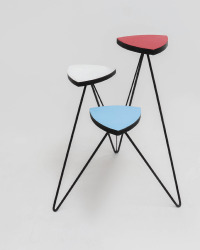
Table - Wood, Beech, Oak


10
days
00
hours
45
minutes
29
seconds
Starting bid
€ 1
No reserve price

Expert
Selected by Francisco Álvarez
Acquired extensive antiques knowledge through renovation works and running own antiques shop.
Estimate € 200 - € 250
No bids placed
Catawiki Buyer Protection
Your payment’s safe with us until you receive your object.View details
Trustpilot 4.4 | 126370 reviews
Rated Excellent on Trustpilot.
Authentic 1930s Bauhaus wooden table from Austria, crafted in solid beech and oak, in good condition with small signs of aging, measuring 80 cm high, 56 cm wide and 37 cm deep.
AI-assisted summary
Description from the seller
Key selling points
• Authentic 1930s period furniture, not a later revival
• Crafted from solid hardwood, showcasing honest materials and functional design
• Elegant architectural proportions with refined vertical slats
• Rare, original piece ideal for collectors, interior designers, and museums
• Strong visual presence yet compact, perfect as side table, console, or accent piece
⸻
This original Bauhaus table from the early twentieth century embodies the radical clarity and intellectual confidence that defined modern European design between the wars. Produced in the 1930s, it reflects a moment when craftsmanship, geometry, and social purpose were brought into perfect balance. Every line serves a reason; every surface speaks quietly of use, durability, and restrained elegance.
Constructed entirely from solid wood, the table reveals the Bauhaus belief in truth to materials. There is no veneer, no superficial ornamentation, only carefully joined timber shaped into a disciplined yet expressive structure. The warm patina developed over decades adds depth and authenticity, offering visual richness that cannot be replicated by contemporary manufacturing. Subtle wear marks, softened edges, and tonal variation confirm its originality and honest age.
The design is defined by vertical rhythm. Slim legs rise confidently, connected by horizontal stretchers that create both stability and visual lightness. This interplay of uprights and rails is a hallmark of Bauhaus furniture, where architectural thinking was translated into domestic scale. The tabletop floats with calm authority above the frame, providing a balanced silhouette that feels intentional from every angle.
Despite its minimalist character, the table is remarkably versatile. It functions effortlessly as a hall table, occasional stand, reading surface, or sculptural element within an interior. Whether placed in a modernist apartment, an eclectic loft, or a carefully curated historic setting, it integrates seamlessly while retaining a distinct identity. Its proportions allow it to complement both spacious rooms and intimate corners.
From a historical perspective, this piece represents the Bauhaus movement’s transition from experimental workshops to refined, usable furniture for everyday life. It aligns with the era’s emphasis on utility, rational construction, and visual harmony, making it not only an object of beauty but also a document of design history. Comparable examples are increasingly difficult to source, especially in such intact and unaltered condition.
For collectors, this table offers investment-grade appeal. Original Bauhaus furniture continues to gain recognition across international auctions, design fairs, and academic collections. Its timeless aesthetic ensures lasting relevance, while its scarcity enhances desirability. For professionals, it provides an anchor piece that communicates taste, knowledge, and respect for authentic modernism.
This is more than a functional object; it is a quiet manifesto of modern design values. Owning it means preserving a tangible link to one of the most influential movements in cultural history—where form followed function, and simplicity became revolutionary.
Key selling points
• Authentic 1930s period furniture, not a later revival
• Crafted from solid hardwood, showcasing honest materials and functional design
• Elegant architectural proportions with refined vertical slats
• Rare, original piece ideal for collectors, interior designers, and museums
• Strong visual presence yet compact, perfect as side table, console, or accent piece
⸻
This original Bauhaus table from the early twentieth century embodies the radical clarity and intellectual confidence that defined modern European design between the wars. Produced in the 1930s, it reflects a moment when craftsmanship, geometry, and social purpose were brought into perfect balance. Every line serves a reason; every surface speaks quietly of use, durability, and restrained elegance.
Constructed entirely from solid wood, the table reveals the Bauhaus belief in truth to materials. There is no veneer, no superficial ornamentation, only carefully joined timber shaped into a disciplined yet expressive structure. The warm patina developed over decades adds depth and authenticity, offering visual richness that cannot be replicated by contemporary manufacturing. Subtle wear marks, softened edges, and tonal variation confirm its originality and honest age.
The design is defined by vertical rhythm. Slim legs rise confidently, connected by horizontal stretchers that create both stability and visual lightness. This interplay of uprights and rails is a hallmark of Bauhaus furniture, where architectural thinking was translated into domestic scale. The tabletop floats with calm authority above the frame, providing a balanced silhouette that feels intentional from every angle.
Despite its minimalist character, the table is remarkably versatile. It functions effortlessly as a hall table, occasional stand, reading surface, or sculptural element within an interior. Whether placed in a modernist apartment, an eclectic loft, or a carefully curated historic setting, it integrates seamlessly while retaining a distinct identity. Its proportions allow it to complement both spacious rooms and intimate corners.
From a historical perspective, this piece represents the Bauhaus movement’s transition from experimental workshops to refined, usable furniture for everyday life. It aligns with the era’s emphasis on utility, rational construction, and visual harmony, making it not only an object of beauty but also a document of design history. Comparable examples are increasingly difficult to source, especially in such intact and unaltered condition.
For collectors, this table offers investment-grade appeal. Original Bauhaus furniture continues to gain recognition across international auctions, design fairs, and academic collections. Its timeless aesthetic ensures lasting relevance, while its scarcity enhances desirability. For professionals, it provides an anchor piece that communicates taste, knowledge, and respect for authentic modernism.
This is more than a functional object; it is a quiet manifesto of modern design values. Owning it means preserving a tangible link to one of the most influential movements in cultural history—where form followed function, and simplicity became revolutionary.
Details
Era
1900-2000
No. of items
1
Country of Origin
Austria
Material
Beech, Oak, Wood
Condition
Good condition - used with small signs of aging & blemishes
Height
80 cm
Width
56 cm
Depth
37 cm
Estimated Period
1920-1930
Sold by