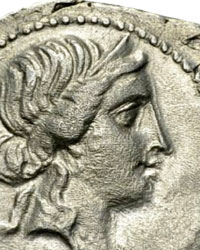
Roman Republic (Imperatorial). Mark Antony. Denarius - LEG III


04
days
23
hours
14
minutes
53
seconds
Current bid
€ 85
Reserve price not met

Expert
Selected by Alessandro Fiamingo
Holds a master’s degree in art history and a master’s degree in chemistry. Has over ten years of experience as a conservation scientist in various contexts, including work at the Vatican Museums.
Estimate € 150 - € 200
8 other people are watching this object
 Bidder 7114 Bidder 7114 | €85 | |
|---|---|---|
| Bidder 7114 | €80 | |
 Bidder 0839 Bidder 0839 | €75 | |
Catawiki Buyer Protection
Your payment’s safe with us until you receive your object.View details
Trustpilot 4.4 | 126446 reviews
Rated Excellent on Trustpilot.
Silver denarius of Mark Antony, 18 mm and 3.8 g, struck in Patrae (32–31 BC) under LEG III, obverse ANT AVG III VIR R P C with a praetorian galley, reverse LEG III with a legionary eagle between two standards; supported by a Certificate of Authenticity.
AI-assisted summary
Description from the seller
RULER: Marc Antony
DATE: Patrae (?), 32-31 B.C
DENOMINATION: Denarius
MATERIAL: Silver, AR
SIZE & WEIGHT: 18 mm, 3,8 gr
OBVERSE: ANT AVG III VIR R P C, Praetorian galley
REVERSE: LEG III, Legionary eagle between two standards.
REFERENCES: Cr544/15, Syd 1216.
Comes with Certificate of Authenticity
The Battle of Actium, fought on September 2, 31 BCE, was the climactic confrontation between Mark Antony, backed by Cleopatra VII of Egypt, and Octavian, later known as Augustus, who became the first Roman Emperor. The clash emerged out of a prolonged power struggle in the Roman Republic following the assassination of Julius Caesar, which left a power vacuum. Mark Antony, a Roman general and supporter of Caesar, formed an alliance with Cleopatra and commanded the eastern half of Rome's territories, while Octavian controlled the west. Their rivalry intensified over time, fueled by Octavian’s portrayal of Antony as a traitor who had "abandoned" Rome for Egypt and Cleopatra, a move that allegedly threatened Roman values and security. Antony's relationship with Cleopatra was exploited by Octavian to paint him as under foreign influence, an affront to Roman ideals that Octavian leveraged for political support.
The battle itself took place off the coast of Actium, in northwestern Greece. Antony’s forces, composed largely of Egyptian ships under Cleopatra's command, were positioned defensively in the Gulf of Ambracia, while Octavian's fleet, commanded by Agrippa, blockaded them from the sea. Despite having numerical superiority, Antony's forces were handicapped by poor morale, shortages of supplies, and a fleet that struggled to match Octavian’s more agile ships. Agrippa’s strategy of cutting Antony's supply lines ultimately forced Antony to break out of the gulf, leading to a chaotic naval engagement. Cleopatra’s flagship, along with a few others, famously deserted mid-battle, prompting Antony to follow her, which led to the disintegration of his forces. This decisive victory for Octavian effectively crushed Antony's and Cleopatra’s power in the eastern Mediterranean.
The aftermath of Actium had significant consequences for Rome and Egypt. Antony and Cleopatra retreated to Egypt, where they committed suicide the following year. Octavian’s unchallenged rule allowed him to annex Egypt as a Roman province, seizing Cleopatra’s wealth to consolidate his own power and effectively ending the Ptolemaic dynasty. Actium marked the end of the Roman Republic and the beginning of the Roman Empire under Octavian, who assumed the title of Augustus in 27 BCE. This victory established Augustus as Rome's supreme leader, bringing stability to a Rome that had been wracked by civil wars and setting the stage for a period of peace and prosperity known as the Pax Romana.
Seller's Story
Your Antiquarian offers ancient art and ancient coins. Our main objective is to offer the highest quality at the best price respecting and strictly complying with the laws of heritage protection and UNESCO heritage norms. Therefore, all the pieces that are published come from private collections in which the provenance can be checked or international auctions. All our antiquities and coins are accompanied by their Certificate of Authenticity. We have a no quibble 90 day return policy. At Your Antiquarian we are committed to helping disadvantaged groups and for this reason a portion of each purchase is donated to charities to help people in need.
Translated by Google TranslateRULER: Marc Antony
DATE: Patrae (?), 32-31 B.C
DENOMINATION: Denarius
MATERIAL: Silver, AR
SIZE & WEIGHT: 18 mm, 3,8 gr
OBVERSE: ANT AVG III VIR R P C, Praetorian galley
REVERSE: LEG III, Legionary eagle between two standards.
REFERENCES: Cr544/15, Syd 1216.
Comes with Certificate of Authenticity
The Battle of Actium, fought on September 2, 31 BCE, was the climactic confrontation between Mark Antony, backed by Cleopatra VII of Egypt, and Octavian, later known as Augustus, who became the first Roman Emperor. The clash emerged out of a prolonged power struggle in the Roman Republic following the assassination of Julius Caesar, which left a power vacuum. Mark Antony, a Roman general and supporter of Caesar, formed an alliance with Cleopatra and commanded the eastern half of Rome's territories, while Octavian controlled the west. Their rivalry intensified over time, fueled by Octavian’s portrayal of Antony as a traitor who had "abandoned" Rome for Egypt and Cleopatra, a move that allegedly threatened Roman values and security. Antony's relationship with Cleopatra was exploited by Octavian to paint him as under foreign influence, an affront to Roman ideals that Octavian leveraged for political support.
The battle itself took place off the coast of Actium, in northwestern Greece. Antony’s forces, composed largely of Egyptian ships under Cleopatra's command, were positioned defensively in the Gulf of Ambracia, while Octavian's fleet, commanded by Agrippa, blockaded them from the sea. Despite having numerical superiority, Antony's forces were handicapped by poor morale, shortages of supplies, and a fleet that struggled to match Octavian’s more agile ships. Agrippa’s strategy of cutting Antony's supply lines ultimately forced Antony to break out of the gulf, leading to a chaotic naval engagement. Cleopatra’s flagship, along with a few others, famously deserted mid-battle, prompting Antony to follow her, which led to the disintegration of his forces. This decisive victory for Octavian effectively crushed Antony's and Cleopatra’s power in the eastern Mediterranean.
The aftermath of Actium had significant consequences for Rome and Egypt. Antony and Cleopatra retreated to Egypt, where they committed suicide the following year. Octavian’s unchallenged rule allowed him to annex Egypt as a Roman province, seizing Cleopatra’s wealth to consolidate his own power and effectively ending the Ptolemaic dynasty. Actium marked the end of the Roman Republic and the beginning of the Roman Empire under Octavian, who assumed the title of Augustus in 27 BCE. This victory established Augustus as Rome's supreme leader, bringing stability to a Rome that had been wracked by civil wars and setting the stage for a period of peace and prosperity known as the Pax Romana.
Seller's Story
Your Antiquarian offers ancient art and ancient coins. Our main objective is to offer the highest quality at the best price respecting and strictly complying with the laws of heritage protection and UNESCO heritage norms. Therefore, all the pieces that are published come from private collections in which the provenance can be checked or international auctions. All our antiquities and coins are accompanied by their Certificate of Authenticity. We have a no quibble 90 day return policy. At Your Antiquarian we are committed to helping disadvantaged groups and for this reason a portion of each purchase is donated to charities to help people in need.
Translated by Google TranslateDetails
Era
Before 1400
Culture/region
Roman Republic (Imperatorial)
Year/Period and Variation
- LEG III
Ruler
Mark Antony
Denomination
Denarius
Metal
AR
Condition
Ungraded
Sold by