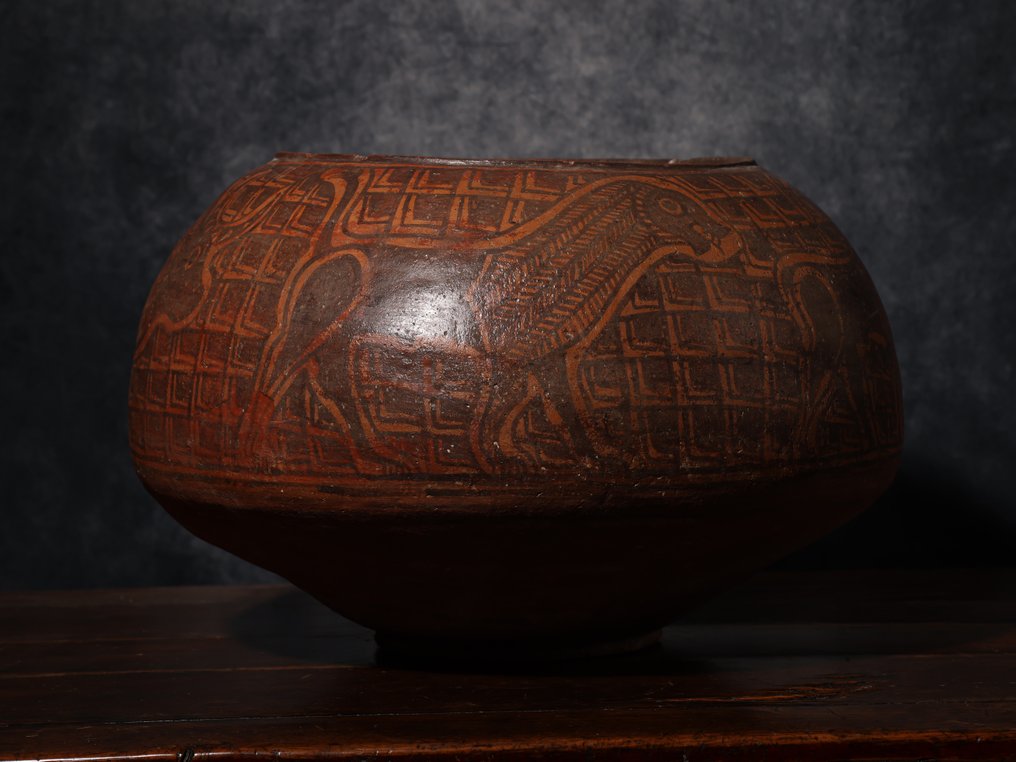
Indus Valley Amazing huge pottery with TL test - 29 cm


06
days
09
hours
35
minutes
35
seconds
Current bid
€ 1
Reserve price not met

Expert
Selected by Ruth Garrido Vila
Directed the Ifergan Collection Museum, specialising in Phoenician and Mediterranean archaeology.
Estimate € 6,600 - € 7,300
14 other people are watching this object
 Bidder 4737 Bidder 4737 | €1 |
|---|
Catawiki Buyer Protection
Your payment’s safe with us until you receive your object.View details
Trustpilot 4.4 | 128055 reviews
Rated Excellent on Trustpilot.
Indus Valley Harappan Madura Period ca. 2600–1900 BC, Amazing huge pottery with TL test, a large hand-shaped ceramic storage vessel with a burnished finish and incised and painted zoomorphic and geometric decoration, 38 cm in diameter and 29 cm high, in Buen estado and accompanied by an authenticity certificate and a TL test.
AI-assisted summary
Description from the seller
The pottery is a large-format ceramic vessel from the Indus Valley region, one of the oldest cradles of urban civilisation in South Asia. With a globular body measuring 38 cm in diameter and a height of 29 cm, this piece stands out both for its imposing presence and for the quality and richness of its incised and painted decoration. Its state of preservation is remarkable, considering its apparent age and the inherent fragility of the ceramic material.
The decoration that runs across its surface represents a sequence of stylised animals—including bovines and possibly goats or antelopes—engraved with firm, precise lines on a geometric grid background, suggesting an ornamental but also symbolic or ritual intention. The animals are represented laterally, with notable stylisation in their legs, horns, and manes, reflecting an abstract aesthetic highly characteristic of the prehistoric art of the Indian subcontinent. This type of animal representation is common in the iconography of the Indus Valley culture (approx. 2600–1900 BC), especially on objects such as seals, ceramics, and reliefs, where animals served both symbolic and documentary functions, perhaps associated with trade, religion, or family clans.
Although the exact date is unknown, its shape, decorative motifs, and material can be related to objects from the late Harappan phase, in which highly standardised ceramic forms decorated with geometric and zoomorphic incisions proliferated. Pottery from this period and region often had both domestic and ceremonial functions, and was common in burial or ritual contexts. Its flat bottom and thick walls suggest use as a storage vessel, possibly for water or grain.
Technically, the pottery was probably hand-shaped, with a burnished finish, and subsequently decorated with incisions or the application of a dark slip that highlights the engraved motifs. This type of work required not only technical expertise but also an advanced aesthetic understanding, given the visual balance between form, decoration, and functionality.
Animal iconography is particularly prominent in ancient cultures of the Middle East and South Asia, and stylistic parallels can be drawn with certain pieces from Mesopotamian culture or even Elamite pottery. However, the stylisation and geometric motifs in the background are distinctive of the Indus Valley, reinforcing its probable attribution to that civilisation.
This type of vessel shares similarities with other ceramic pieces discovered at sites such as Harappa and Lothal, where sizable vessels with similar decorative motifs have been found. Examples exist in museum collections such as the National Museum in New Delhi and the British Museum, allowing us to trace a stylistic and functional lineage between this piece and others documented archaeologically.
Acquired from a Spanish private collection, A.P in the 80's.
-The piece includes an authenticity certificate as well as the TL test.
The seller can prove that the lot was obtained legally. Important information. The seller guarantees that he is entitled to ship this lot. The seller will ensure that any necessary permits are arranged; this process can take between 2 and 4 weeks.
IMPORTANT: Due to new laws on the export of archaeological pieces, we have decided to NO LONGER sell outside the European territory for the following countries: Switzerland & United States of America.
For destinations outside European territory: all our items will be shipped after obtaining a definitive EXPORT LICENSE from the Ministry of Culture of Spain. We inform our clients that it may take between
4-8 weeks. According to Spanish legislation, items sent outside the European Union are subject to export taxes. The taxes will be added to the invoice at the buyer's expense. These export fees are fixed based on the final auction price, and the tax rate is not applied directly to the total value of the item to be exported, but rather, different percentages are applied to sections of it.
Up to 6,000 euros: 5%. / From 6,001 to 60,000 euros: 10%.
Please note that for far destinations (Asia, Middle East, etc.), there will be an additional cost for shipping.
The pottery is a large-format ceramic vessel from the Indus Valley region, one of the oldest cradles of urban civilisation in South Asia. With a globular body measuring 38 cm in diameter and a height of 29 cm, this piece stands out both for its imposing presence and for the quality and richness of its incised and painted decoration. Its state of preservation is remarkable, considering its apparent age and the inherent fragility of the ceramic material.
The decoration that runs across its surface represents a sequence of stylised animals—including bovines and possibly goats or antelopes—engraved with firm, precise lines on a geometric grid background, suggesting an ornamental but also symbolic or ritual intention. The animals are represented laterally, with notable stylisation in their legs, horns, and manes, reflecting an abstract aesthetic highly characteristic of the prehistoric art of the Indian subcontinent. This type of animal representation is common in the iconography of the Indus Valley culture (approx. 2600–1900 BC), especially on objects such as seals, ceramics, and reliefs, where animals served both symbolic and documentary functions, perhaps associated with trade, religion, or family clans.
Although the exact date is unknown, its shape, decorative motifs, and material can be related to objects from the late Harappan phase, in which highly standardised ceramic forms decorated with geometric and zoomorphic incisions proliferated. Pottery from this period and region often had both domestic and ceremonial functions, and was common in burial or ritual contexts. Its flat bottom and thick walls suggest use as a storage vessel, possibly for water or grain.
Technically, the pottery was probably hand-shaped, with a burnished finish, and subsequently decorated with incisions or the application of a dark slip that highlights the engraved motifs. This type of work required not only technical expertise but also an advanced aesthetic understanding, given the visual balance between form, decoration, and functionality.
Animal iconography is particularly prominent in ancient cultures of the Middle East and South Asia, and stylistic parallels can be drawn with certain pieces from Mesopotamian culture or even Elamite pottery. However, the stylisation and geometric motifs in the background are distinctive of the Indus Valley, reinforcing its probable attribution to that civilisation.
This type of vessel shares similarities with other ceramic pieces discovered at sites such as Harappa and Lothal, where sizable vessels with similar decorative motifs have been found. Examples exist in museum collections such as the National Museum in New Delhi and the British Museum, allowing us to trace a stylistic and functional lineage between this piece and others documented archaeologically.
Acquired from a Spanish private collection, A.P in the 80's.
-The piece includes an authenticity certificate as well as the TL test.
The seller can prove that the lot was obtained legally. Important information. The seller guarantees that he is entitled to ship this lot. The seller will ensure that any necessary permits are arranged; this process can take between 2 and 4 weeks.
IMPORTANT: Due to new laws on the export of archaeological pieces, we have decided to NO LONGER sell outside the European territory for the following countries: Switzerland & United States of America.
For destinations outside European territory: all our items will be shipped after obtaining a definitive EXPORT LICENSE from the Ministry of Culture of Spain. We inform our clients that it may take between
4-8 weeks. According to Spanish legislation, items sent outside the European Union are subject to export taxes. The taxes will be added to the invoice at the buyer's expense. These export fees are fixed based on the final auction price, and the tax rate is not applied directly to the total value of the item to be exported, but rather, different percentages are applied to sections of it.
Up to 6,000 euros: 5%. / From 6,001 to 60,000 euros: 10%.
Please note that for far destinations (Asia, Middle East, etc.), there will be an additional cost for shipping.
Details
Culture
Indus Valley
Century/timeframe
Harappan Madura Period, ca. 2600–1900 BC
Name of object
Amazing huge pottery with TL test
Acquired from
Private collection
Year acquired
1980
Country acquired from
Spain
Condition
Good
Previous owner acquired from
Private collection
Height
29 cm
Previous owner - year acquired
1980
Width
38 cm
Previous owner - country acquired from
Spain
Depth
38 cm
I verify that I have obtained this object legally and that I am allowed to sell it
Yes
Disclaimer
The seller was informed by Catawiki about documentation requirements and guarantees the following: - the object was legally obtained, - the seller has the right to sell and/or export the object, as relevant, - the seller will provide the necessary provenance information and arrange required documentation and permits/licenses, as applicable and as per local laws, - the seller will notify the buyer of any delays in obtaining permits/licenses. By bidding, you acknowledge that import documentation may be required depending on your country of residence and that obtaining permits/licenses may cause delays in the delivery of your object.
The seller was informed by Catawiki about documentation requirements and guarantees the following: - the object was legally obtained, - the seller has the right to sell and/or export the object, as relevant, - the seller will provide the necessary provenance information and arrange required documentation and permits/licenses, as applicable and as per local laws, - the seller will notify the buyer of any delays in obtaining permits/licenses. By bidding, you acknowledge that import documentation may be required depending on your country of residence and that obtaining permits/licenses may cause delays in the delivery of your object.
