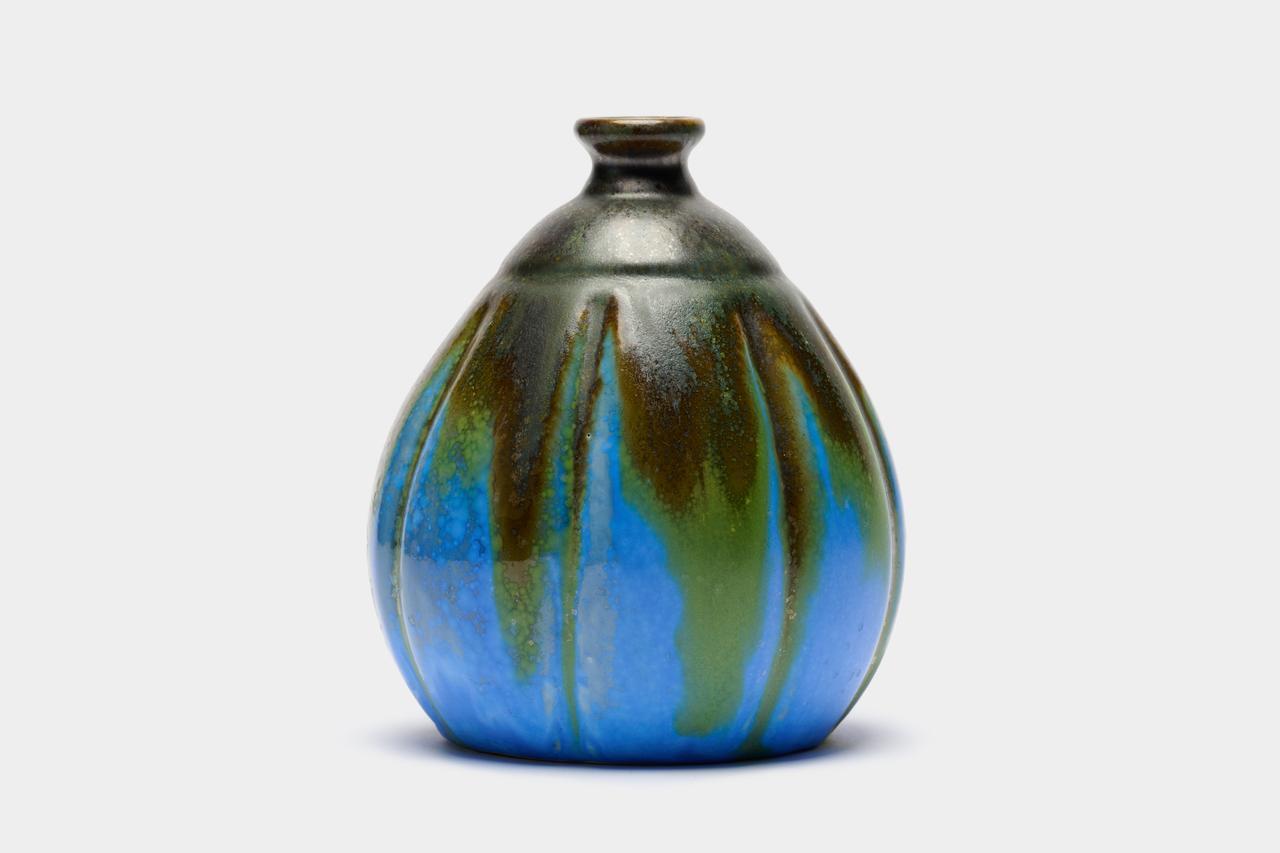
Vase (3) - Earthenware - Art Nouveau


06
days
00
hours
00
minutes
16
seconds
Starting bid
€ 1
Reserve price not met

Expert
Selected by Michel Karis
Art historian with extensive experience working at various auction houses in antiques.
Estimate € 170 - € 200
No bids placed
Catawiki Buyer Protection
Your payment’s safe with us until you receive your object.View details
Trustpilot 4.4 | 128528 reviews
Rated Excellent on Trustpilot.
A set of three Majolica Art Nouveau vases attributed to Eichwald from Bohemia (now Dubí, Czechia), dating to the late 19th/early 20th century, with a dark green glaze and gilt highlights, in faience, and heights of 15 cm (small), 32 cm (medium) and 42 cm (large) with bases of 10.5 cm, 18 cm and 18 cm respectively, in used condition with possible minor losses.
AI-assisted summary
Description from the seller
This ensemble comprises three Art Nouveau majolica vases, attributed to the manufacturer Eichwald, from Bohemia (today Dubí, in the Czech Republic). Produced at the end of the 19th century and the beginning of the 20th century, these pieces exemplify early Jugendstil, recognizable by its flowing lines, organic shapes, and stylized decorative details.
Dimensions :
Small: Height 15 cm – Neck diameter 4 cm – Base diameter 10.5 cm
Medium: Height 32 cm – Small width 15 cm – Large width 18 cm
Large: Height 42 cm – Neck diameter 4.5 cm – Base diameter 18 cm
Crafted in majolica ceramic coated with a glossy dark green glaze, the vases are distinguished by their elegant gilded highlights that emphasize the reliefs and underscore their decorative character. Majolica, a tin-glazed earthenware technique, enables a luminous and deep surface here, highlighting the relief forms obtained by molding and slip.
The shapes reflect a naturalistic and architectural inspiration typical of Art Nouveau.
* One vase, slender and cylindrical, rests on a flared, openwork base, outlined by sinuous lines evoking the “whip stroke” motif.
* A second model, more massive, features a double handle harmoniously integrated into the body and neck, with stylized gilded details enhancing its monumental appearance.
* The third vase, more compact in format, adopts a rounded and sober silhouette, enriched with delicate reliefs and touches of gold.
These pieces are very likely from the factory founded in 1871 by Bernhard Bloch in Eichwald. At that time, some early productions were not systematically marked, which explains the absence of a signature. No other manufacturer produced such characteristic classic green Jugendstil patterns, reinforcing the attribution to Eichwald.
Collectors’ items, Eichwald Majolica vases are valued for the quality of their glaze, the richness of their reliefs, and their excellent condition despite their age. This set stands as a fine example of Bohemian production during the Secession period, combining decorative refinement with technical mastery.
This ensemble comprises three Art Nouveau majolica vases, attributed to the manufacturer Eichwald, from Bohemia (today Dubí, in the Czech Republic). Produced at the end of the 19th century and the beginning of the 20th century, these pieces exemplify early Jugendstil, recognizable by its flowing lines, organic shapes, and stylized decorative details.
Dimensions :
Small: Height 15 cm – Neck diameter 4 cm – Base diameter 10.5 cm
Medium: Height 32 cm – Small width 15 cm – Large width 18 cm
Large: Height 42 cm – Neck diameter 4.5 cm – Base diameter 18 cm
Crafted in majolica ceramic coated with a glossy dark green glaze, the vases are distinguished by their elegant gilded highlights that emphasize the reliefs and underscore their decorative character. Majolica, a tin-glazed earthenware technique, enables a luminous and deep surface here, highlighting the relief forms obtained by molding and slip.
The shapes reflect a naturalistic and architectural inspiration typical of Art Nouveau.
* One vase, slender and cylindrical, rests on a flared, openwork base, outlined by sinuous lines evoking the “whip stroke” motif.
* A second model, more massive, features a double handle harmoniously integrated into the body and neck, with stylized gilded details enhancing its monumental appearance.
* The third vase, more compact in format, adopts a rounded and sober silhouette, enriched with delicate reliefs and touches of gold.
These pieces are very likely from the factory founded in 1871 by Bernhard Bloch in Eichwald. At that time, some early productions were not systematically marked, which explains the absence of a signature. No other manufacturer produced such characteristic classic green Jugendstil patterns, reinforcing the attribution to Eichwald.
Collectors’ items, Eichwald Majolica vases are valued for the quality of their glaze, the richness of their reliefs, and their excellent condition despite their age. This set stands as a fine example of Bohemian production during the Secession period, combining decorative refinement with technical mastery.
Details
Era
1900-2000
Weight
2500 g
Style subtype
Jugendstil
Specific region of origin
Bohême
Title additional information
Art Nouveau
No. of items
3
Country of Origin
Czechia
Material
Earthenware
Style
Art Nouveau
Colour
Gold, Green
Condition
Fair condition - heavily used & with possibly minor parts missing
Height
42 cm
Width
18 cm
Depth
18 cm
Diameter
18 cm
Estimated period
1900-1910
Sold by