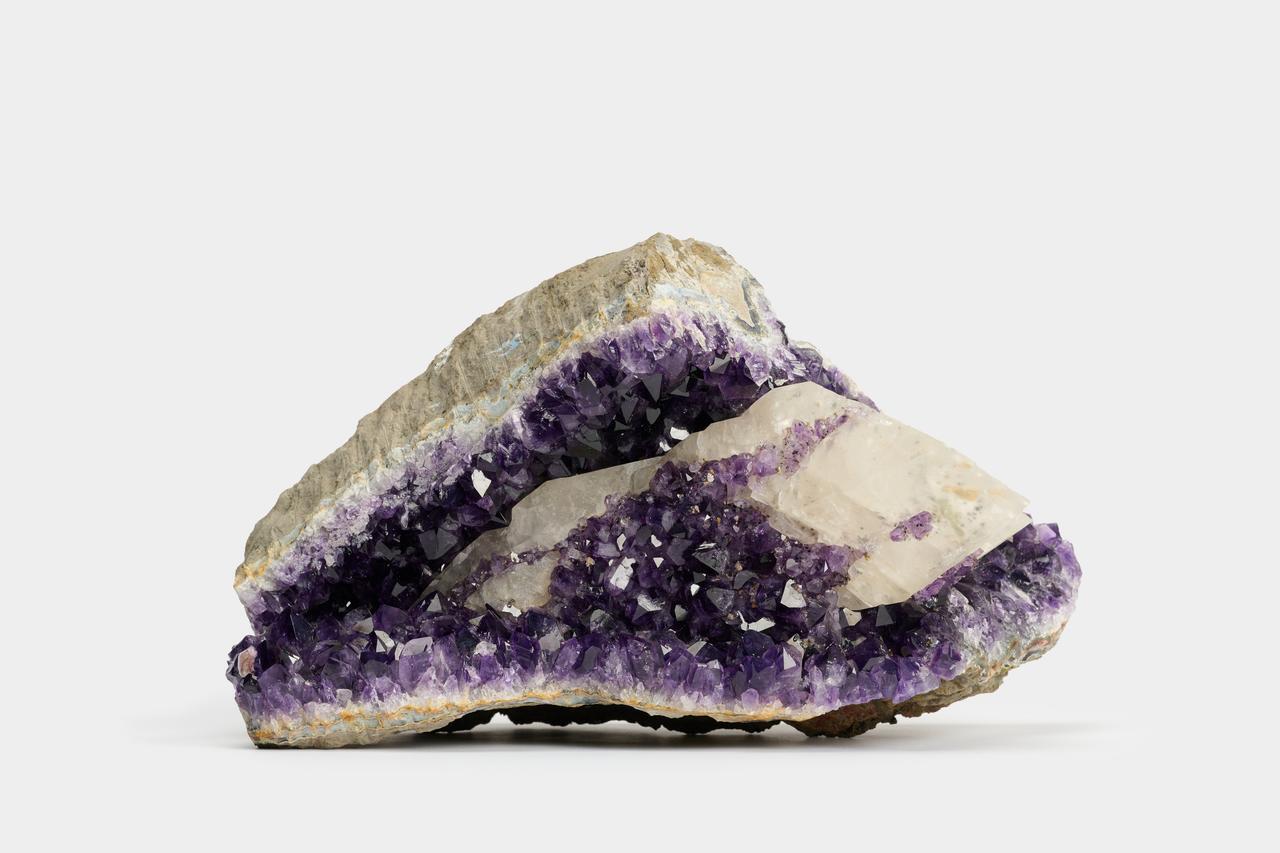
demonstration stage - Height: 9 cm - Width: 17.5 cm- 1.42 kg


05
days
19
hours
42
minutes
31
seconds

1 other person has their eye on this
 Bidder 1420 Bidder 1420 | €10 |
|---|
Catawiki Buyer Protection
Your payment’s safe with us until you receive your object.View details
Trustpilot 4.4 | 128070 reviews
Rated Excellent on Trustpilot.
Main mineral sulfur; meteorite name Schaustufe; mineral form Schaustufe; country of origin Italy; origin (region/city) Agrigento, Sicily.
AI-assisted summary
Description from the seller
From my collection
A beautiful large specimen with many yellow sulfur crystals on a matrix of celestite
Locality: Racalmuto Mine in Agrigento / Sicily / Italy
Weight approx. 1.42 kg
Size approx. 9.0 x 17.5 x 10.0 cm
As early as antiquity sulfur was mined north and east of Agrigento in the triangle Sciacca-Enna-Gela. While in the Middle Ages sulfur was mainly needed for the production of gunpowder, since the 19th century in industrialized countries the production of sulfuric acid has become more important.
Around 1900, Sicily had 730 sulfur mines in operation, mostly open-pit. Here 38,000 miners (zolfatari) worked and extracted 3.4 million tons of ore, from which 0.54 million tons of pure sulfur were obtained. That accounted for 90% of the world’s total production. The working conditions remained practically unchanged from antiquity to the 19th century and were characterized by extreme hardship. In a report by Leopoldo Franchetti and Sidney Sonnino from 1876, it is noted that the picconieri (pickaxemen) dependent on the large landowners hired children, so-called carusi, aged between 7 and 16, who were responsible for transporting the rocks and had to haul up to 80 kilograms. The outdated methods and poor equipment often led to blasting accidents and other deadly incidents. As the oldest railway line in Sicily, around 1870 the Agrigent–Palermo line was built to connect the capital Palermo with the mining districts and the port town of Porto Empedocle. Because of the inhumane working conditions, the zolfatari were the first to form unions and in the 1890s massively joined the Fasci Siciliani movement. At the beginning of the 20th century, however, there was a decline in production, mainly due to increasing cheaper competition from the USA.
Already by 1917 Italy’s share of world production had fallen to 14%, in 1965 there were still 180 mines in operation, and in 1983 there were only 13 mines. Today there is not a single sulfur mine in Sicily in operation.
From my collection
A beautiful large specimen with many yellow sulfur crystals on a matrix of celestite
Locality: Racalmuto Mine in Agrigento / Sicily / Italy
Weight approx. 1.42 kg
Size approx. 9.0 x 17.5 x 10.0 cm
As early as antiquity sulfur was mined north and east of Agrigento in the triangle Sciacca-Enna-Gela. While in the Middle Ages sulfur was mainly needed for the production of gunpowder, since the 19th century in industrialized countries the production of sulfuric acid has become more important.
Around 1900, Sicily had 730 sulfur mines in operation, mostly open-pit. Here 38,000 miners (zolfatari) worked and extracted 3.4 million tons of ore, from which 0.54 million tons of pure sulfur were obtained. That accounted for 90% of the world’s total production. The working conditions remained practically unchanged from antiquity to the 19th century and were characterized by extreme hardship. In a report by Leopoldo Franchetti and Sidney Sonnino from 1876, it is noted that the picconieri (pickaxemen) dependent on the large landowners hired children, so-called carusi, aged between 7 and 16, who were responsible for transporting the rocks and had to haul up to 80 kilograms. The outdated methods and poor equipment often led to blasting accidents and other deadly incidents. As the oldest railway line in Sicily, around 1870 the Agrigent–Palermo line was built to connect the capital Palermo with the mining districts and the port town of Porto Empedocle. Because of the inhumane working conditions, the zolfatari were the first to form unions and in the 1890s massively joined the Fasci Siciliani movement. At the beginning of the 20th century, however, there was a decline in production, mainly due to increasing cheaper competition from the USA.
Already by 1917 Italy’s share of world production had fallen to 14%, in 1965 there were still 180 mines in operation, and in 1983 there were only 13 mines. Today there is not a single sulfur mine in Sicily in operation.
Details
Mineral Form
demonstration stage
Weight
1.42 kg
Origin (Region/ City)
Agrigento, Sicily
Country of Origin
Italy
Height
9 cm
Width
17.5 cm
Depth
10 cm
Sold by