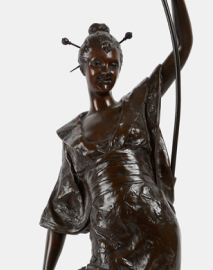
Sculpture, Tête Ifé Yoruba - 35 cm - Patinated bronze


05
days
19
hours
11
minutes
42
seconds
Starting bid
€ 1
Reserve price not met

No bids placed
Catawiki Buyer Protection
Your payment’s safe with us until you receive your object.View details
Trustpilot 4.4 | 127823 reviews
Rated Excellent on Trustpilot.
Tête Ifé Yoruba, bronze patiné head from Ife, Nigeria, dating to the 15th century, 35 cm high, 17 cm wide, 21 cm deep, unsigned, in excellent condition, without a stand.
AI-assisted summary
Description from the seller
Description
Head lfé Yoruba
Figurative bronzes in African art from the ancient Yoruba civilizations. The city of Ife in Nigeria was in the 15th century.
The center of a powerful forest state in the west of the Niger delta. The work of bronze was a prerogative of the king 'Oni,' according to the lost-wax technique.
These prestige objects embodying the sovereigns were placed on royal altars for ceremonial use.
This commemorative sculpture in a naturalistic style depicts a royal figure proudly wearing a highly ornate helmet-like headdress. The vertical striations on his face
It evokes the traditional scarifications of the ethnic group and the name of the ancient religious capital of Nigeria, Ife.
This bronze head is inspired by those produced by sculptors from Ile-Ife and demonstrates their great skill in facial treatment.
It would be an artisan from Ile-Ife who taught the Edo people of the Benin kingdom the art of metals.
However, the artisans of Ile-Ife were more attached to the resemblance of their portraits than those of Benin.
seemed to pour their iconic works into quite similar molds.
The parallel folds on the neck evoke the flesh folds of prosperous notables, and the hollowed parts that accompany them likely served to fix the king's pearl veil. The openings around the mouth probably symbolized a beard created by fixing hair or pearls, while those located at the base of the neck may have facilitated attachment to a wooden body during funeral ceremonies.
Description
Head lfé Yoruba
Figurative bronzes in African art from the ancient Yoruba civilizations. The city of Ife in Nigeria was in the 15th century.
The center of a powerful forest state in the west of the Niger delta. The work of bronze was a prerogative of the king 'Oni,' according to the lost-wax technique.
These prestige objects embodying the sovereigns were placed on royal altars for ceremonial use.
This commemorative sculpture in a naturalistic style depicts a royal figure proudly wearing a highly ornate helmet-like headdress. The vertical striations on his face
It evokes the traditional scarifications of the ethnic group and the name of the ancient religious capital of Nigeria, Ife.
This bronze head is inspired by those produced by sculptors from Ile-Ife and demonstrates their great skill in facial treatment.
It would be an artisan from Ile-Ife who taught the Edo people of the Benin kingdom the art of metals.
However, the artisans of Ile-Ife were more attached to the resemblance of their portraits than those of Benin.
seemed to pour their iconic works into quite similar molds.
The parallel folds on the neck evoke the flesh folds of prosperous notables, and the hollowed parts that accompany them likely served to fix the king's pearl veil. The openings around the mouth probably symbolized a beard created by fixing hair or pearls, while those located at the base of the neck may have facilitated attachment to a wooden body during funeral ceremonies.
Details
Era
After 2000
Bronze type
Patinated bronze
Country of Origin
Nigeria
Material
Bronze
Title of artwork
Tête Ifé Yoruba
Signature
Not signed
Sold with stand
No
Condition
Excellent condition
Height
35 cm
Width
17 cm
Depth
21 cm
Sold by