Ancient Roman Glass Candlestick Unguentarium


14
days
18
hours
46
minutes
03
seconds
Starting bid
€ 1
Reserve price not met

Expert
Selected by Peter Reynaers
Has nearly 30 years’ experience and moderated multiple online art research groups.
Estimate € 180 - € 210
No bids placed
Catawiki Buyer Protection
Your payment’s safe with us until you receive your object.View details
Trustpilot 4.4 | 128017 reviews
Rated Excellent on Trustpilot.
Ancient Roman glass unguentarium (Candlestick Unguentarium) blown as a pale blue perfume bottle with a wide everted rim, long narrow neck curving to a bell-shaped body, dating to circa 1st–3rd century AD; good condition, about 15 cm high and 6 cm wide; acquired 2025 from a private collection.
AI-assisted summary
Description from the seller
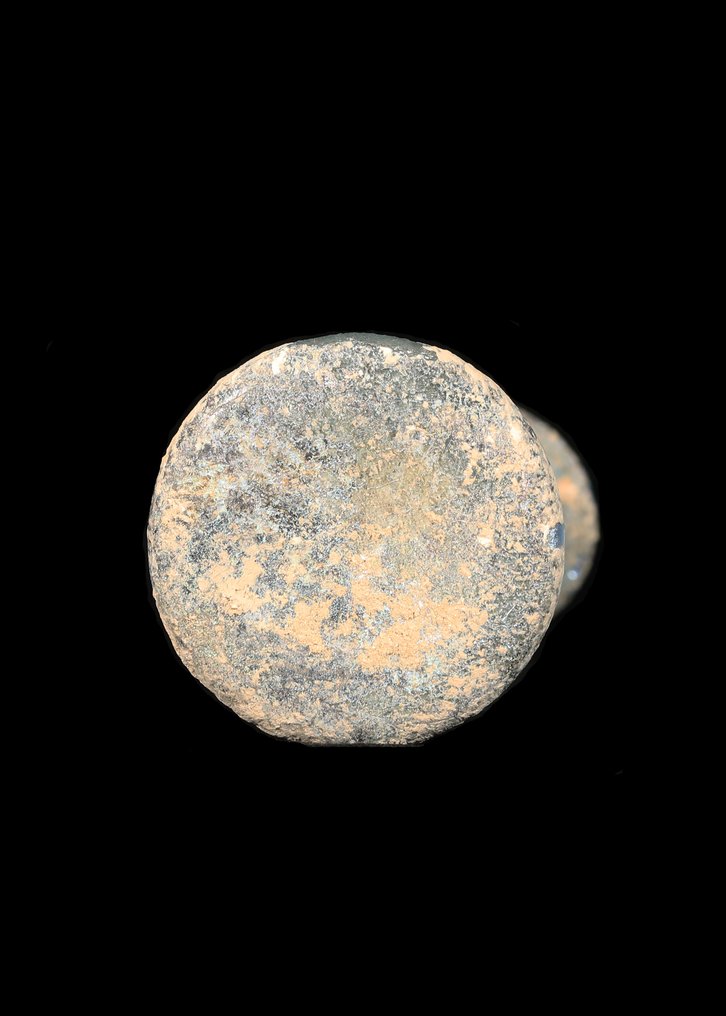
An ancient Roman unguentarium blown from pale blue glass, most likely used as a perfume bottle. The vessel features a wide everted rim and a long, narrow cylindrical neck which curves outwards towards the bell-shaped body, ending in a slightly concave base. The piece is covered with beautiful silver and polychrome iridescence along with earthly encrustations.
Unguentaria were amongst the most common objects of Roman blown glass: produced in large numbers, they were items of everyday use for keeping expensive perfumes and cosmetic oils. The small body and mouth were ideal for slow, careful pouring, while glass was preferred for holding liquids, due to its non-porous, non-absorbent nature. By the 1st century AD, the technique of glass-blowing had revolutionised the art of glass-making. The new technique allowed craftsmen to use smaller amounts of glass for each vessel and obtain much thinner walls, so enabling the creation of small medicine, incense, and perfume containers in new forms.
Measurements: Circa H 15cm x W 6cm
Provenance: From the collection of a London gentleman, bought 1970s and by descent.
Seller's Story
N.B: TAXES & VAT ARE NOT INCLUDED WITHIN THE SHIPPING COSTS. INTERNATIONAL DELIVERY TIME SUBJECT TO CUSTOMS CLEARANCE.
ANTIQUITIES: All items sold will come with their own Certificate of Authenticity, including the item's description, image and provenance. Please also note, for insurance purposes, an item's value cannot be under- declared. All items when shipped (if required) will be declared as antiquities over 100 years old and their valued price.
Liability and the applicable Customs Regulations or Import Requirements in the country of your destination are the sole responsibility of the buyer. We cannot be held responsible for any delays occurred by Custom Procedures. Import Tax or payable VAT depends on the Country of your destination. Payments of any taxes or any dispute with Customs Authorities are the sole responsibility of the buyer. Please note that from the 1st of January 2021, as Britain will officially leave the EU, artefacts dispatched to any European country might have to go through Customs Procedures and fees.
Watches: Watches are provided with a hard cardboard box and pillow as shown in the images.
The Seller can prove that the lot was obtained legally, provenance statement seen by Catawiki. Important information. The seller guarantees that he is entitled to ship this lot.
The seller will take care that any necessary permits will be arranged.
The seller will inform the buyer about this if this takes more than a few days.
An ancient Roman unguentarium blown from pale blue glass, most likely used as a perfume bottle. The vessel features a wide everted rim and a long, narrow cylindrical neck which curves outwards towards the bell-shaped body, ending in a slightly concave base. The piece is covered with beautiful silver and polychrome iridescence along with earthly encrustations.
Unguentaria were amongst the most common objects of Roman blown glass: produced in large numbers, they were items of everyday use for keeping expensive perfumes and cosmetic oils. The small body and mouth were ideal for slow, careful pouring, while glass was preferred for holding liquids, due to its non-porous, non-absorbent nature. By the 1st century AD, the technique of glass-blowing had revolutionised the art of glass-making. The new technique allowed craftsmen to use smaller amounts of glass for each vessel and obtain much thinner walls, so enabling the creation of small medicine, incense, and perfume containers in new forms.
Measurements: Circa H 15cm x W 6cm
Provenance: From the collection of a London gentleman, bought 1970s and by descent.
Seller's Story
N.B: TAXES & VAT ARE NOT INCLUDED WITHIN THE SHIPPING COSTS. INTERNATIONAL DELIVERY TIME SUBJECT TO CUSTOMS CLEARANCE.
ANTIQUITIES: All items sold will come with their own Certificate of Authenticity, including the item's description, image and provenance. Please also note, for insurance purposes, an item's value cannot be under- declared. All items when shipped (if required) will be declared as antiquities over 100 years old and their valued price.
Liability and the applicable Customs Regulations or Import Requirements in the country of your destination are the sole responsibility of the buyer. We cannot be held responsible for any delays occurred by Custom Procedures. Import Tax or payable VAT depends on the Country of your destination. Payments of any taxes or any dispute with Customs Authorities are the sole responsibility of the buyer. Please note that from the 1st of January 2021, as Britain will officially leave the EU, artefacts dispatched to any European country might have to go through Customs Procedures and fees.
Watches: Watches are provided with a hard cardboard box and pillow as shown in the images.
The Seller can prove that the lot was obtained legally, provenance statement seen by Catawiki. Important information. The seller guarantees that he is entitled to ship this lot.
The seller will take care that any necessary permits will be arranged.
The seller will inform the buyer about this if this takes more than a few days.
Details
Culture
Ancient Roman
Century/timeframe
Circa 1st-3rd Century AD
Name of object
Candlestick Unguentarium
Acquired from
Private collection
Year acquired
2025
Material
Glass
Country acquired from
Unknown
Condition
Good
Previous owner acquired from
Inherited
Previous owner - year acquired
1970
Previous owner - country acquired from
Unknown
I verify that I have obtained this object legally and that I am allowed to sell it
Yes
Sold by
Disclaimer
The seller was informed by Catawiki about documentation requirements and guarantees the following: - the object was legally obtained, - the seller has the right to sell and/or export the object, as relevant, - the seller will provide the necessary provenance information and arrange required documentation and permits/licenses, as applicable and as per local laws, - the seller will notify the buyer of any delays in obtaining permits/licenses. By bidding, you acknowledge that import documentation may be required depending on your country of residence and that obtaining permits/licenses may cause delays in the delivery of your object.
The seller was informed by Catawiki about documentation requirements and guarantees the following: - the object was legally obtained, - the seller has the right to sell and/or export the object, as relevant, - the seller will provide the necessary provenance information and arrange required documentation and permits/licenses, as applicable and as per local laws, - the seller will notify the buyer of any delays in obtaining permits/licenses. By bidding, you acknowledge that import documentation may be required depending on your country of residence and that obtaining permits/licenses may cause delays in the delivery of your object.
