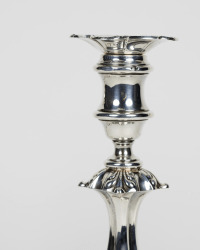
Monstrance - .800 silver - 1800-1850


04
days
22
hours
01
minute
04
seconds
Current bid
€ 160
Reserve price not met

Expert
Selected by Inés Fernández
Specialised in Spanish and Portuguese silver with over 10 years in galleries and auctions.
Estimate € 900 - € 1,100
25 other people are watching this object
 Bidder 8896 Bidder 8896 | €160 | |
|---|---|---|
| Bidder 8896 | €150 | |
| Bidder 7728 | €4 | |
Catawiki Buyer Protection
Your payment’s safe with us until you receive your object.View details
Trustpilot 4.4 | 130109 reviews
Rated Excellent on Trustpilot.
Rare Solenne monstrance in 800 silver bearing the 'Giglio di Firenze' mark, dating to the mid-19th century (circa 1840–1850), with a hand-hathed radiating structure, removable gilded capsule, and dimensions 46 cm high, 20 cm wide, 10 cm deep, weighing 1000 g, produced in Italy, in good used condition with minor signs of age and spots.
AI-assisted summary
Description from the seller
Rare Solen Monstrance in 800 Silver "Giglio di Firenze" – 19th Century – 1 kg
Lot Description
Exceptional specimen of high Tuscan sacred silverware, dateable to the mid-19th century (circa 1840-1850). This radiating monstrance represents an superb testimony to the goldsmithing mastery of the Grand Duchy of Tuscany, combining an imposing structure in solid silver with decorative details of exquisite workmanship.
Decorative and Technical Apparatus:
The Radiating Structure (Raggiera): Fully hand-chased with volumetric cloud motifs, enriched by cherub heads in cast applied decor. The center is encircled by a precious bezel inlaid with original polychrome glass pastes (ruby red and emerald green), all intact and of the same period.
The Base: The vase-shaped stem, finely chased with foliate motifs, rests on a convex circular base. A highly valuable detail are the three lion-paw shaped cast feet, typical of the wealthiest commissions of the period.
The Removable Case (Capsula): The true highlight of the lot is the presence of its original gold-plated metal case, entirely removable. The extraction mechanism, the hinge and the inner lid are perfectly intact and functional. This technical feature was reserved for only the very highest-quality pieces.
Punctuation Analysis (Guarantee of Authenticity)
The piece is regularly hallmarked in multiple places, confirming its integrity as solid silver:
Florence Lily (Giglio di Firenze): The famous "buttoned lily" (assay mark of the city of Florence) is visible on the radiating structure, guaranteeing provenance and silver content.
Assay Mark in Shield: Present on the base, typical of the precious metals certification of the 19th century in the Tuscany area.
Rare Solen Monstrance in 800 Silver "Giglio di Firenze" – 19th Century – 1 kg
Lot Description
Exceptional specimen of high Tuscan sacred silverware, dateable to the mid-19th century (circa 1840-1850). This radiating monstrance represents an superb testimony to the goldsmithing mastery of the Grand Duchy of Tuscany, combining an imposing structure in solid silver with decorative details of exquisite workmanship.
Decorative and Technical Apparatus:
The Radiating Structure (Raggiera): Fully hand-chased with volumetric cloud motifs, enriched by cherub heads in cast applied decor. The center is encircled by a precious bezel inlaid with original polychrome glass pastes (ruby red and emerald green), all intact and of the same period.
The Base: The vase-shaped stem, finely chased with foliate motifs, rests on a convex circular base. A highly valuable detail are the three lion-paw shaped cast feet, typical of the wealthiest commissions of the period.
The Removable Case (Capsula): The true highlight of the lot is the presence of its original gold-plated metal case, entirely removable. The extraction mechanism, the hinge and the inner lid are perfectly intact and functional. This technical feature was reserved for only the very highest-quality pieces.
Punctuation Analysis (Guarantee of Authenticity)
The piece is regularly hallmarked in multiple places, confirming its integrity as solid silver:
Florence Lily (Giglio di Firenze): The famous "buttoned lily" (assay mark of the city of Florence) is visible on the radiating structure, guaranteeing provenance and silver content.
Assay Mark in Shield: Present on the base, typical of the precious metals certification of the 19th century in the Tuscany area.
Details
Era
1400-1900
Gross weight
1000 g
Silver type
.800 silver
Material
Metal, Silver
Country of origin
Italy
Height
46 cm
Width
20 cm
Depth
10 cm
Condition
Good condition - used with small signs of aging & blemishes
Estimated period
1800-1850
Sold by