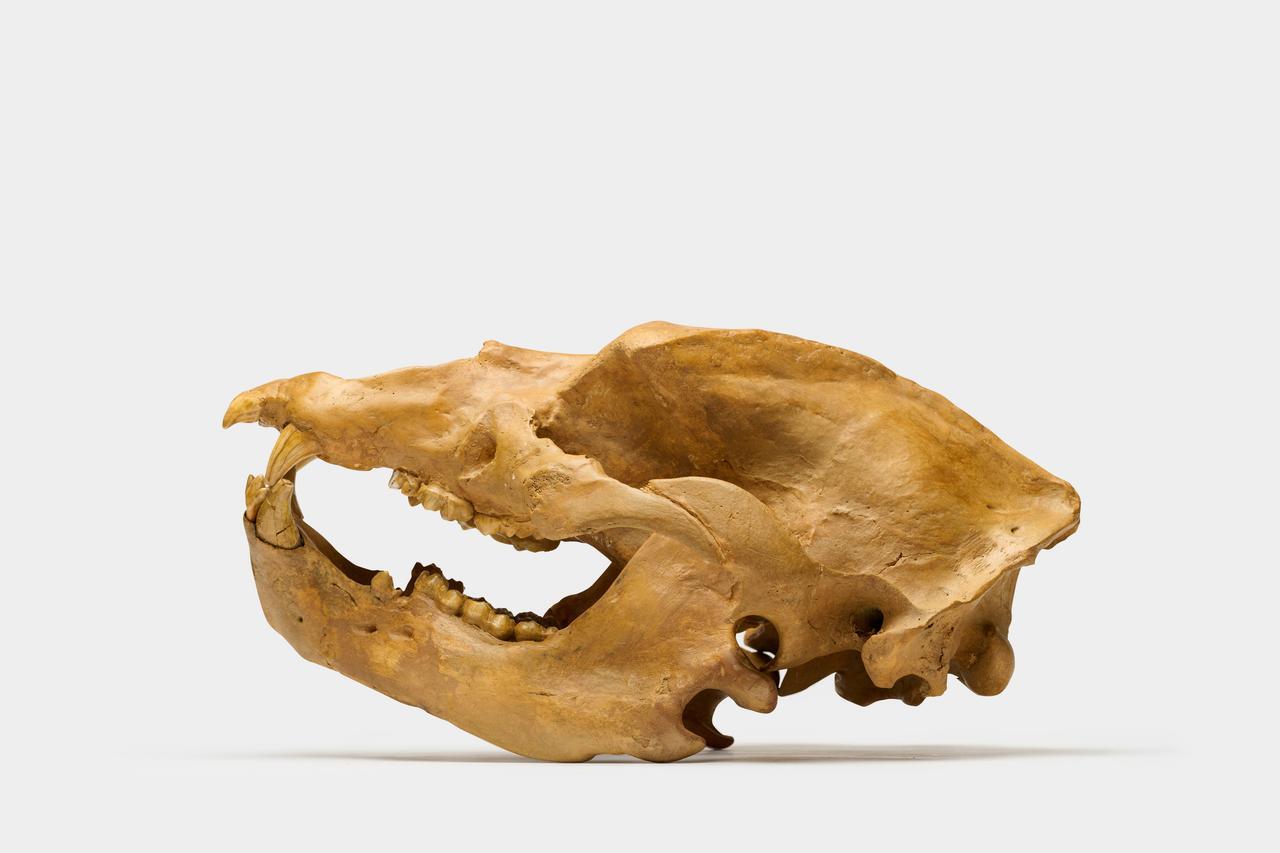
Short-Faced Bear Skeleton - REPLICA - 320 cm - 90 cm - 120 cm - (1)


07
days
03
hours
02
minutes
06
seconds

No bids placed
Catawiki Buyer Protection
Your payment’s safe with us until you receive your object.View details
Trustpilot 4.4 | 130049 reviews
Rated Excellent on Trustpilot.
REPLICA Short-Faced Bear specimen from the Netherlands, dated 2023, in good condition, measuring 320 cm high, 120 cm deep, 90 cm wide and weighing 150 kg.
AI-assisted summary
Description from the seller
Ultra Rare Short-Faced Bear
24 Kt. Gold Leaf Plated / Fiberglass / Metal
Original 1/1
2023
The short-faced bear (*Arctodus simus*) was one of the largest land carnivores of the Pleistocene.
It lived in North America and became extinct around 11,000 years ago.
This bear could stand over 3 meters tall on its hind legs, making it taller than modern bears.
Despite its name, its face was broad and flat rather than truly “short.”
It had long legs, suggesting it could run faster than most other bears.
Scientists debate whether it was mainly a predator or a scavenger.
Its diet likely included large animals like bison and horses.
The short-faced bear may have competed with early humans and other predators.
Climate change and human activity are possible reasons for its extinction.
Today, it is studied to understand prehistoric ecosystems and megafauna.
Seller's Story
B-art
Bart Stillekens - Contemporary Artist (1993) - Netherlands
Translated by Google TranslateUltra Rare Short-Faced Bear
24 Kt. Gold Leaf Plated / Fiberglass / Metal
Original 1/1
2023
The short-faced bear (*Arctodus simus*) was one of the largest land carnivores of the Pleistocene.
It lived in North America and became extinct around 11,000 years ago.
This bear could stand over 3 meters tall on its hind legs, making it taller than modern bears.
Despite its name, its face was broad and flat rather than truly “short.”
It had long legs, suggesting it could run faster than most other bears.
Scientists debate whether it was mainly a predator or a scavenger.
Its diet likely included large animals like bison and horses.
The short-faced bear may have competed with early humans and other predators.
Climate change and human activity are possible reasons for its extinction.
Today, it is studied to understand prehistoric ecosystems and megafauna.
Seller's Story
B-art
Bart Stillekens - Contemporary Artist (1993) - Netherlands
Translated by Google TranslateDetails
Era
After 2000
Specimen
Short-Faced Bear
Scientific name
REPLICA
Number of objects
1
Country of origin
Netherlands
Condition
Good condition
Year
2023
Weight
150 kg
Depth
120 cm
Height
320 cm
Width
90 cm
Authenticity
Reproduction/replica
Sold by