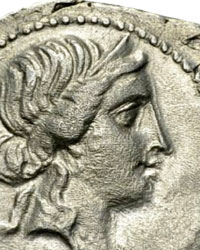
Roman Republic. Julius Caesar. Denarius 48-47 a.C


Experienced antique appraiser specialising in Spanish coins with deep knowledge of ancient currency.
| €700 | ||
|---|---|---|
| €650 | ||
| €600 | ||
Catawiki Buyer Protection
Your payment’s safe with us until you receive your object.View details
Trustpilot 4.4 | 130109 reviews
Rated Excellent on Trustpilot.
Julius Caesar denarius in silver (AR) from 48–47 BC, minted in Africa, weighing 3.52 g with a 17.46 mm diameter, obverse depicting Venus wearing a diadem and perlitic edge, reverse showing Aeneas carrying Anchises with Palladium.
Description from the seller
Julius Caesar, 48–47 B.C. – Silver denarius (AR), African mint. Weight: 3.52 g. Diameter: 17.46 mm.
Obv: Venus’s head to the right, wearing a diadem, edge beaded.
Rev: CAESAR. Aeneas walking, with Ascanius on his shoulders and Palladium in his right hand, edge beaded.
Condition: Good Very Fine.
This issue directly recalls the mythical roots of the gens Iulia, to which Julius Caesar belonged. The presence of Venus is not accidental: the goddess was considered the divine ancestress of the family, through her son Aeneas. In this way Caesar does not merely evoke divine protection, but asserts an almost sacred legitimization of his power. The choice of this subject conveys a precise political message: Caesar’s command is not only the fruit of military strength, but fits into a line of descent tracing back to the gods themselves, reinforcing his prestige in the eyes of soldiers and citizens.
The reverse with Aeneas carrying Ascanius and Palladium represents one of the foundational moments of the Roman tradition. Aeneas embodies pietas, duty toward family, the gods, and fate. Carrying his father symbolizes the continuity of the lineage, while Palladium, a sacred Trojan object, represents the transmission of legitimacy and divine protection to future Rome. In this image lies the idea of Rome as the direct heir of Trojan civilization: by associating with Aeneas, Caesar presents himself as guarantor of Rome’s continuity and historical destiny.
Historically, this denarius is closely tied to the Civil War against Pompey. Minted in Africa, it reflects a crucial moment when Caesar needed resources to support his military campaigns. These coins were not merely economic tools, but true means of propaganda: they circulated among the legions and in the territories under his control, spreading the political message of their issuer. Owning a specimen from this series means possessing an object that participated directly in the events leading to the end of the Roman Republic.
This coin represents an extraordinary meeting point between myth, politics, and history. It is not just a silver denarius, but a tangible document of the rise of one of the most influential figures in Western history who inspired emperors and dictators for centuries, shaping the very form of empires in history. The combination of symbolic iconography, military context, and Caesar’s figure makes this specimen particularly sought after: a concrete testimony to Rome’s transformation from Republic to a system ruled by a personal power embodied precisely by Julius Caesar.
Julius Caesar, 48–47 B.C. – Silver denarius (AR), African mint. Weight: 3.52 g. Diameter: 17.46 mm.
Obv: Venus’s head to the right, wearing a diadem, edge beaded.
Rev: CAESAR. Aeneas walking, with Ascanius on his shoulders and Palladium in his right hand, edge beaded.
Condition: Good Very Fine.
This issue directly recalls the mythical roots of the gens Iulia, to which Julius Caesar belonged. The presence of Venus is not accidental: the goddess was considered the divine ancestress of the family, through her son Aeneas. In this way Caesar does not merely evoke divine protection, but asserts an almost sacred legitimization of his power. The choice of this subject conveys a precise political message: Caesar’s command is not only the fruit of military strength, but fits into a line of descent tracing back to the gods themselves, reinforcing his prestige in the eyes of soldiers and citizens.
The reverse with Aeneas carrying Ascanius and Palladium represents one of the foundational moments of the Roman tradition. Aeneas embodies pietas, duty toward family, the gods, and fate. Carrying his father symbolizes the continuity of the lineage, while Palladium, a sacred Trojan object, represents the transmission of legitimacy and divine protection to future Rome. In this image lies the idea of Rome as the direct heir of Trojan civilization: by associating with Aeneas, Caesar presents himself as guarantor of Rome’s continuity and historical destiny.
Historically, this denarius is closely tied to the Civil War against Pompey. Minted in Africa, it reflects a crucial moment when Caesar needed resources to support his military campaigns. These coins were not merely economic tools, but true means of propaganda: they circulated among the legions and in the territories under his control, spreading the political message of their issuer. Owning a specimen from this series means possessing an object that participated directly in the events leading to the end of the Roman Republic.
This coin represents an extraordinary meeting point between myth, politics, and history. It is not just a silver denarius, but a tangible document of the rise of one of the most influential figures in Western history who inspired emperors and dictators for centuries, shaping the very form of empires in history. The combination of symbolic iconography, military context, and Caesar’s figure makes this specimen particularly sought after: a concrete testimony to Rome’s transformation from Republic to a system ruled by a personal power embodied precisely by Julius Caesar.