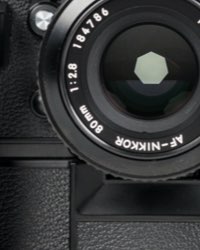
Nikon F5 Analogue camera


08
days
19
hours
19
minutes
25
seconds
Current bid
€ 35
Reserve price not met

Expert
Selected by Edwin Molenaar
Has over 15 years' experience in photography and camera building, formerly a trader.
Estimate € 500 - € 550
19 other people are watching this object
 Bidder 6858 Bidder 6858 | €35 | |
|---|---|---|
 Bidder 2500 Bidder 2500 | €30 | |
 Bidder 6377 Bidder 6377 | €5 |
Catawiki Buyer Protection
Your payment’s safe with us until you receive your object.View details
Trustpilot 4.4 | 129956 reviews
Rated Excellent on Trustpilot.
The Nikon F5 35 mm film SLR, in good physical condition and tested and working, features a robust professional-grade body with integrated vertical grip and compatibility with Nikon AI/AIs lenses.
AI-assisted summary
Description from the seller
The Nikon F5 is a professional 35 mm film SLR introduced in the mid-1990s by Nikon. It was designed as the definitive tool for the professional photographer, representing one of the high points of the evolution of analog SLRs before the arrival of the digital era.
The body is heavy, exceptionally robust and weather-sealed, built to withstand challenging conditions. The vertical grip is integrated, with duplicate controls for vertical shooting, making it ergonomic and balanced even with heavy lenses. The aesthetic is functional and modern, with defined lines and a total focus on operability.
Technically, the F5 introduces an advanced autofocus system for its era, fast and precise, capable of reliably tracking moving subjects. The metering system is among the most sophisticated ever implemented on a film camera, able to analyze the scene intelligently and provide extremely accurate results.
The film advance motor is integrated and very fast, allowing rapid bursts typical of sports and reportage photography. Everything is designed for speed and responsiveness, without compromising full manual control.
Compatibility with Nikon’s extensive range of lenses is one of its strengths: it can use a wide variety of lenses, offering great creative flexibility. The viewfinder is bright and covers virtually 100% of the frame, enabling precise composition control.
The interface combines physical buttons and an LCD display, providing quick access to settings without slowing down the workflow. Despite the technological complexity, the camera remains intuitive for those accustomed to professional tools.
The Nikon F5 is today considered one of the best analog SLRs ever built: powerful, reliable and complete, it represents the pinnacle of film photography in terms of performance and engineering.
The Nikon F5 is a professional 35 mm film SLR introduced in the mid-1990s by Nikon. It was designed as the definitive tool for the professional photographer, representing one of the high points of the evolution of analog SLRs before the arrival of the digital era.
The body is heavy, exceptionally robust and weather-sealed, built to withstand challenging conditions. The vertical grip is integrated, with duplicate controls for vertical shooting, making it ergonomic and balanced even with heavy lenses. The aesthetic is functional and modern, with defined lines and a total focus on operability.
Technically, the F5 introduces an advanced autofocus system for its era, fast and precise, capable of reliably tracking moving subjects. The metering system is among the most sophisticated ever implemented on a film camera, able to analyze the scene intelligently and provide extremely accurate results.
The film advance motor is integrated and very fast, allowing rapid bursts typical of sports and reportage photography. Everything is designed for speed and responsiveness, without compromising full manual control.
Compatibility with Nikon’s extensive range of lenses is one of its strengths: it can use a wide variety of lenses, offering great creative flexibility. The viewfinder is bright and covers virtually 100% of the frame, enabling precise composition control.
The interface combines physical buttons and an LCD display, providing quick access to settings without slowing down the workflow. Despite the technological complexity, the camera remains intuitive for those accustomed to professional tools.
The Nikon F5 is today considered one of the best analog SLRs ever built: powerful, reliable and complete, it represents the pinnacle of film photography in terms of performance and engineering.
Details
Era
1900-2000
Brand
Nikon
Model/type nr
F5
Physical condition
Good
Functional condition
Tested and working
Lens Mount Type
Nikon AI / AIs
Film type
35mm
Estimated period
1990-2000
Sold by