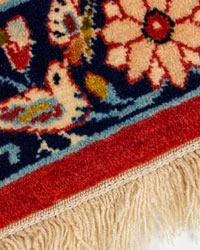
Derbent - Rug - 230 cm - 124 cm - Carpet


Opens tomorrow
Starting bid
€ 1
Add to your favourites to get an alert when the auction starts.

Expert
Selected by Richard Ebbers
Certified appraiser at Federation TMV with 30 years' professional antiques experience.
Estimate € 700 - € 800
Catawiki Buyer Protection
Your payment’s safe with us until you receive your object.View details
Trustpilot 4.4 | 130932 reviews
Rated Excellent on Trustpilot.
Description from the seller
Derbent, Russia
Hand-knotted wool Oriental runner rug, with three central medallions, on a red and beige background with floral borders.
Sold with its certificate of authenticity.
Derbent (Derbent rug): hand-knotted rugs with geometric motifs made in the city of Derbent and its surroundings, in Dagestan, in the northeast Caucasus. Rugs made before 1925 are distinguished from others by a longer pile, fewer colors, and a looser, thicker knot.
When we speak of Caucasian carpets, we refer to carpets originating from the regions located south, east, and north of the Caucasus Mountain range. The rugs before 1925 are divided into five groups: Kazakh, Karabakh, Shirvan, Kuba, and Dagestani carpets. Karabakh region carpets often have soft motifs and resemble Persian carpets. Besides this classification, there are also Gandja, Sile, and Verni carpets. These rugs are distinguished by their highly varied and imaginative geometric motifs. Sometimes stylized animal figures or motifs can be seen.
The older Caucasian carpets are made from hand-spun wool yarn for the warp, the weft, and the pile. Natural colors are as bright as they are durable. Thanks to good-quality wool and the Turkish knot, the carpets are durable and have a good reputation.
Derbent, Russia
Hand-knotted wool Oriental runner rug, with three central medallions, on a red and beige background with floral borders.
Sold with its certificate of authenticity.
Derbent (Derbent rug): hand-knotted rugs with geometric motifs made in the city of Derbent and its surroundings, in Dagestan, in the northeast Caucasus. Rugs made before 1925 are distinguished from others by a longer pile, fewer colors, and a looser, thicker knot.
When we speak of Caucasian carpets, we refer to carpets originating from the regions located south, east, and north of the Caucasus Mountain range. The rugs before 1925 are divided into five groups: Kazakh, Karabakh, Shirvan, Kuba, and Dagestani carpets. Karabakh region carpets often have soft motifs and resemble Persian carpets. Besides this classification, there are also Gandja, Sile, and Verni carpets. These rugs are distinguished by their highly varied and imaginative geometric motifs. Sometimes stylized animal figures or motifs can be seen.
The older Caucasian carpets are made from hand-spun wool yarn for the warp, the weft, and the pile. Natural colors are as bright as they are durable. Thanks to good-quality wool and the Turkish knot, the carpets are durable and have a good reputation.
Details
Era
After 2000
Title additional information
Carpet
Number of objects
1
Model
Derbent
Colour
Multicolour
Length
230 cm
Width
124 cm
Material
Wool on cotton
Country of origin
Russia
Condition
In very good condition
Professionally cleaned
Yes
Manufacturing period
Late 20th century
Weight
12 kg
Sold by