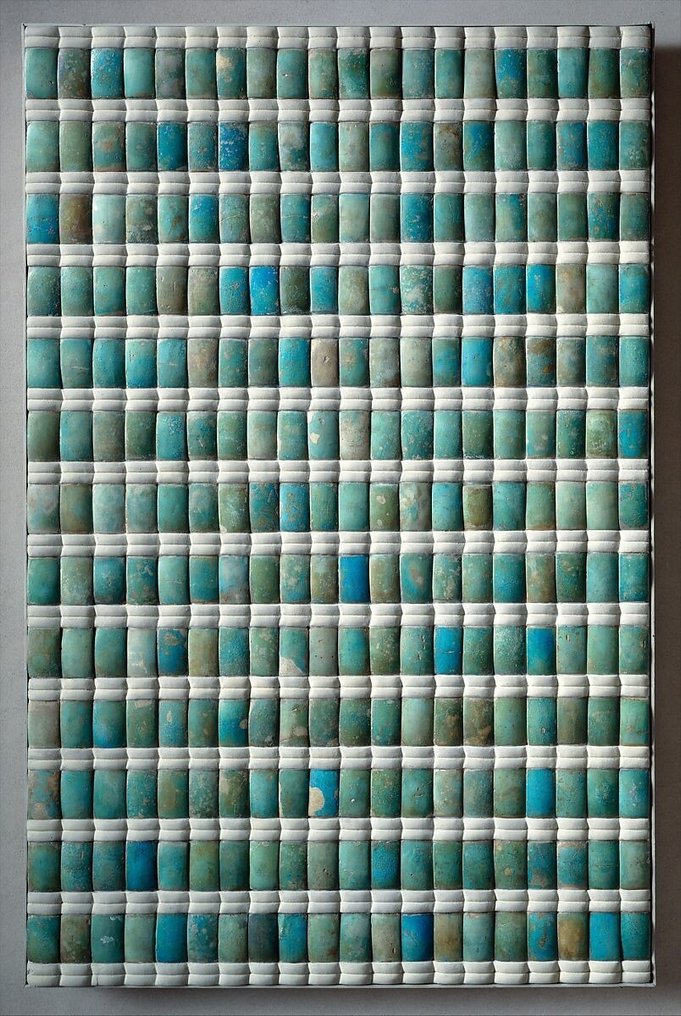
Ancient Egypt, Old Kingdom Faience Djoser's Pyramid funerary Tile. 5,7 cm H. From a Royal collection.



01
day
14
hours
37
minutes
46
seconds
Current bid
€ 345
Reserve price not met

Expert
Selected by Ruth Garrido Vila
Directed the Ifergan Collection Museum, specialising in Phoenician and Mediterranean archaeology.
Estimate € 750 - € 850
27 other people are watching this object
 Bidder 3189 Bidder 3189 | €345 | |
|---|---|---|
 Bidder 0657 Bidder 0657 | €325 | |
 Bidder 8228 Bidder 8228 | €310 | |
Catawiki Buyer Protection
Your payment’s safe with us until you receive your object.View details
Trustpilot 4.4 | 121798 reviews
Rated Excellent on Trustpilot.
Djoser's Pyramid funerary tile in faience from Saqqara's Old Kingdom, c. 2682–2663 BC, from a royal Qatar collection with authentic provenance.
AI-assisted summary
Description from the seller
From the royal Qatari collection!
Wall tile from the funerary apartments of king Djoser.
From Saqqara, Djoser Pyramid precinct.
- royal tomb -
- first pyramid -
Faience.
Ancient Egypt, Old Kingdom, Reign of Djoser. c. 2682 - 2663 BC.
Faience
5,7 cm H.
CONDITION: Good condition, see photos.
PROVENANCE: Private collection of Prince Saud bin Muhammad bin Ali bin Abdullah bin Jassim bin Muhammed Al Thani (28 February 1966 – 9 November 2014), who served as minister of Culture, Arts and Heritage of Qatar. Subsequently, inherited by his heirs until 2024.
DOCUMENTS: Provided of a certificate of authenticity and export license by the Ministry of Culture.
DESCRIPTION:
Djoser was the first king of 3rd Dynasty at the beginning of the Old Kingdom. His Step Pyramid and the surrounding mostly solid dummy structures are the earliest preserved stone buildings in Egypt. They represent an attempt to create an eternal royal residence of durable materials for the afterlife.
Tiles mounted between sculpted limestone ledges decorated the walls of the galleries underneath Djoser's Step Pyramid and underneath a building in his complex called the Southern Tomb. The decoration was meant to imitate the reed matting that covered the walls of his palace.
The marks on the backs of the tiles they have an unknown meaning. Perhaps they refer to the manufacturing group or unit.
The most impressive monument of Saqqara is the Step Pyramid, the final resting place for Hor Netjerykhet (known to the later generations as Djoser) built by an architect and polymath Imhotep. The world’s first pyramid is surrounded with an array of structures enclosed by a towering, 10 m high limestone wall and encircled by the Dry Moat – a vast rock-cut trench. It is here, on the western side of the complex and between the enclosure wall and the Dry Moat, where the excavation site is situated. In the morning, we start our work in a comfortable shadow cast by the Step Pyramid, which shifts away by the noon time, but the pyramid is always present, as it has been since almost five millennia.
Unsurprisingly, evidence of 3rd Dynasty activity on the site is omnipresent: from the remains of the Netjerykhet’s enclosure wall – which marks the eastern limit of our excavations, through the traces of a quarry that yielded stone for the complex, and the Dry Moat, as well as numerous small objects – such as fragments of ‘boundary stelae’ or blue faience tiles that decorated chambers under the pyramid.
Provenance:
Once widely regarded as the world’s richest and most powerful art collector, Saud bin Muhammad bin Ali bin Abdullah bin Jassim bin Muhammed Al Thani (28 February 1966 – 9 November 2014) was a Qatari prince who served as minister of Culture, Arts and Heritage of Qatar,
By the turn of the 21st century, Shaikh Sa’ud had established an international reputation as an avid art collector, both for his own collection as well as those of several state-owned museums he oversaw in Qatar.
As Minister of Culture, Arts, and Heritage from 1997, he was entrusted with creating the collections to fill an ambitious program of world-class museums in Qatar, including a Museum of Islamic Art a combined Qatar National Library and Natural History Museum, a Museum of Photography, and a Museum of Traditional Clothes & Textiles.
Sheik Saud, the cousin of the Qatar’s current Emir, Sheikh Al-Thani served as the country’s president of the National Council for Culture, Arts and Heritage, from 1997 to 2005 he spent well over $1 billion on art purchases during that period, more than any other individual, according to many art-market observers.
Notes:
- The piece includes authenticity certificate.
- The piece includes Spanish Export License (Passport for European Union) - If the piece is destined outside the European Union a substitution of the export permit should be requested, can take between 1-2 weeks maximum.
- The seller guarantees that he acquired this piece according to all national and international laws related to the ownership of cultural property. Provenance statement seen by Catawiki.
Seller's Story
Gallery of Ancient Art - Archeology based in Barcelona with more than fifteen years of experience. Specialized in classical art, Egyptian art, Asian art and pre-Columbian art. It guarantees the authenticity of all its pieces. It participates in the most important art fairs in Spain, such as Feriarte, as well as in fairs abroad, BRAFA, Parcours des Mondes, Cultures Brussels.
All the pieces are sent with an Export Permit issued by the Spanish Ministry of Culture.
We are quick to ship via DHL Express or Direct Art Transport.
Translated by Google TranslateFrom the royal Qatari collection!
Wall tile from the funerary apartments of king Djoser.
From Saqqara, Djoser Pyramid precinct.
- royal tomb -
- first pyramid -
Faience.
Ancient Egypt, Old Kingdom, Reign of Djoser. c. 2682 - 2663 BC.
Faience
5,7 cm H.
CONDITION: Good condition, see photos.
PROVENANCE: Private collection of Prince Saud bin Muhammad bin Ali bin Abdullah bin Jassim bin Muhammed Al Thani (28 February 1966 – 9 November 2014), who served as minister of Culture, Arts and Heritage of Qatar. Subsequently, inherited by his heirs until 2024.
DOCUMENTS: Provided of a certificate of authenticity and export license by the Ministry of Culture.
DESCRIPTION:
Djoser was the first king of 3rd Dynasty at the beginning of the Old Kingdom. His Step Pyramid and the surrounding mostly solid dummy structures are the earliest preserved stone buildings in Egypt. They represent an attempt to create an eternal royal residence of durable materials for the afterlife.
Tiles mounted between sculpted limestone ledges decorated the walls of the galleries underneath Djoser's Step Pyramid and underneath a building in his complex called the Southern Tomb. The decoration was meant to imitate the reed matting that covered the walls of his palace.
The marks on the backs of the tiles they have an unknown meaning. Perhaps they refer to the manufacturing group or unit.
The most impressive monument of Saqqara is the Step Pyramid, the final resting place for Hor Netjerykhet (known to the later generations as Djoser) built by an architect and polymath Imhotep. The world’s first pyramid is surrounded with an array of structures enclosed by a towering, 10 m high limestone wall and encircled by the Dry Moat – a vast rock-cut trench. It is here, on the western side of the complex and between the enclosure wall and the Dry Moat, where the excavation site is situated. In the morning, we start our work in a comfortable shadow cast by the Step Pyramid, which shifts away by the noon time, but the pyramid is always present, as it has been since almost five millennia.
Unsurprisingly, evidence of 3rd Dynasty activity on the site is omnipresent: from the remains of the Netjerykhet’s enclosure wall – which marks the eastern limit of our excavations, through the traces of a quarry that yielded stone for the complex, and the Dry Moat, as well as numerous small objects – such as fragments of ‘boundary stelae’ or blue faience tiles that decorated chambers under the pyramid.
Provenance:
Once widely regarded as the world’s richest and most powerful art collector, Saud bin Muhammad bin Ali bin Abdullah bin Jassim bin Muhammed Al Thani (28 February 1966 – 9 November 2014) was a Qatari prince who served as minister of Culture, Arts and Heritage of Qatar,
By the turn of the 21st century, Shaikh Sa’ud had established an international reputation as an avid art collector, both for his own collection as well as those of several state-owned museums he oversaw in Qatar.
As Minister of Culture, Arts, and Heritage from 1997, he was entrusted with creating the collections to fill an ambitious program of world-class museums in Qatar, including a Museum of Islamic Art a combined Qatar National Library and Natural History Museum, a Museum of Photography, and a Museum of Traditional Clothes & Textiles.
Sheik Saud, the cousin of the Qatar’s current Emir, Sheikh Al-Thani served as the country’s president of the National Council for Culture, Arts and Heritage, from 1997 to 2005 he spent well over $1 billion on art purchases during that period, more than any other individual, according to many art-market observers.
Notes:
- The piece includes authenticity certificate.
- The piece includes Spanish Export License (Passport for European Union) - If the piece is destined outside the European Union a substitution of the export permit should be requested, can take between 1-2 weeks maximum.
- The seller guarantees that he acquired this piece according to all national and international laws related to the ownership of cultural property. Provenance statement seen by Catawiki.
Seller's Story
Gallery of Ancient Art - Archeology based in Barcelona with more than fifteen years of experience. Specialized in classical art, Egyptian art, Asian art and pre-Columbian art. It guarantees the authenticity of all its pieces. It participates in the most important art fairs in Spain, such as Feriarte, as well as in fairs abroad, BRAFA, Parcours des Mondes, Cultures Brussels.
All the pieces are sent with an Export Permit issued by the Spanish Ministry of Culture.
We are quick to ship via DHL Express or Direct Art Transport.
Translated by Google TranslateDetails
Culture
Ancient Egypt, Old Kingdom
Century/ Timeframe
Reign of Djoser. c. 2682 - 2663 BC.
Name of object
Djoser's Pyramid funerary Tile. 5,7 cm H. From a Royal collection.
Acquired from
Auction house
Year acquired
2024
Material
Faience
Country acquired from
United Kingdom
Condition
Very good
Previous owner acquired from
Private collection
Previous owner - year acquired
1980
Previous owner - country acquired from
Qatar
I verify that I have obtained this object legally and that I am allowed to sell it
Yes
Disclaimer
The seller was informed by Catawiki about documentation requirements and guarantees the following: - the object was legally obtained, - the seller has the right to sell and/or export the object, as relevant, - the seller will provide the necessary provenance information and arrange required documentation and permits/licenses, as applicable and as per local laws, - the seller will notify the buyer of any delays in obtaining permits/licenses. By bidding, you acknowledge that import documentation may be required depending on your country of residence and that obtaining permits/licenses may cause delays in the delivery of your object.
The seller was informed by Catawiki about documentation requirements and guarantees the following: - the object was legally obtained, - the seller has the right to sell and/or export the object, as relevant, - the seller will provide the necessary provenance information and arrange required documentation and permits/licenses, as applicable and as per local laws, - the seller will notify the buyer of any delays in obtaining permits/licenses. By bidding, you acknowledge that import documentation may be required depending on your country of residence and that obtaining permits/licenses may cause delays in the delivery of your object.
