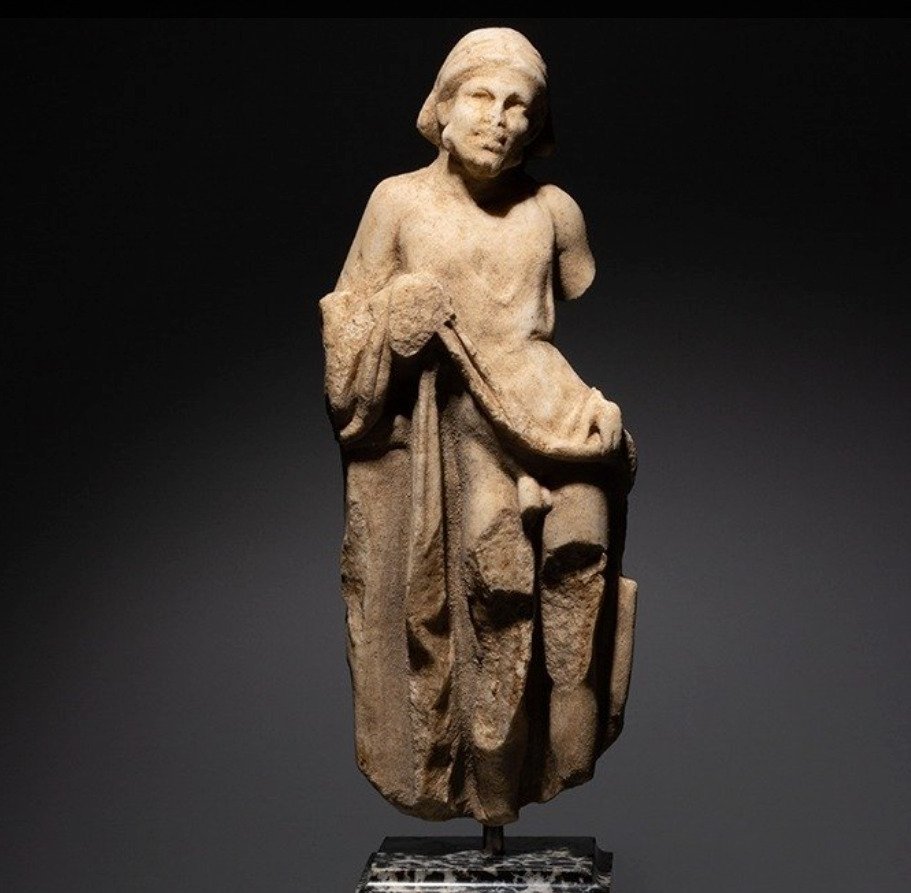
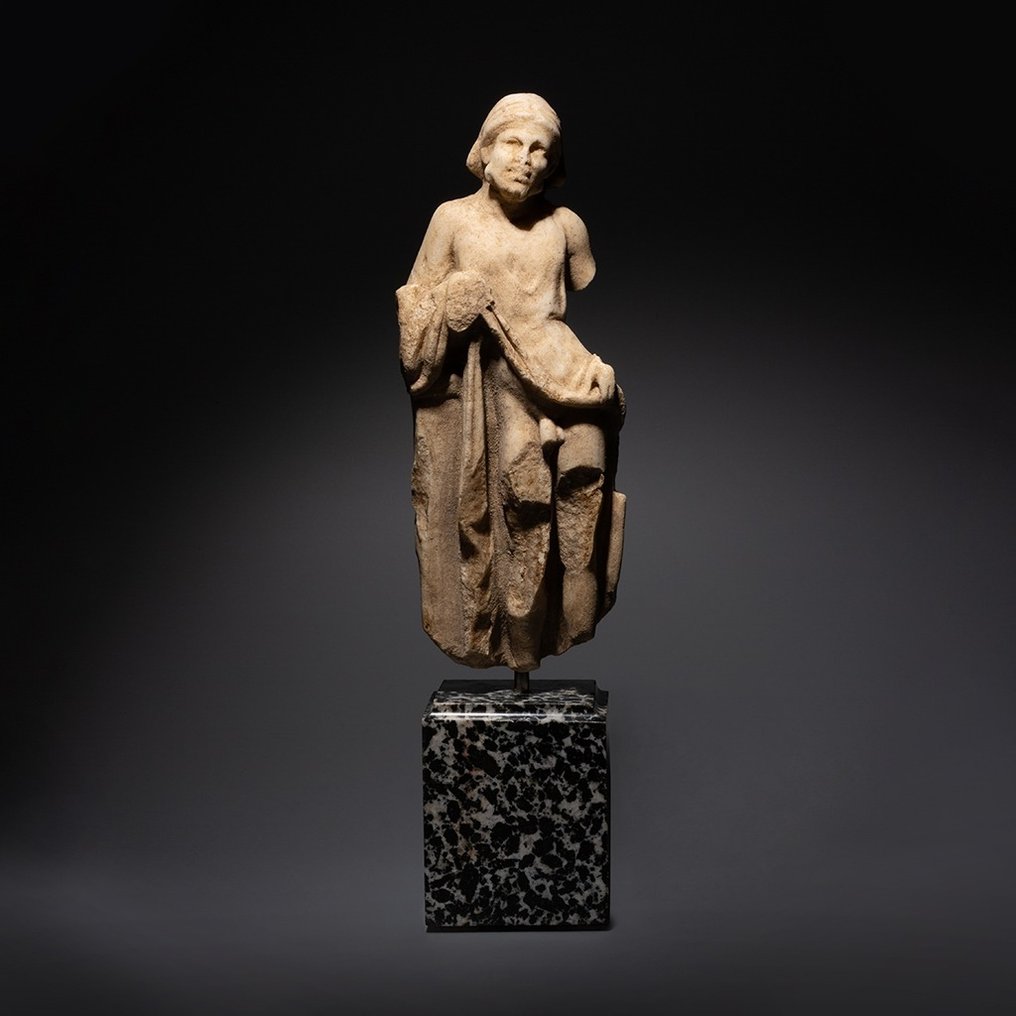
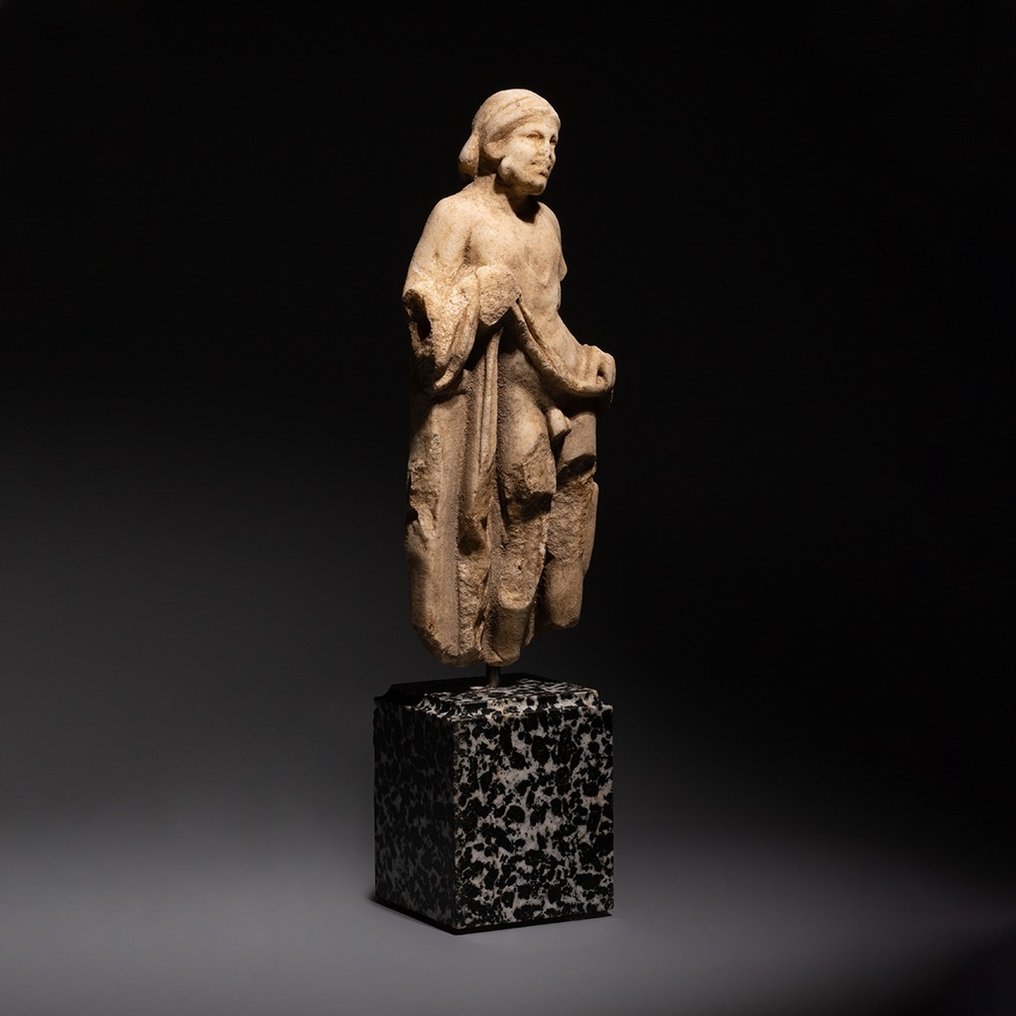
Ancient Greek Marble Priapus Sculpture. 2nd - 1st century BC. 24 cm height. Spanish Export License


07
days
03
hours
01
minute
30
seconds
Current bid
€ 160
Reserve price not met

Expert
Selected by Ruth Garrido Vila
Directed the Ifergan Collection Museum, specialising in Phoenician and Mediterranean archaeology.
Estimate € 10,500 - € 11,600
19 other people are watching this object
 Bidder 7837 Bidder 7837 | €160 | |
|---|---|---|
 Bidder 4277 Bidder 4277 | €150 |
Catawiki Buyer Protection
Your payment’s safe with us until you receive your object.View details
Trustpilot 4.4 | 123759 reviews
Rated Excellent on Trustpilot.
Ancient Greek Priapus sculpture, marble, dating to the 2nd–1st century BC, about 24 cm in height, unrestored with natural patina, provenance from a private collection and supplied with a Spanish export license.
AI-assisted summary
Description from the seller
Priapus sculpture.
- Important! -
- Unique! -
Greek Hellenistic, 2nd - 1st century BC
Marble
24 cm Height (without stand)
PROVENANCE: Private collection, London, acquired 1960s - 1980s.
CONDITION: Unrestored, as found. Untouched natural patina.
DESCRIPTION:
Depicted standing, resting on a pillar, in the act of lifting the robe, discovering the genitals; the head is wrapped in a drape and a flap-like extensions beneath the chin representing a cock’s wattle. This rather unique figure of Priapus finds some paralels on groups such as the statue in Berlin which shows the head of the maenad, found before 1872 on the Quirinal near the Piazza Barberini, and a second in the National Museum at Athens where the head of Priapus is preserved. Cf. M. B. Comstock and C. C. Vermeule, Sculpture in Stone, The Greek, Roman and Etruscan collections of the Museum of Fine Arts Boston, Boston, 1976, p. 127, no. 196, for a similar Graeco-Roman group.
We did not found direct paralels for this sculpture since it was never copied in mass scale in roman times, that fact makes this sculpture very unique and unparalllel and a new form of the known corpus of images of Priapus.
Priapus was described in varying sources as the son of Aphrodite by Dionysus; as the son of Dionysus and Chione; as perhaps the father or son of Hermes; or as the son of Zeus or Pan. According to legend, Hera cursed him with inconvenient impotence (he could not sustain an erection when the time came for sexual intercourse), ugliness and foul-mindedness while he was still in Aphrodite's womb, in revenge for the hero Paris having the temerity to judge Aphrodite more beautiful than Hera. The other gods refused to allow him to live on Mount Olympus and threw him down to Earth, leaving him on a hillside. He was eventually found by shepherds and was brought up by them.
Priapus joined Pan and the satyrs as a spirit of fertility and growth, though he was perennially frustrated by his impotence. In a ribald anecdote told by Ovid, he attempted to rape the goddess Hestia but was thwarted by an ass, whose braying caused him to lose his erection at the critical moment and woke Hestia. The episode gave him a lasting hatred of asses and a willingness to see them killed in his honour. The emblem of his lustful nature was his permanent erection and his large penis.
The first extant mention of Priapus is in the eponymous comedy Priapus, written in the 4th century BC by Xenarchus. Originally worshipped by Greek colonists in Lampsacus in Asia Minor, the cult of Priapus spread to mainland Greece and eventually to Italy during the 3rd century BC. Lucian (De saltatione) tells that in Bithynia Priapus was accounted as a warlike god, a rustic tutor to the infant Ares, "who taught him dancing first and war only afterwards," Karl Kerenyi observed. Arnobius is aware of the importance accorded Priapus in this region near the Hellespont. Also, Pausanias notes:
This god is worshipped where goats and sheep pasture or there are swarms of bees; but by the people of Lampsacus he is more revered than any other god, being called by them a son of Dionysus and Aphrodite.
In later antiquity, his worship meant little more than a cult of sophisticated pornography.
Outside his "home" region in Asia Minor, Priapus was regarded as something of a joke by urban dwellers. However, he played a more important role in the countryside, where he was seen as a guardian deity. He was regarded as the patron god of sailors and fishermen and others in need of luck, and his presence was believed to avert the evil eye.
Priapus does not appear to have had an organized cult and was mostly worshiped in gardens or homes, though there are attestations of temples dedicated to the god. His sacrificial animal was the ass, but agricultural offerings (such as fruit, flowers, vegetables and fish) were also very common.
Notes:
The Seller can prove that the lot was obtained legally , provenance statement seen by Catawiki.
Important information. The seller guarantees that he is entitled to ship this lot.
The piece includes authenticity certificate.
The piece includes Spanish Export License (Passport for European Union) - If the piece is destined outside the European Union a substitution of the export permit should be requested.
#MasterpiecesW39
Seller's Story
Gallery of Ancient Art - Archeology based in Barcelona with more than fifteen years of experience. Specialized in classical art, Egyptian art, Asian art and pre-Columbian art. It guarantees the authenticity of all its pieces. It participates in the most important art fairs in Spain, such as Feriarte, as well as in fairs abroad, BRAFA, Parcours des Mondes, Cultures Brussels.
All the pieces are sent with an Export Permit issued by the Spanish Ministry of Culture.
We are quick to ship via DHL Express or Direct Art Transport.
Translated by Google TranslatePriapus sculpture.
- Important! -
- Unique! -
Greek Hellenistic, 2nd - 1st century BC
Marble
24 cm Height (without stand)
PROVENANCE: Private collection, London, acquired 1960s - 1980s.
CONDITION: Unrestored, as found. Untouched natural patina.
DESCRIPTION:
Depicted standing, resting on a pillar, in the act of lifting the robe, discovering the genitals; the head is wrapped in a drape and a flap-like extensions beneath the chin representing a cock’s wattle. This rather unique figure of Priapus finds some paralels on groups such as the statue in Berlin which shows the head of the maenad, found before 1872 on the Quirinal near the Piazza Barberini, and a second in the National Museum at Athens where the head of Priapus is preserved. Cf. M. B. Comstock and C. C. Vermeule, Sculpture in Stone, The Greek, Roman and Etruscan collections of the Museum of Fine Arts Boston, Boston, 1976, p. 127, no. 196, for a similar Graeco-Roman group.
We did not found direct paralels for this sculpture since it was never copied in mass scale in roman times, that fact makes this sculpture very unique and unparalllel and a new form of the known corpus of images of Priapus.
Priapus was described in varying sources as the son of Aphrodite by Dionysus; as the son of Dionysus and Chione; as perhaps the father or son of Hermes; or as the son of Zeus or Pan. According to legend, Hera cursed him with inconvenient impotence (he could not sustain an erection when the time came for sexual intercourse), ugliness and foul-mindedness while he was still in Aphrodite's womb, in revenge for the hero Paris having the temerity to judge Aphrodite more beautiful than Hera. The other gods refused to allow him to live on Mount Olympus and threw him down to Earth, leaving him on a hillside. He was eventually found by shepherds and was brought up by them.
Priapus joined Pan and the satyrs as a spirit of fertility and growth, though he was perennially frustrated by his impotence. In a ribald anecdote told by Ovid, he attempted to rape the goddess Hestia but was thwarted by an ass, whose braying caused him to lose his erection at the critical moment and woke Hestia. The episode gave him a lasting hatred of asses and a willingness to see them killed in his honour. The emblem of his lustful nature was his permanent erection and his large penis.
The first extant mention of Priapus is in the eponymous comedy Priapus, written in the 4th century BC by Xenarchus. Originally worshipped by Greek colonists in Lampsacus in Asia Minor, the cult of Priapus spread to mainland Greece and eventually to Italy during the 3rd century BC. Lucian (De saltatione) tells that in Bithynia Priapus was accounted as a warlike god, a rustic tutor to the infant Ares, "who taught him dancing first and war only afterwards," Karl Kerenyi observed. Arnobius is aware of the importance accorded Priapus in this region near the Hellespont. Also, Pausanias notes:
This god is worshipped where goats and sheep pasture or there are swarms of bees; but by the people of Lampsacus he is more revered than any other god, being called by them a son of Dionysus and Aphrodite.
In later antiquity, his worship meant little more than a cult of sophisticated pornography.
Outside his "home" region in Asia Minor, Priapus was regarded as something of a joke by urban dwellers. However, he played a more important role in the countryside, where he was seen as a guardian deity. He was regarded as the patron god of sailors and fishermen and others in need of luck, and his presence was believed to avert the evil eye.
Priapus does not appear to have had an organized cult and was mostly worshiped in gardens or homes, though there are attestations of temples dedicated to the god. His sacrificial animal was the ass, but agricultural offerings (such as fruit, flowers, vegetables and fish) were also very common.
Notes:
The Seller can prove that the lot was obtained legally , provenance statement seen by Catawiki.
Important information. The seller guarantees that he is entitled to ship this lot.
The piece includes authenticity certificate.
The piece includes Spanish Export License (Passport for European Union) - If the piece is destined outside the European Union a substitution of the export permit should be requested.
#MasterpiecesW39
Seller's Story
Gallery of Ancient Art - Archeology based in Barcelona with more than fifteen years of experience. Specialized in classical art, Egyptian art, Asian art and pre-Columbian art. It guarantees the authenticity of all its pieces. It participates in the most important art fairs in Spain, such as Feriarte, as well as in fairs abroad, BRAFA, Parcours des Mondes, Cultures Brussels.
All the pieces are sent with an Export Permit issued by the Spanish Ministry of Culture.
We are quick to ship via DHL Express or Direct Art Transport.
Translated by Google TranslateDetails
Culture
Ancient Greek
Century/ Timeframe
2nd - 1st century BC
Name of object
Priapus Sculpture. 2nd - 1st century BC. 24 cm height. Spanish Export License
Acquired from
Private collection
Material
Marble
Condition
Good
Disclaimer
The seller was informed by Catawiki about documentation requirements and guarantees the following: - the object was legally obtained, - the seller has the right to sell and/or export the object, as relevant, - the seller will provide the necessary provenance information and arrange required documentation and permits/licenses, as applicable and as per local laws, - the seller will notify the buyer of any delays in obtaining permits/licenses. By bidding, you acknowledge that import documentation may be required depending on your country of residence and that obtaining permits/licenses may cause delays in the delivery of your object.
The seller was informed by Catawiki about documentation requirements and guarantees the following: - the object was legally obtained, - the seller has the right to sell and/or export the object, as relevant, - the seller will provide the necessary provenance information and arrange required documentation and permits/licenses, as applicable and as per local laws, - the seller will notify the buyer of any delays in obtaining permits/licenses. By bidding, you acknowledge that import documentation may be required depending on your country of residence and that obtaining permits/licenses may cause delays in the delivery of your object.
