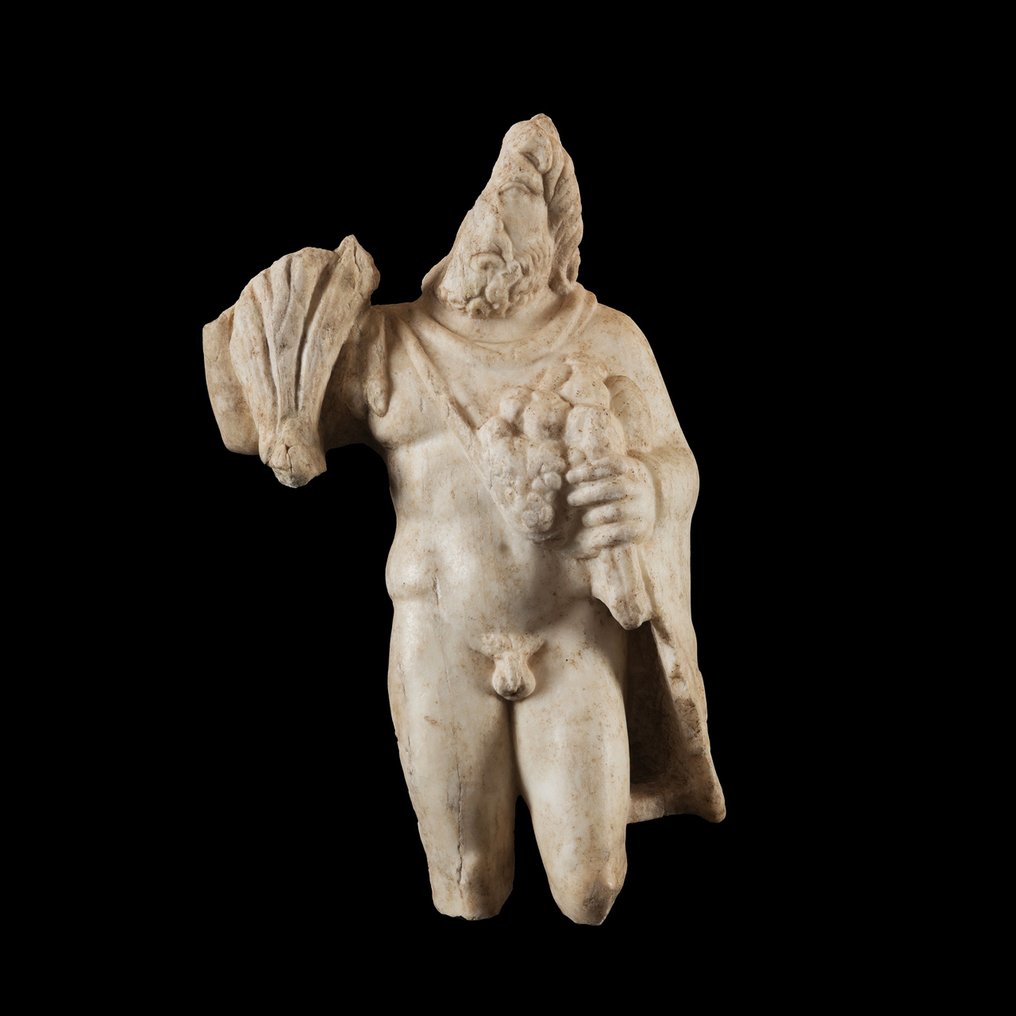
Ancient Roman Marble Sculpture of the God Silvanus. 2nd century AD. 46 cm height. Ex-Christie's



03
days
14
hours
27
minutes
02
seconds
Current bid
€ 100
Reserve price not met

Expert
Selected by Ruth Garrido Vila
Directed the Ifergan Collection Museum, specialising in Phoenician and Mediterranean archaeology.
Estimate € 39,000 - € 44,000
10 other people are watching this object
 Bidder 1528 Bidder 1528 | €100 |
|---|
Catawiki Buyer Protection
Your payment’s safe with us until you receive your object.View details
Trustpilot 4.4 | 123113 reviews
Rated Excellent on Trustpilot.
Ancient Roman marble sculpture of the god Silvanus, 2nd century AD, about 46 cm high, acquired from Christie's in the United States in 2015.
AI-assisted summary
Description from the seller
Sculpture of the God Silvanus.
Ancient Roman, 2nd century AD.
Marble.
46 cm height.
PROVENANCE:
- Private collection, Los Angeles, USA, mid-1990s at Quatrain Inc.
- Christies, London, acquired in New York, 2015.
- Private collection, Madrid.
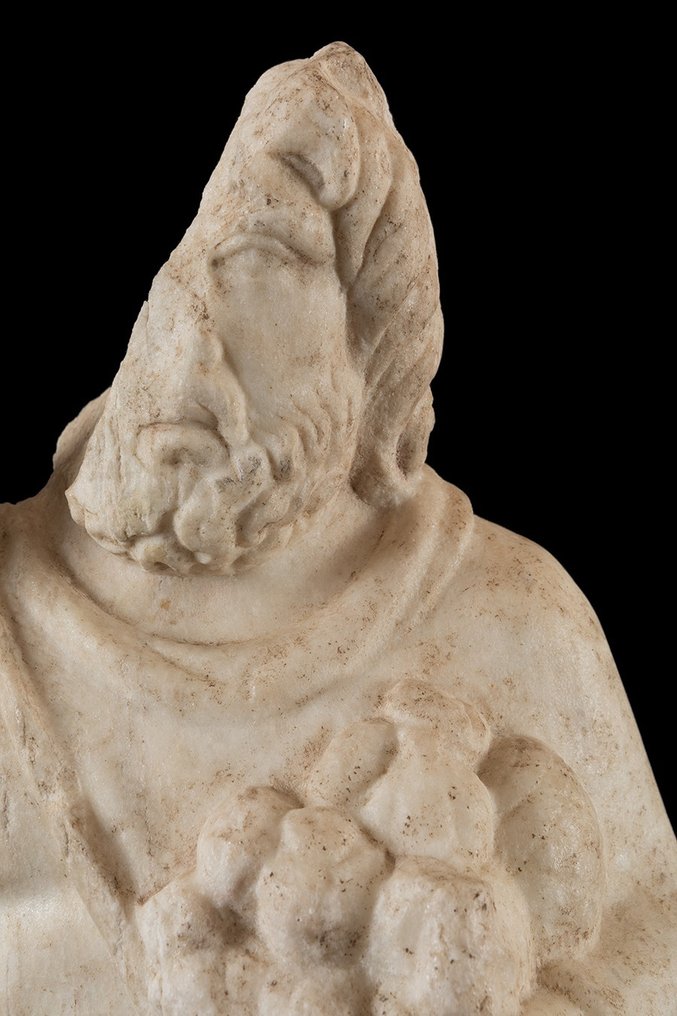
CONDITION: Good condition. He has lost half his head, the lower part of his legs and the cypress trunk that he held in his right hand.
DESCRIPTION:
Round sculpture, possibly as a decoration for a private garden or a domus, of the god Silvanus in his iconic representation. An adult man, with lush hair and a beard, is only dressed in a goat skin, it rests on his left shoulder and crosses his torso and back diagonally, knotted at the right shoulder. The rest of the body is presented nude. With his left forearm, aided by his chest, he supports an array of fruit, his closed hand holds a hatchet. The left arm, mostly missing, rises from the elbow of a cypress trunk (fig. 1). Due to the position of the thighs, a slight contraposto of the legs is intuited (fig. 2). The sculpture would be supported on a more or less circular base. The reverse, especially in the carving of the skin, is outlined and flat, although the buttocks have a good volume and are polished, which denotes that it was destined to be positioned in front of a wall (fig. 3). Noteworthy is the back of the head, worked flat with notches, a sign that the other half was made as a separate piece and fastened with a binder, these marks would help in its fixation.
Silvanus, translates from Latin as "of the woods", in Roman mythology, personified the tutelary spirit of the fields and forests, a genius loci, to whom it is said that in very remote times the Tyrrhenian Pelasgians had dedicated a grove and a festival. He is described as a god who acts over the fields and farmers, he was also considered the protector of the borders of the fields. Hyginus Gromaticus tells that Silvanus was the first to put stones to mark the boundaries of the fields and that each state had three Silvanus: a Silvanus domesticus, a Silvanus agrestis who was worshiped by shepherds, and a Silvanus orientalis, the god who presided over the point at which the state began. For this reason he was often referred to as the Sylvans, in the plural.
In relation to the forests, he especially presided over the plantations and enjoyed the trees that grew wild, for which he is represented carrying the trunk of a cypress. Regarding the cypress, the following story is told: Silvanus, or according to other sources Apollo, was in love with the young Cipariso and once accidentally killed a hind that belonged to him. Cipariso died of grief for it and was transformed into a cypress.
He is also narrated as the patron deity of herds of cattle, which he guards from wolves and whose fertility he promotes. Being passionate about music: the syrinx was consecrated to him and he is mentioned along with the Loaves and the Nymphs. They even identified Silvano with Pan, Fauno, Inuus and Égipan. In Latin poetry, as well as in artistic works, he always appears as an elderly but cheerful man in love with Pomona. The sacrifices offered to him consisted of grapes, ears of wheat, milk, meat, wine and pigs.
PARALLELS:
Fig. 1 Relief of Silvanus. Roman Kingdom, 2nd century AD. Marble. 83 cm high. Musei Capitolini, Rome.
Fig. 2 Sculpture of Silvanus. Roman Kingdom, 1st - 2nd century AD. Marble. 136cm tall. Staatliche Kunstsammlungen, Dresden.
Fig. 3 Niche with the god Sivano in high relief. Roman Kingdom, 1st - 2nd century AD. Marble. 102 cm high. Palazzo Doria-Pamfili, Rome.
Notes:
- The piece includes authenticity certificate.
- The piece includes Spanish Export License (Passport for European Union) - If the piece is destined outside the European Union a substitution of the export permit should be requested, can take between 1-2 weeks maximum.
- The seller guarantees that he acquired this piece according to all national and international laws related to the ownership of cultural property. Provenance statement seen by Catawiki.
#MasterpiecesW39
Seller's Story
Gallery of Ancient Art - Archeology based in Barcelona with more than fifteen years of experience. Specialized in classical art, Egyptian art, Asian art and pre-Columbian art. It guarantees the authenticity of all its pieces. It participates in the most important art fairs in Spain, such as Feriarte, as well as in fairs abroad, BRAFA, Parcours des Mondes, Cultures Brussels.
All the pieces are sent with an Export Permit issued by the Spanish Ministry of Culture.
We are quick to ship via DHL Express or Direct Art Transport.
Translated by Google TranslateSculpture of the God Silvanus.
Ancient Roman, 2nd century AD.
Marble.
46 cm height.
PROVENANCE:
- Private collection, Los Angeles, USA, mid-1990s at Quatrain Inc.
- Christies, London, acquired in New York, 2015.
- Private collection, Madrid.
CONDITION: Good condition. He has lost half his head, the lower part of his legs and the cypress trunk that he held in his right hand.
DESCRIPTION:
Round sculpture, possibly as a decoration for a private garden or a domus, of the god Silvanus in his iconic representation. An adult man, with lush hair and a beard, is only dressed in a goat skin, it rests on his left shoulder and crosses his torso and back diagonally, knotted at the right shoulder. The rest of the body is presented nude. With his left forearm, aided by his chest, he supports an array of fruit, his closed hand holds a hatchet. The left arm, mostly missing, rises from the elbow of a cypress trunk (fig. 1). Due to the position of the thighs, a slight contraposto of the legs is intuited (fig. 2). The sculpture would be supported on a more or less circular base. The reverse, especially in the carving of the skin, is outlined and flat, although the buttocks have a good volume and are polished, which denotes that it was destined to be positioned in front of a wall (fig. 3). Noteworthy is the back of the head, worked flat with notches, a sign that the other half was made as a separate piece and fastened with a binder, these marks would help in its fixation.
Silvanus, translates from Latin as "of the woods", in Roman mythology, personified the tutelary spirit of the fields and forests, a genius loci, to whom it is said that in very remote times the Tyrrhenian Pelasgians had dedicated a grove and a festival. He is described as a god who acts over the fields and farmers, he was also considered the protector of the borders of the fields. Hyginus Gromaticus tells that Silvanus was the first to put stones to mark the boundaries of the fields and that each state had three Silvanus: a Silvanus domesticus, a Silvanus agrestis who was worshiped by shepherds, and a Silvanus orientalis, the god who presided over the point at which the state began. For this reason he was often referred to as the Sylvans, in the plural.
In relation to the forests, he especially presided over the plantations and enjoyed the trees that grew wild, for which he is represented carrying the trunk of a cypress. Regarding the cypress, the following story is told: Silvanus, or according to other sources Apollo, was in love with the young Cipariso and once accidentally killed a hind that belonged to him. Cipariso died of grief for it and was transformed into a cypress.
He is also narrated as the patron deity of herds of cattle, which he guards from wolves and whose fertility he promotes. Being passionate about music: the syrinx was consecrated to him and he is mentioned along with the Loaves and the Nymphs. They even identified Silvano with Pan, Fauno, Inuus and Égipan. In Latin poetry, as well as in artistic works, he always appears as an elderly but cheerful man in love with Pomona. The sacrifices offered to him consisted of grapes, ears of wheat, milk, meat, wine and pigs.
PARALLELS:
Fig. 1 Relief of Silvanus. Roman Kingdom, 2nd century AD. Marble. 83 cm high. Musei Capitolini, Rome.
Fig. 2 Sculpture of Silvanus. Roman Kingdom, 1st - 2nd century AD. Marble. 136cm tall. Staatliche Kunstsammlungen, Dresden.
Fig. 3 Niche with the god Sivano in high relief. Roman Kingdom, 1st - 2nd century AD. Marble. 102 cm high. Palazzo Doria-Pamfili, Rome.
Notes:
- The piece includes authenticity certificate.
- The piece includes Spanish Export License (Passport for European Union) - If the piece is destined outside the European Union a substitution of the export permit should be requested, can take between 1-2 weeks maximum.
- The seller guarantees that he acquired this piece according to all national and international laws related to the ownership of cultural property. Provenance statement seen by Catawiki.
#MasterpiecesW39
Seller's Story
Gallery of Ancient Art - Archeology based in Barcelona with more than fifteen years of experience. Specialized in classical art, Egyptian art, Asian art and pre-Columbian art. It guarantees the authenticity of all its pieces. It participates in the most important art fairs in Spain, such as Feriarte, as well as in fairs abroad, BRAFA, Parcours des Mondes, Cultures Brussels.
All the pieces are sent with an Export Permit issued by the Spanish Ministry of Culture.
We are quick to ship via DHL Express or Direct Art Transport.
Translated by Google TranslateDetails
Culture
Ancient Roman
Century/ Timeframe
2nd century AD
Name of object
Sculpture of the God Silvanus. 2nd century AD. 46 cm height. Ex-Christie's
Acquired from
Auction house
Year acquired
2015
Material
Marble
Country acquired from
United States
Condition
Excellent
Disclaimer
The seller was informed by Catawiki about documentation requirements and guarantees the following: - the object was legally obtained, - the seller has the right to sell and/or export the object, as relevant, - the seller will provide the necessary provenance information and arrange required documentation and permits/licenses, as applicable and as per local laws, - the seller will notify the buyer of any delays in obtaining permits/licenses. By bidding, you acknowledge that import documentation may be required depending on your country of residence and that obtaining permits/licenses may cause delays in the delivery of your object.
The seller was informed by Catawiki about documentation requirements and guarantees the following: - the object was legally obtained, - the seller has the right to sell and/or export the object, as relevant, - the seller will provide the necessary provenance information and arrange required documentation and permits/licenses, as applicable and as per local laws, - the seller will notify the buyer of any delays in obtaining permits/licenses. By bidding, you acknowledge that import documentation may be required depending on your country of residence and that obtaining permits/licenses may cause delays in the delivery of your object.
