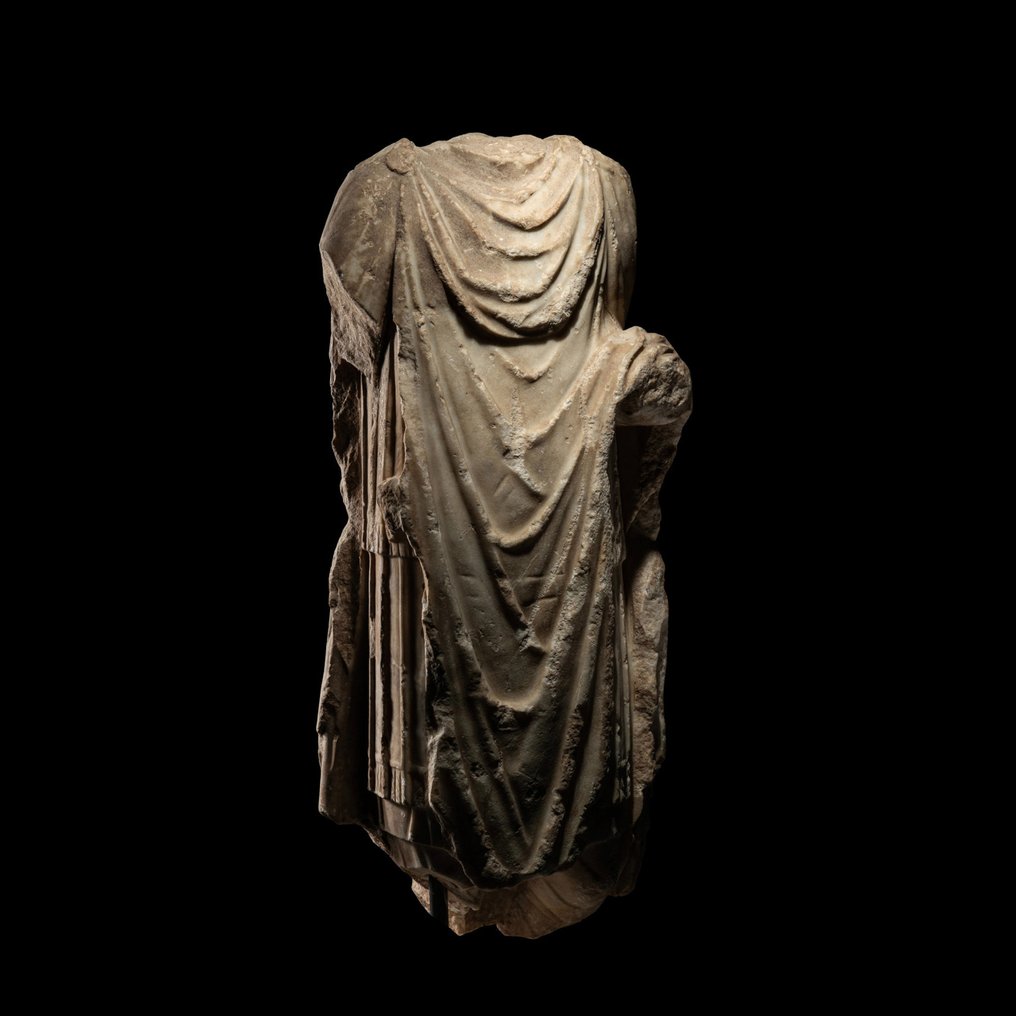
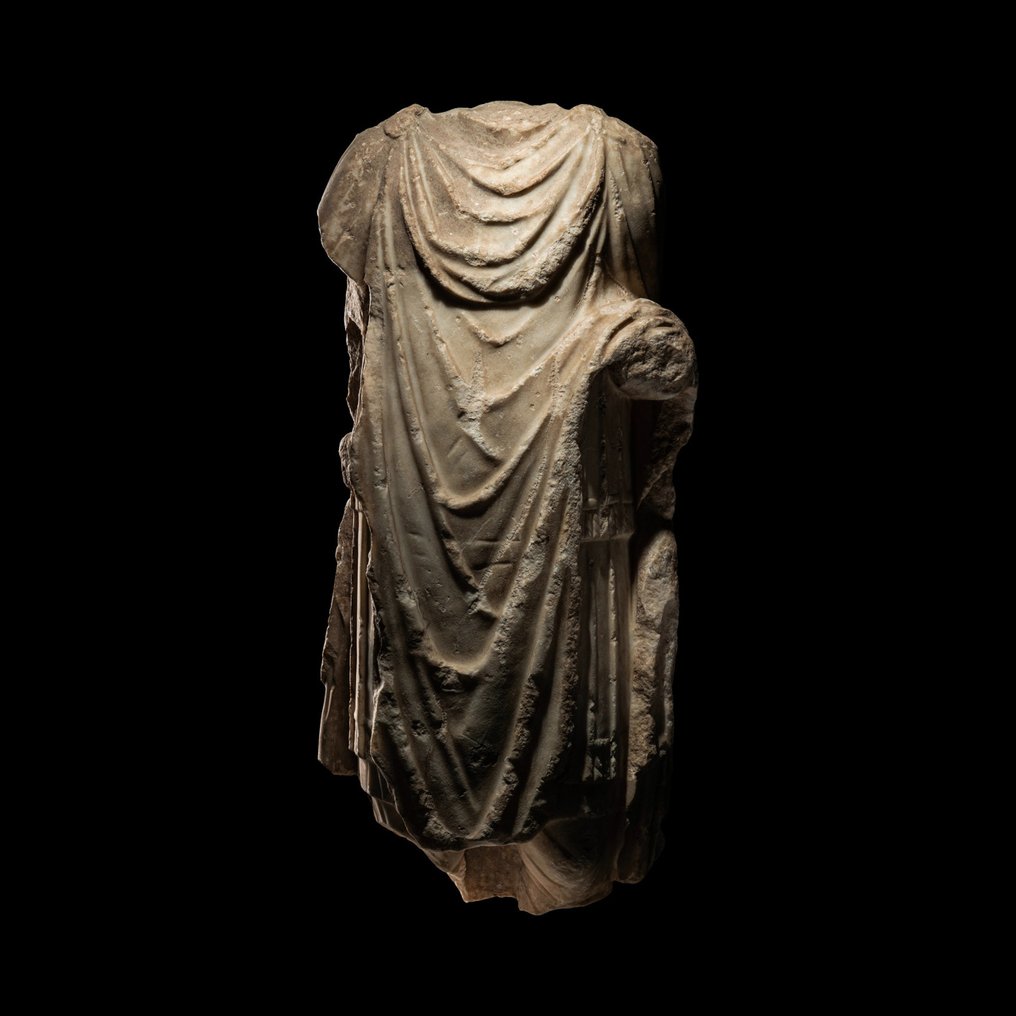
Ancient Roman Marble Torso of a Soldier with Chlamys. 2nd century AD. 71.2 cm height. Published. Spanish Export License.

05
days
17
hours
51
minutes
06
seconds
Current bid
€ 1,100
Reserve price not met

Expert
Selected by Ruth Garrido Vila
Directed the Ifergan Collection Museum, specialising in Phoenician and Mediterranean archaeology.
Estimate € 65,000 - € 75,000
20 other people are watching this object
 Bidder 4603 Bidder 4603 | €1,100 | |
|---|---|---|
 Bidder 9481 Bidder 9481 | €1,000 | |
| Bidder 9481 | €950 | |
Catawiki Buyer Protection
Your payment’s safe with us until you receive your object.View details
Trustpilot 4.4 | 123779 reviews
Rated Excellent on Trustpilot.
Ancient Roman marble life-size torso of a soldier with a chlamys, 2nd century AD, 71.2 cm high, in good condition and published with a Spanish export license.
AI-assisted summary
Description from the seller
Torso of a Soldier with Chlamys.
- Masterpiece! -
- Museum Parallels -
- Published -
Ancient Roman, 2nd century AD.
Marble.
71.2 cm height.
PROVENANCE:
- Gorny & Mosch, Munich, Auktion 137, December 15, 2004, lot 144.
- Fortuna Fine Art, Ltd., New York, 2009.
- Private collection, New York (USA), acquired from the previous one, on May 12, 2011.
CONDITION: Good state of conservation, without restorations.
PUBLICATION:
- Fortuna Fine Art. After Twenty Years. New York. p. 12, no. 15.
BIBLIOGRAPHY:
- BIANCHI, R. Roma: l’arte al centro del potere (dalle origini al II secolo d.C.). RCS. 2005.
- FRIEDLAND, E.A.; SOBOCINSKI, M.G.; GAZDA, E.K. (eds). The Oxford Handbook of Roman Sculpture. Oxford University Press. 2015.
- KLEINER, Diana E. Roman sculpture. Yale University Press. 1992.
- KOUSSER, Rachel M. Hellenistic and Roman Ideal Sculpture: The Allure of the Classical. Cambridge University Press. 2008.
- OLSON, K. Masculinity and Dress in Roman Antiquity. Routledge. 2020.
DESCRIPTION:
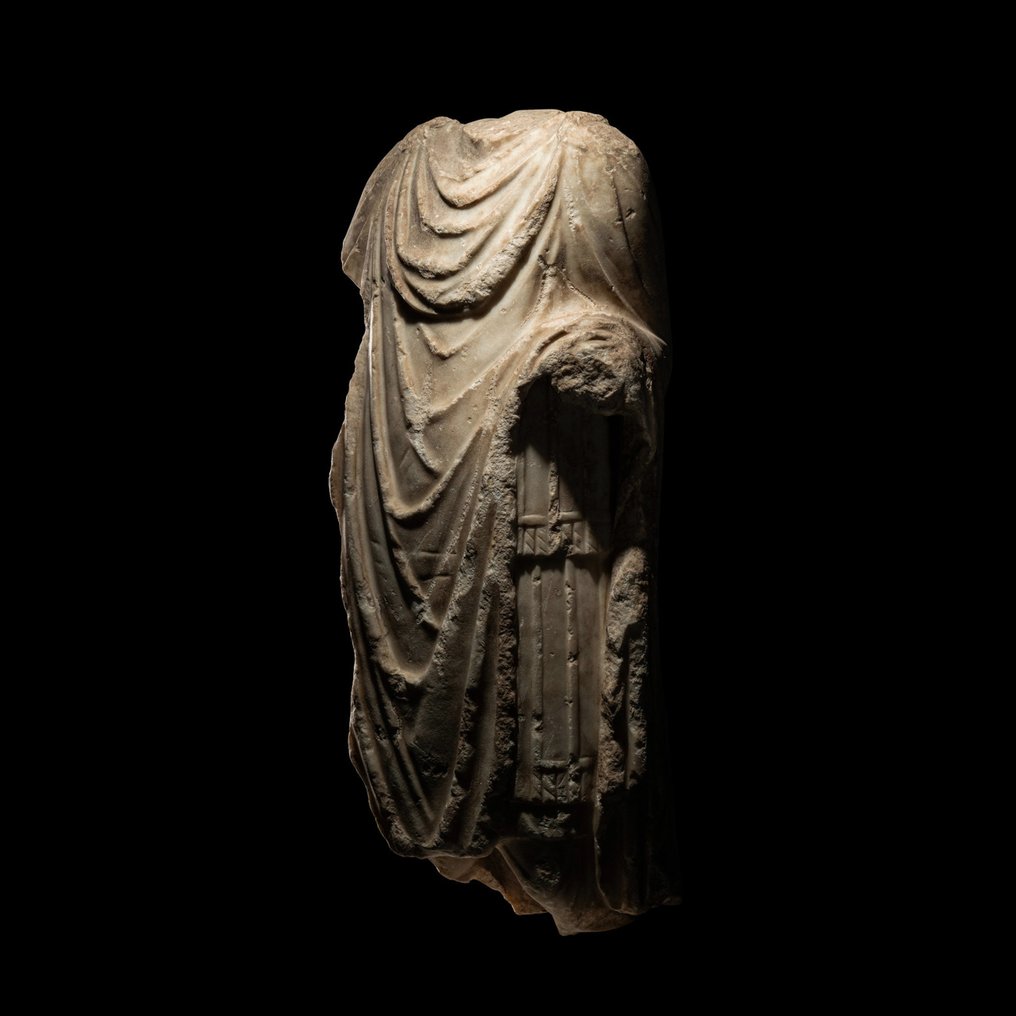
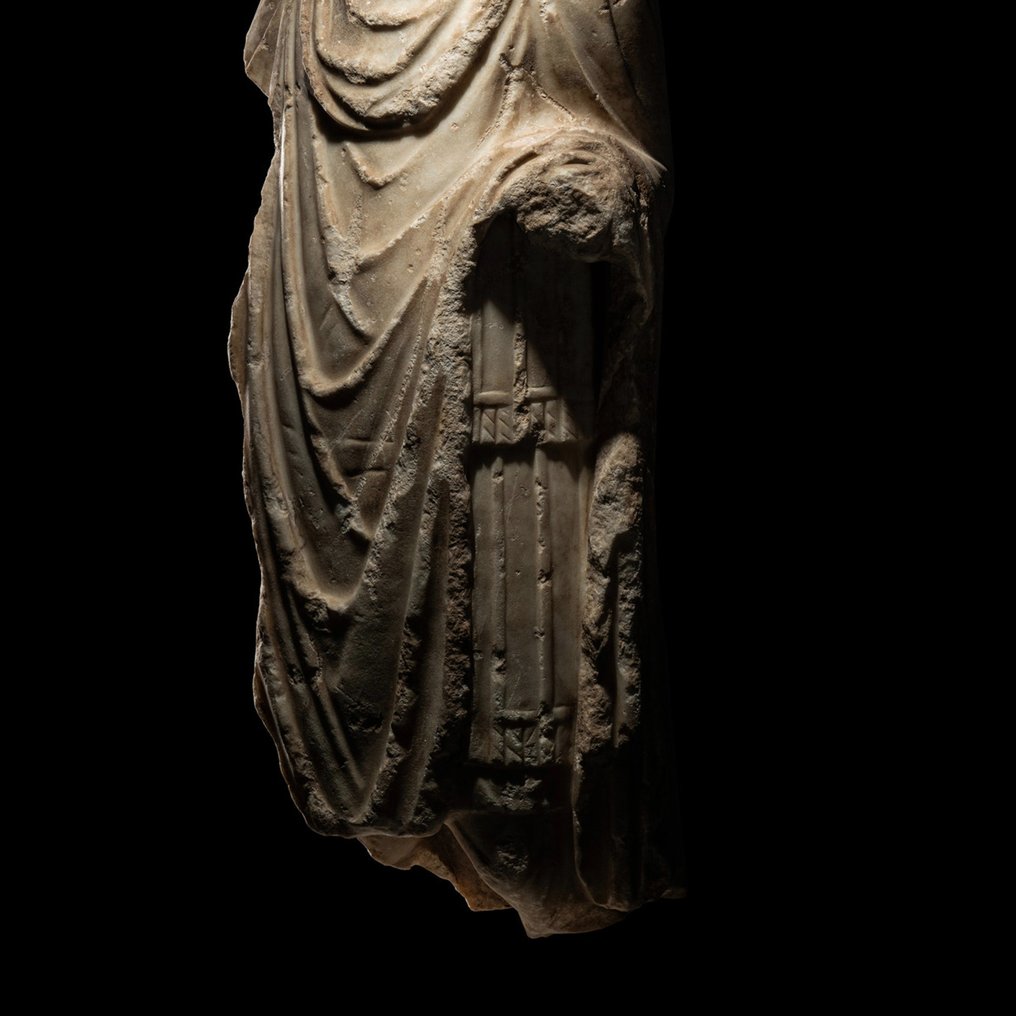
Torso of a life-size round sculpture, carved in marble, representing a male character. He wears trousers, a leather cuirass, and a chlamys, an unusual combination found only in representations of high-ranking soldiers on historical reliefs from the times of Trajan and Antoninus Pius (fig. 1), in the first half of the 2nd century. AD
The sculptural work is magnificent, although the most delicate parts of the work have been lost, such as the head and hands. The folds of the chlamyd are heavy, very expressive, and curve parallel over the chest and in a V-shape towards the knees, giving the figure a monumentality, a solemn and heroic air typical of the character represented. This prominence of the garment, as well as the work of the folds, can be found in contemporary works that represent mythical or real heroes (fig. 2). Perhaps the reference for this way of representing the chlamys, falling vertically and completely hiding the body, are certain Greek representations of the god Hermes, of which Roman copies are preserved (fig. 3).
On the other hand, the arrangement of the upper part of the cloak, which falls on the chest, forming differentiated folds in this area, is an expressive resource that can be found in other portraits of the period, both full-length, breaking with the excessive uniformity of the front, like a bust, where this resource takes on special relevance due to the composition itself, becoming in fact an ornamental element (fig. 4).
The breastplate is hidden under the cloak, although it appears worked with care and detail, with great attention to volumetric play. Above the knee that is preserved, the fine trousers are wrinkled, accentuating the slight movement of the leg. The back of the sculpture presents only outlined volumes and an unpolished surface, which indicates that it is a work to be seen from the front, intended to be placed in front of a wall or in a niche or niche.
The Roman military commanders traditionally used the cuirass together with the chlamys, the latter garment already worn by the cavalry in Greece. However, the use of pants is much later. Although in the time of Cicero this garment was rejected by the Romans because it belonged to barbarians (it was identifying the Gauls), with the expansion of the Kingdom its use began to spread among the Roman troops for practical reasons, especially on the battlefields of the north. Some of the first evidence of the use of this garment by Roman soldiers can be found on Trajan's Column in Rome (fig. 5), which shows the emperor's triumph over the Dacians of present-day Romania. In this representation, as mentioned above, only the generals and prominent soldiers appear wearing them, while the common soldiers wear simpler socks that fit the leg. Over time, the military fashion spread to the rest of the Roman population, and by the end of the fourth century trousers had become so popular that the brother emperors Honorius and Arcadius issued an edict prohibiting their use not for aesthetic or cultural reasons, but for cultural reasons. to prevent civilians from wearing military attire, and thus easily distinguish one from the other in a time marked by social tensions.
PARALLELS:
Fig. 1 Detail of the plinth of the Column of Antoninus Pius with a scene of the emperor's funeral. Rome, AD 161, marble. Vatican Museums, inv. 5115.
Fig. 2 Hero sculpture with chlamys and shield at his feet. Roman Kingdom, c. 1-160 AD, marble. British Museum, London, inv. 1868.0620.16.
Fig. 3 Statue of Hermes with chlamys. Roman copy of the s. I AD from a Greek original in bronze from the s. V BC, marble. Museo Nazionale Romano di Palazzo Altemps, Rome, inv. 8583.
Fig. 4 Bust portrait of Emperor Lucio Vero. Roman Kingdom, c. 161-170 AD, marble. British Museum, London, inv. 1805.0703.103.
Fig. 5 Detail of the relief of Trajan's Column with the emperor addressing his troops. Rome, AD 113, marble.
Notes:
The piece includes authenticity certificate.
The piece includes Spanish Export License (Passport for European Union) - If the piece is destined outside the European Union a substitution of the export permit should be requested. This process could take between 1 and 2 weeks.
#MasterpiecesW39
Seller's Story
Gallery of Ancient Art - Archeology based in Barcelona with more than fifteen years of experience. Specialized in classical art, Egyptian art, Asian art and pre-Columbian art. It guarantees the authenticity of all its pieces. It participates in the most important art fairs in Spain, such as Feriarte, as well as in fairs abroad, BRAFA, Parcours des Mondes, Cultures Brussels.
All the pieces are sent with an Export Permit issued by the Spanish Ministry of Culture.
We are quick to ship via DHL Express or Direct Art Transport.
Translated by Google TranslateTorso of a Soldier with Chlamys.
- Masterpiece! -
- Museum Parallels -
- Published -
Ancient Roman, 2nd century AD.
Marble.
71.2 cm height.
PROVENANCE:
- Gorny & Mosch, Munich, Auktion 137, December 15, 2004, lot 144.
- Fortuna Fine Art, Ltd., New York, 2009.
- Private collection, New York (USA), acquired from the previous one, on May 12, 2011.
CONDITION: Good state of conservation, without restorations.
PUBLICATION:
- Fortuna Fine Art. After Twenty Years. New York. p. 12, no. 15.
BIBLIOGRAPHY:
- BIANCHI, R. Roma: l’arte al centro del potere (dalle origini al II secolo d.C.). RCS. 2005.
- FRIEDLAND, E.A.; SOBOCINSKI, M.G.; GAZDA, E.K. (eds). The Oxford Handbook of Roman Sculpture. Oxford University Press. 2015.
- KLEINER, Diana E. Roman sculpture. Yale University Press. 1992.
- KOUSSER, Rachel M. Hellenistic and Roman Ideal Sculpture: The Allure of the Classical. Cambridge University Press. 2008.
- OLSON, K. Masculinity and Dress in Roman Antiquity. Routledge. 2020.
DESCRIPTION:
Torso of a life-size round sculpture, carved in marble, representing a male character. He wears trousers, a leather cuirass, and a chlamys, an unusual combination found only in representations of high-ranking soldiers on historical reliefs from the times of Trajan and Antoninus Pius (fig. 1), in the first half of the 2nd century. AD
The sculptural work is magnificent, although the most delicate parts of the work have been lost, such as the head and hands. The folds of the chlamyd are heavy, very expressive, and curve parallel over the chest and in a V-shape towards the knees, giving the figure a monumentality, a solemn and heroic air typical of the character represented. This prominence of the garment, as well as the work of the folds, can be found in contemporary works that represent mythical or real heroes (fig. 2). Perhaps the reference for this way of representing the chlamys, falling vertically and completely hiding the body, are certain Greek representations of the god Hermes, of which Roman copies are preserved (fig. 3).
On the other hand, the arrangement of the upper part of the cloak, which falls on the chest, forming differentiated folds in this area, is an expressive resource that can be found in other portraits of the period, both full-length, breaking with the excessive uniformity of the front, like a bust, where this resource takes on special relevance due to the composition itself, becoming in fact an ornamental element (fig. 4).
The breastplate is hidden under the cloak, although it appears worked with care and detail, with great attention to volumetric play. Above the knee that is preserved, the fine trousers are wrinkled, accentuating the slight movement of the leg. The back of the sculpture presents only outlined volumes and an unpolished surface, which indicates that it is a work to be seen from the front, intended to be placed in front of a wall or in a niche or niche.
The Roman military commanders traditionally used the cuirass together with the chlamys, the latter garment already worn by the cavalry in Greece. However, the use of pants is much later. Although in the time of Cicero this garment was rejected by the Romans because it belonged to barbarians (it was identifying the Gauls), with the expansion of the Kingdom its use began to spread among the Roman troops for practical reasons, especially on the battlefields of the north. Some of the first evidence of the use of this garment by Roman soldiers can be found on Trajan's Column in Rome (fig. 5), which shows the emperor's triumph over the Dacians of present-day Romania. In this representation, as mentioned above, only the generals and prominent soldiers appear wearing them, while the common soldiers wear simpler socks that fit the leg. Over time, the military fashion spread to the rest of the Roman population, and by the end of the fourth century trousers had become so popular that the brother emperors Honorius and Arcadius issued an edict prohibiting their use not for aesthetic or cultural reasons, but for cultural reasons. to prevent civilians from wearing military attire, and thus easily distinguish one from the other in a time marked by social tensions.
PARALLELS:
Fig. 1 Detail of the plinth of the Column of Antoninus Pius with a scene of the emperor's funeral. Rome, AD 161, marble. Vatican Museums, inv. 5115.
Fig. 2 Hero sculpture with chlamys and shield at his feet. Roman Kingdom, c. 1-160 AD, marble. British Museum, London, inv. 1868.0620.16.
Fig. 3 Statue of Hermes with chlamys. Roman copy of the s. I AD from a Greek original in bronze from the s. V BC, marble. Museo Nazionale Romano di Palazzo Altemps, Rome, inv. 8583.
Fig. 4 Bust portrait of Emperor Lucio Vero. Roman Kingdom, c. 161-170 AD, marble. British Museum, London, inv. 1805.0703.103.
Fig. 5 Detail of the relief of Trajan's Column with the emperor addressing his troops. Rome, AD 113, marble.
Notes:
The piece includes authenticity certificate.
The piece includes Spanish Export License (Passport for European Union) - If the piece is destined outside the European Union a substitution of the export permit should be requested. This process could take between 1 and 2 weeks.
#MasterpiecesW39
Seller's Story
Gallery of Ancient Art - Archeology based in Barcelona with more than fifteen years of experience. Specialized in classical art, Egyptian art, Asian art and pre-Columbian art. It guarantees the authenticity of all its pieces. It participates in the most important art fairs in Spain, such as Feriarte, as well as in fairs abroad, BRAFA, Parcours des Mondes, Cultures Brussels.
All the pieces are sent with an Export Permit issued by the Spanish Ministry of Culture.
We are quick to ship via DHL Express or Direct Art Transport.
Translated by Google TranslateDetails
Culture
Ancient Roman
Century/ Timeframe
2nd century AD
Name of object
Torso of a Soldier with Chlamys. 2nd century AD. 71.2 cm height. Published. Spanish Export License.
Acquired from
Private collection
Year acquired
2011
Material
Marble
Country acquired from
United States
Condition
Good
Previous owner acquired from
Auction house
Previous owner - year acquired
2004
Previous owner - country acquired from
Germany
Disclaimer
The seller was informed by Catawiki about documentation requirements and guarantees the following: - the object was legally obtained, - the seller has the right to sell and/or export the object, as relevant, - the seller will provide the necessary provenance information and arrange required documentation and permits/licenses, as applicable and as per local laws, - the seller will notify the buyer of any delays in obtaining permits/licenses. By bidding, you acknowledge that import documentation may be required depending on your country of residence and that obtaining permits/licenses may cause delays in the delivery of your object.
The seller was informed by Catawiki about documentation requirements and guarantees the following: - the object was legally obtained, - the seller has the right to sell and/or export the object, as relevant, - the seller will provide the necessary provenance information and arrange required documentation and permits/licenses, as applicable and as per local laws, - the seller will notify the buyer of any delays in obtaining permits/licenses. By bidding, you acknowledge that import documentation may be required depending on your country of residence and that obtaining permits/licenses may cause delays in the delivery of your object.
