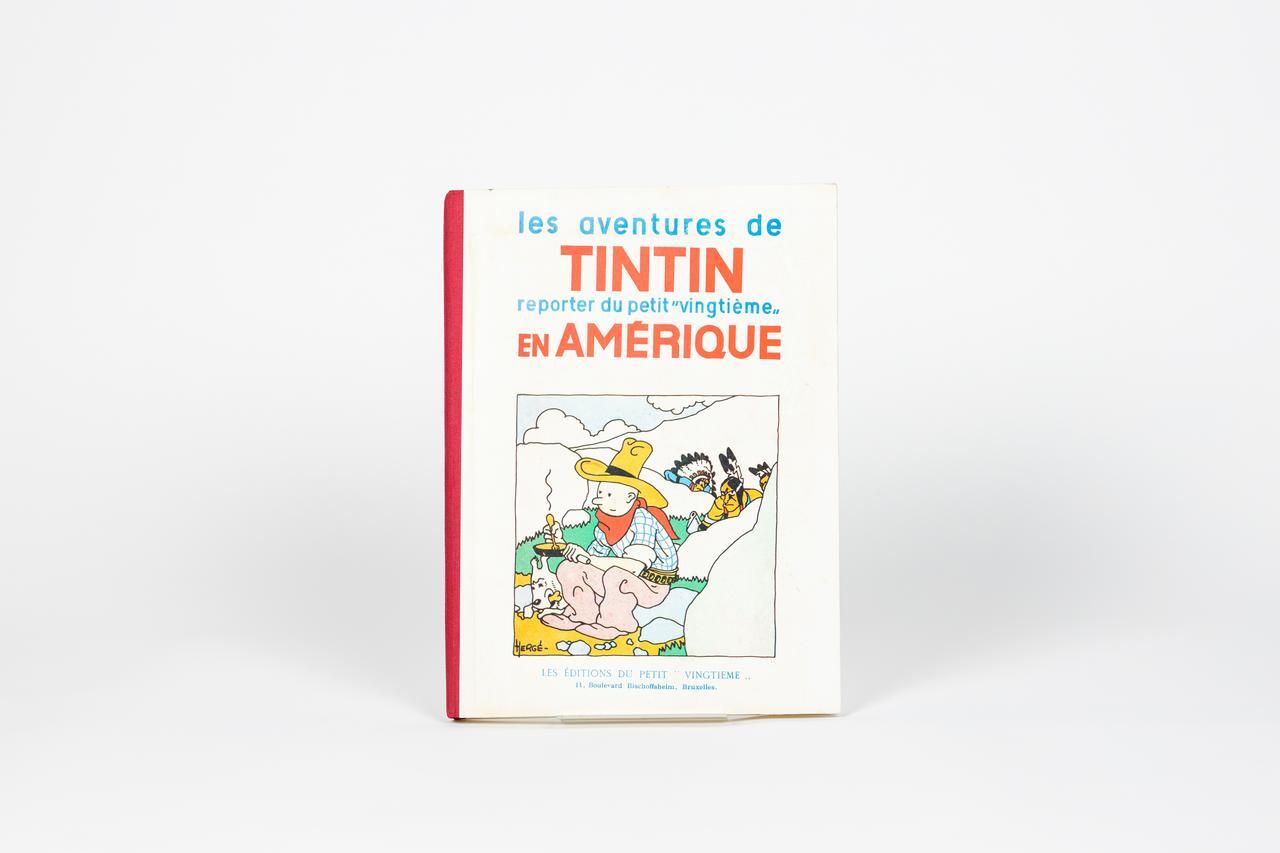
Hergé - épreuve d'imprimerie Casterman N&B + annotations


Opens tomorrow
Starting bid
€ 1
Add to your favourites to get an alert when the auction starts.

Expert
Selected by Marc Toussaint
Has over 25 years collecting comics and organised festivals and exhibitions.
Estimate € 1,600 - € 1,900
Catawiki Buyer Protection
Your payment’s safe with us until you receive your object.View details
Trustpilot 4.4 | 126370 reviews
Rated Excellent on Trustpilot.
Description from the seller
Original vintage print, concerning panel No. 7 of Tintin from the color edition of the comic 'Les Cigares du Pharaon' (1955).
A single page released and officially stamped on the back by the Hergé Studio, Belgium, for the Comics Museum in Italy, which later closed.
The panel bears important and obvious notes and pre-press modifications drawn in blue pencil, used to highlight additions, probably made by the same Hergé.
From the analyses attached by the expert appraiser commissioned to verify this drawing, there appear to be areas and modifications retraced in ink.
Recently, the Hergé Foundation confirmed its provenance from the studio, and that it would be a probable pre-press test. The stamp on the back confirms its authenticity.
At the bottom left, there appears to be an erasure of what looks like a note containing technical details, or perhaps a dedication.
The board had been glued at the corners onto a black piece of cardboard; the lower part had been pried off to verify the authenticity of the stamp.
A variety of images and details are published, some scanned and others photographed.
the dimensions of this board are
40 x 28.7 cm
Original vintage print, concerning panel No. 7 of Tintin from the color edition of the comic 'Les Cigares du Pharaon' (1955).
A single page released and officially stamped on the back by the Hergé Studio, Belgium, for the Comics Museum in Italy, which later closed.
The panel bears important and obvious notes and pre-press modifications drawn in blue pencil, used to highlight additions, probably made by the same Hergé.
From the analyses attached by the expert appraiser commissioned to verify this drawing, there appear to be areas and modifications retraced in ink.
Recently, the Hergé Foundation confirmed its provenance from the studio, and that it would be a probable pre-press test. The stamp on the back confirms its authenticity.
At the bottom left, there appears to be an erasure of what looks like a note containing technical details, or perhaps a dedication.
The board had been glued at the corners onto a black piece of cardboard; the lower part had been pried off to verify the authenticity of the stamp.
A variety of images and details are published, some scanned and others photographed.
the dimensions of this board are
40 x 28.7 cm
Details
Artist
Hergé
Sold by
Owner or reseller
Edition
Limited edition
Title of artwork
épreuve d'imprimerie Casterman N&B + annotations
Technique
Mixed technique
Signature
Authenticity stamp
Country of Origin
Belgium
Year
1955
Condition
Good condition
Height
40 cm
Width
28.5 cm
Weight
1 g
Depiction/Theme
Cartoons and comics
Period
1950-1960
Sold with frame
No
Sold by