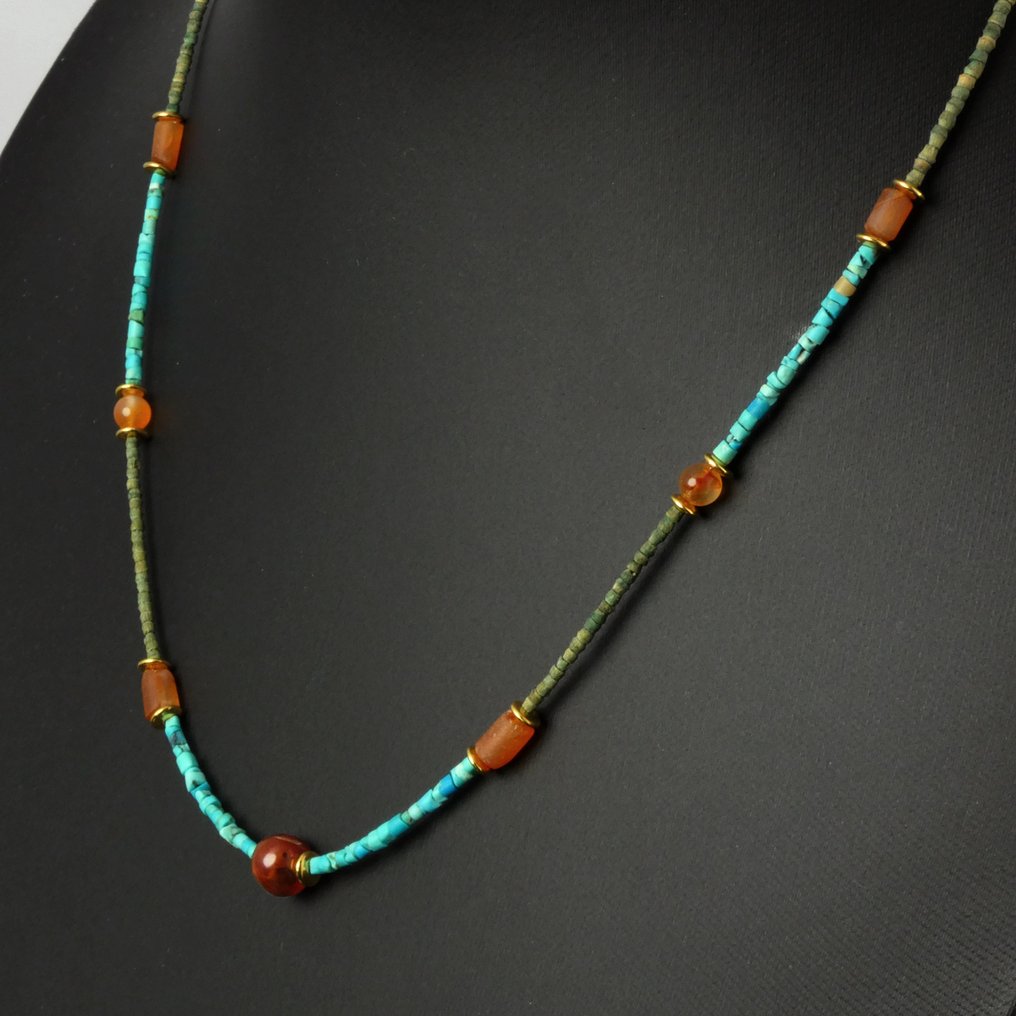
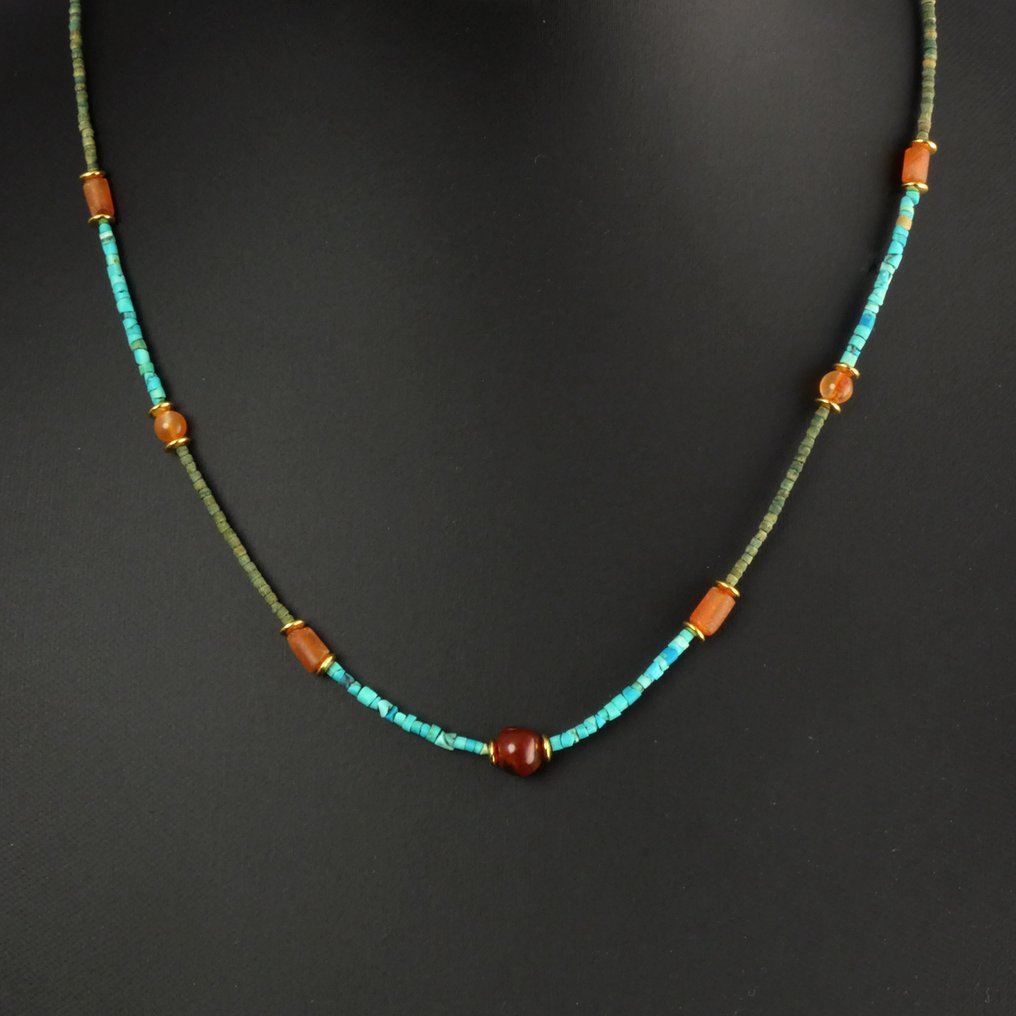
Ancient Egypt, Late Period Necklace with Egyptian faience, turquoise and carnelian beads


03
days
21
hours
26
minutes
17
seconds
Current bid
€ 120
Reserve price not met

Expert
Selected by Peter Reynaers
Has nearly 30 years’ experience and moderated multiple online art research groups.
Estimate € 350 - € 430
49 other people are watching this object
 Bidder 3431 Bidder 3431 | €120 | |
|---|---|---|
| Bidder 3431 | €100 | |
 Bidder 0501 Bidder 0501 | €40 | |
Catawiki Buyer Protection
Your payment’s safe with us until you receive your object.View details
Trustpilot 4.4 | 123779 reviews
Rated Excellent on Trustpilot.
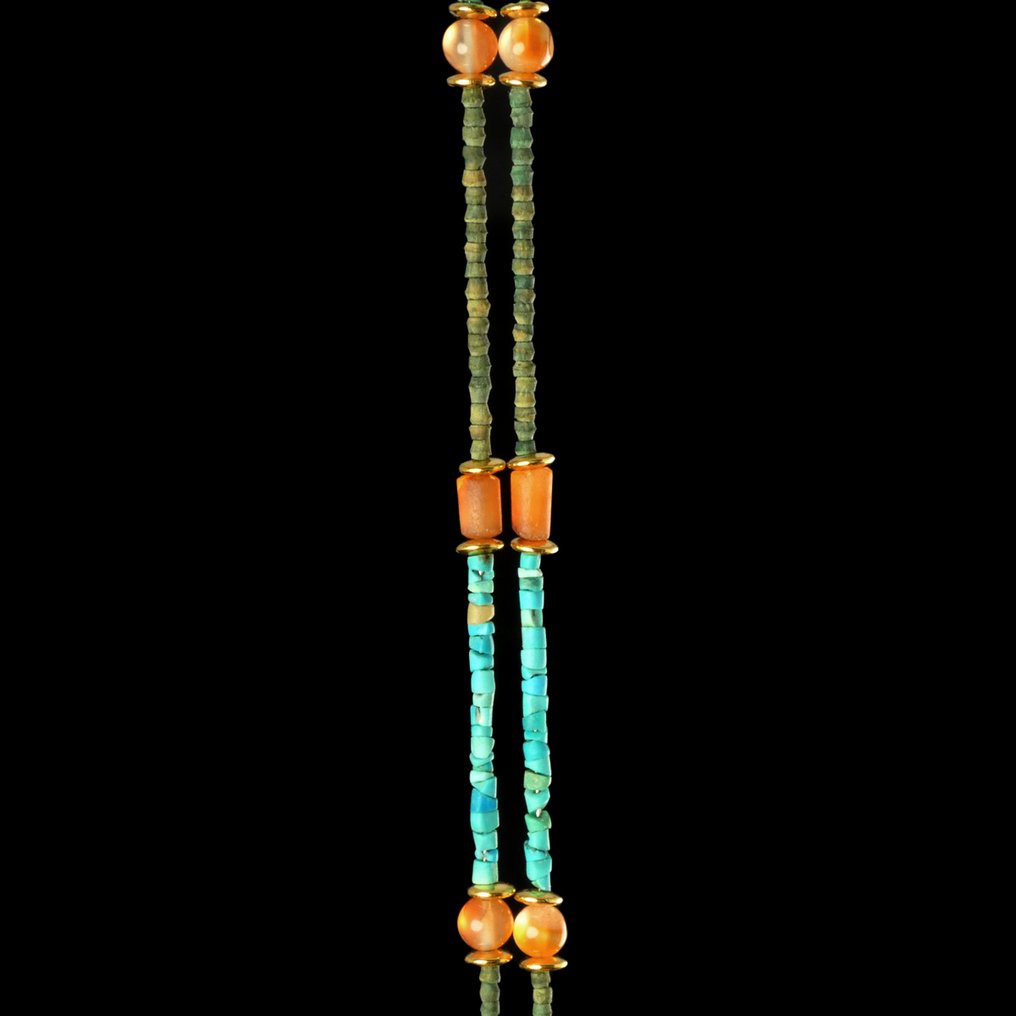
Necklace with Egyptian faience, turquoise and carnelian beads from the Late Period (664–332 BC), approximately 44 cm long with beads up to 7.1 mm, in good condition and restrung with modern fittings.
AI-assisted summary
Description from the seller
Attention: due to customs regulations we can only ship inside the European Union. Please ensure you have a valid EU shipping address before placing a bid.
Necklace with ancient Egyptian faience, semi-precious turquoise stone and carnelian beads from the Late period. The ancient beads are carefully restrung, making them suitable for modern wear while preserving their historical charm.
Length: ± 44 cm
Diameter beads: ± 7,1 mm maximum
Condition: good condition and wearable. The ancient beads are restrung with modern materials and fittings. Signs of wear consistent with age and use. See images.
Composed with beads originating from various old collections, acquired in the UK between 2016-2024.
Every ancient bead shows subtle variations and signs of age, reflecting its history and adding to the unique charm of every composition.
Certificate of Authenticity (PDF) is available upon request.
TURQUOISE was a prized possession for ancient Egyptians and their Pharaohs. The iconic burial mask of Tutankhamun was extravagantly adorned with this gemstone.
Its light blue-green colour was greatly valued by the ancient Egyptians who associated it with fertility and vegetation. The ancient Egyptians believed it protected all those who wore it.
At the end of the 5th Millennium BC the Egyptians started making faience. This allowed them to imitate the highly prized and rare semi-precious turquoise gemstones and produce it in higher quantities.
CARNELIAN
The Egyptians believed carnelian had magical powers; it was believed it could ward off evil, help the blood circulation and make the skin look healthy and youthful.
Carnelian was known as the 'Blood of Isis' (Goddess of nature and guide of souls to the Underworld). Accordingly, a carnelian amulet called a 'thet' was placed on mummies to assist the dead in their journey to the afterlife.
The Egyptian faith in carnelian was so strong that, along with turquoise and lapis lazuli, it was the most used stone in ancient Egyptian jewellery.
FAIENCE
Faience was very popular and widely used in ancient Egypt. The earliest evidence of faience production was discovered in a 7500 year old workshop near the temple in Abydos. The production and style of faience changed through Egyptian history.
Different colourants were used for aesthetic and symbolic purposes, or to imitate the more expensive and rare semi-precious gemstones like turquoise, carnelian, lapis lazuli, garnets or obsidian. Egyptians believed that faience in the colour of gemstones had the same properties. Red had protective powers, dark lapis blue gave strength, courage and wisdom, bright turquoise was associated with fertility and offered protection to the wearer.
As faience was more available than semi-precious gemstones it became a popular and widely used material for small objects like scarabs and other forms of amulets, beads, jewellery, small size statuettes, cosmetic vessels and ritual objects.
In ancient Egypt, faience objects were seen as magical, reflecting the eternal shimmer of the sun and infused with the powers of rebirth and sparkle with the brilliance of eternity.
Seller's Story
Please read our information carefully.
*SHIPPING INFO Due to insurance procedures, combined shipping is only possible with a single payment. (1 payment reference = 1 insured parcel.) If you accept an offer after the auction and pay separately, shipments cannot be manually combined afterward. Please ensure your shipping address is complete and correct before paying. Changes made after payment are not automatically forwarded to us.
* CERTIFICATE OF AUTHENTICITY (COA) For insurance purposes we can provide a digital Certificate of Authenticity (PDF) for every item with a hammer price of Euro 100 or more. The COA is available upon request within 20 days of the auction date. Instructions will be provided when your order is shipped. Certificates are not included in the package.
* INSURANCE & CLAIMS All our parcels are shipped with external insurance. This insurance requires the following:
-> Monitor the online tracking and notify delays to the seller within 14 days after the shipping date.
-> In case of damage: write a reservation on the delivery note and report the damage to the seller via the Catawiki online chat within 24 hours. Keep all packaging and send us photos of the damage.
* IMPORTANT BUYERS OUTSIDE THE EU: We cannot ship to countries outside the European Union. Please ensure you have an EU shipping address before bidding. No exceptions can be made. Switzerland, Norway and the United Kingdom are not part of the EU.
* DOCUMENTATION NOTICE: Previous invoices and import/export documents will not be shared with customers.
----------------------
Thank you for your interest, and best of luck with your bids!
Attention: due to customs regulations we can only ship inside the European Union. Please ensure you have a valid EU shipping address before placing a bid.
Necklace with ancient Egyptian faience, semi-precious turquoise stone and carnelian beads from the Late period. The ancient beads are carefully restrung, making them suitable for modern wear while preserving their historical charm.
Length: ± 44 cm
Diameter beads: ± 7,1 mm maximum
Condition: good condition and wearable. The ancient beads are restrung with modern materials and fittings. Signs of wear consistent with age and use. See images.
Composed with beads originating from various old collections, acquired in the UK between 2016-2024.
Every ancient bead shows subtle variations and signs of age, reflecting its history and adding to the unique charm of every composition.
Certificate of Authenticity (PDF) is available upon request.
TURQUOISE was a prized possession for ancient Egyptians and their Pharaohs. The iconic burial mask of Tutankhamun was extravagantly adorned with this gemstone.
Its light blue-green colour was greatly valued by the ancient Egyptians who associated it with fertility and vegetation. The ancient Egyptians believed it protected all those who wore it.
At the end of the 5th Millennium BC the Egyptians started making faience. This allowed them to imitate the highly prized and rare semi-precious turquoise gemstones and produce it in higher quantities.
CARNELIAN
The Egyptians believed carnelian had magical powers; it was believed it could ward off evil, help the blood circulation and make the skin look healthy and youthful.
Carnelian was known as the 'Blood of Isis' (Goddess of nature and guide of souls to the Underworld). Accordingly, a carnelian amulet called a 'thet' was placed on mummies to assist the dead in their journey to the afterlife.
The Egyptian faith in carnelian was so strong that, along with turquoise and lapis lazuli, it was the most used stone in ancient Egyptian jewellery.
FAIENCE
Faience was very popular and widely used in ancient Egypt. The earliest evidence of faience production was discovered in a 7500 year old workshop near the temple in Abydos. The production and style of faience changed through Egyptian history.
Different colourants were used for aesthetic and symbolic purposes, or to imitate the more expensive and rare semi-precious gemstones like turquoise, carnelian, lapis lazuli, garnets or obsidian. Egyptians believed that faience in the colour of gemstones had the same properties. Red had protective powers, dark lapis blue gave strength, courage and wisdom, bright turquoise was associated with fertility and offered protection to the wearer.
As faience was more available than semi-precious gemstones it became a popular and widely used material for small objects like scarabs and other forms of amulets, beads, jewellery, small size statuettes, cosmetic vessels and ritual objects.
In ancient Egypt, faience objects were seen as magical, reflecting the eternal shimmer of the sun and infused with the powers of rebirth and sparkle with the brilliance of eternity.
Seller's Story
Please read our information carefully.
*SHIPPING INFO Due to insurance procedures, combined shipping is only possible with a single payment. (1 payment reference = 1 insured parcel.) If you accept an offer after the auction and pay separately, shipments cannot be manually combined afterward. Please ensure your shipping address is complete and correct before paying. Changes made after payment are not automatically forwarded to us.
* CERTIFICATE OF AUTHENTICITY (COA) For insurance purposes we can provide a digital Certificate of Authenticity (PDF) for every item with a hammer price of Euro 100 or more. The COA is available upon request within 20 days of the auction date. Instructions will be provided when your order is shipped. Certificates are not included in the package.
* INSURANCE & CLAIMS All our parcels are shipped with external insurance. This insurance requires the following:
-> Monitor the online tracking and notify delays to the seller within 14 days after the shipping date.
-> In case of damage: write a reservation on the delivery note and report the damage to the seller via the Catawiki online chat within 24 hours. Keep all packaging and send us photos of the damage.
* IMPORTANT BUYERS OUTSIDE THE EU: We cannot ship to countries outside the European Union. Please ensure you have an EU shipping address before bidding. No exceptions can be made. Switzerland, Norway and the United Kingdom are not part of the EU.
* DOCUMENTATION NOTICE: Previous invoices and import/export documents will not be shared with customers.
----------------------
Thank you for your interest, and best of luck with your bids!
Details
Culture
Ancient Egypt, Late Period
Century/ Timeframe
664-332 BC
Name of object
Necklace with Egyptian faience, turquoise and carnelian beads
Acquired from
Gallery / Antique dealer
Year acquired
2016
Country acquired from
United Kingdom
Condition
Good
Previous owner acquired from
Gallery / Antique dealer
Previous owner - year acquired
2016
Previous owner - country acquired from
United Kingdom
I verify that I have obtained this object legally and that I am allowed to sell it
Yes
Sold by
Disclaimer
The seller was informed by Catawiki about documentation requirements and guarantees the following: - the object was legally obtained, - the seller has the right to sell and/or export the object, as relevant, - the seller will provide the necessary provenance information and arrange required documentation and permits/licenses, as applicable and as per local laws, - the seller will notify the buyer of any delays in obtaining permits/licenses. By bidding, you acknowledge that import documentation may be required depending on your country of residence and that obtaining permits/licenses may cause delays in the delivery of your object.
The seller was informed by Catawiki about documentation requirements and guarantees the following: - the object was legally obtained, - the seller has the right to sell and/or export the object, as relevant, - the seller will provide the necessary provenance information and arrange required documentation and permits/licenses, as applicable and as per local laws, - the seller will notify the buyer of any delays in obtaining permits/licenses. By bidding, you acknowledge that import documentation may be required depending on your country of residence and that obtaining permits/licenses may cause delays in the delivery of your object.
