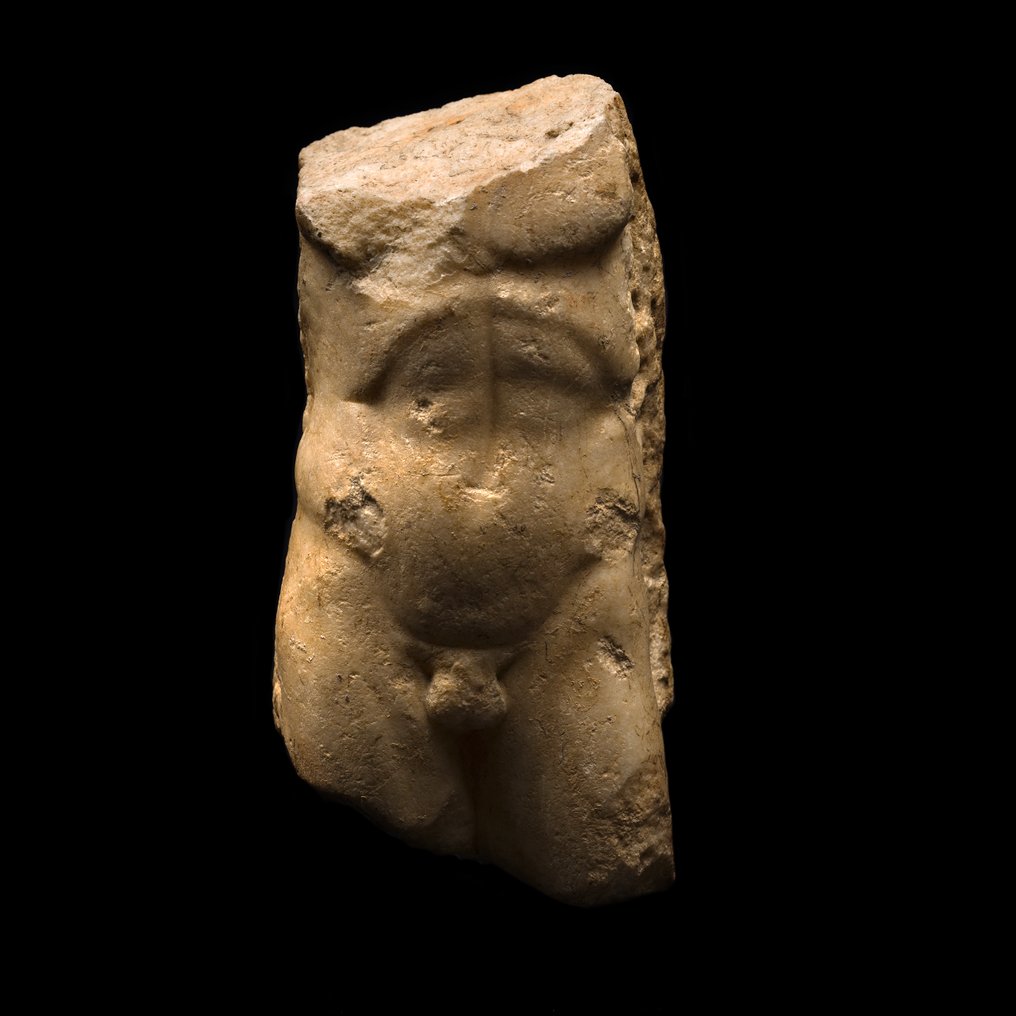
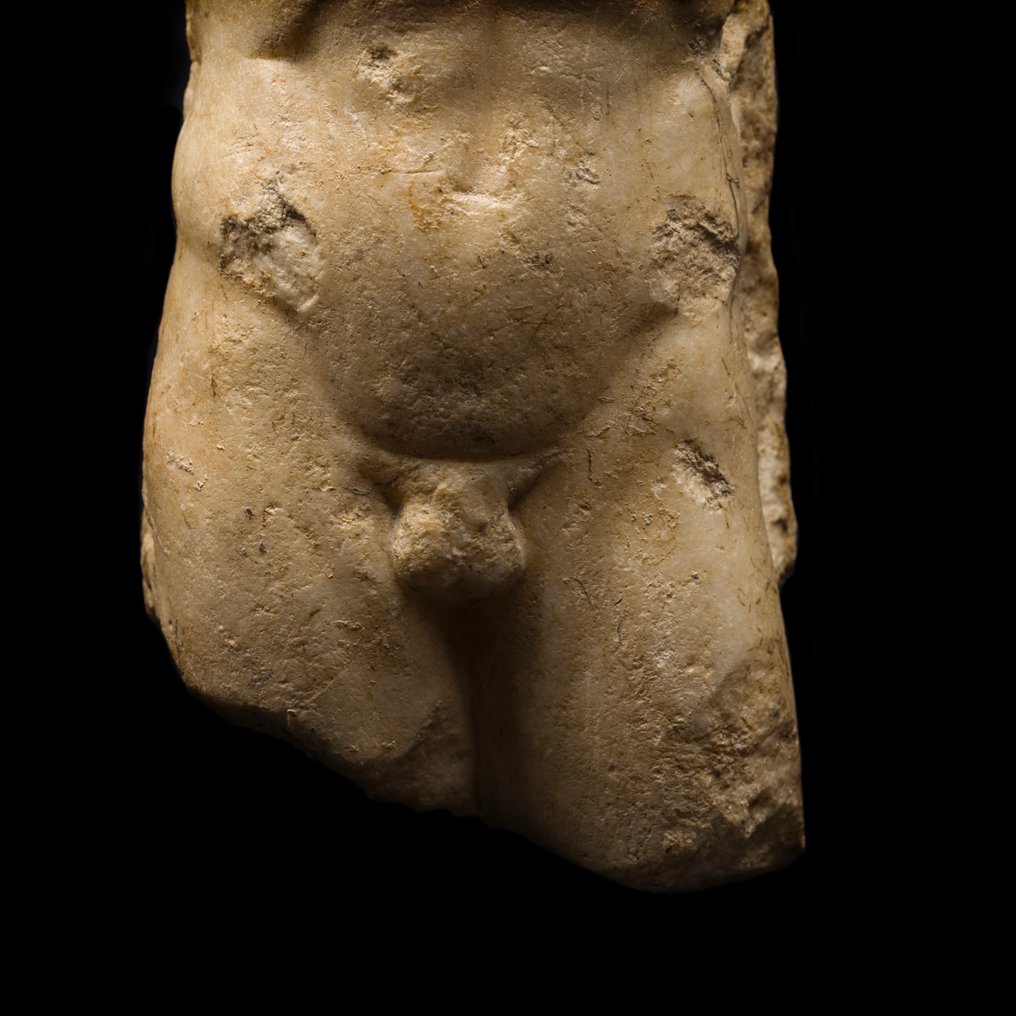
Ancient Roman Marble Male Torso. 1st - 3rd century AD. 23 cm height.



09
days
01
hour
19
minutes
36
seconds
Starting bid
€ 1
Reserve price not met

Expert
Selected by Ruth Garrido Vila
Directed the Ifergan Collection Museum, specialising in Phoenician and Mediterranean archaeology.
Estimate € 20,000 - € 22,000
No bids placed
Catawiki Buyer Protection
Your payment’s safe with us until you receive your object.View details
Trustpilot 4.4 | 123053 reviews
Rated Excellent on Trustpilot.
Ancient Roman marble male torso, 23 cm high, dating to the 1st–3rd century AD, in very good condition with no restoration, accompanied by an authenticity certificate and a Spanish export license; provenance includes private collections in the United Kingdom and Switzerland.
AI-assisted summary
Description from the seller
Male Torso.
Ancient Roman, 1st - 3rd century AD.
Marble.
23 cm height.
CONDITION: Good condition, without restoration.
PROVENANCE:
- Private collection, United Kingdom, formed in the 1980s and 1990s.
- Private collection, Switzerland, acquired by inheritance, until 2024.
DESCRIPTION:
Fragment of the torso of a small, round, marble sculpture depicting a nude, athletic, muscular man in a restrained contrapposto position, his body weight resting on his right leg while his left leg is brought forward, slightly bent at the knee. As a result, his chest rises and his right hip is slightly raised, forming a diagonal opposite to that defined by his chest, with his left shoulder above his right. This slight inclination of the body to the right indicates that the sculpture must have originally had some kind of structural support, probably integrated into the composition. On the left side, on the other hand, remains of a vertical element that would have framed the figure are preserved, probably a chlamys hanging from his left shoulder in the manner of the Hermes Cryophoros of Naucides (fig. 1). The sculpture's strict frontality reveals its dependence on Greek models of late Classicism, as does the controlled serpentine movement of the silhouette and, especially, the modeling of the anatomy, delicately crafted in its idealization and far removed from both Hellenistic expressiveness and Roman realism.
Classical Greek models were a constant source of inspiration in Roman art, especially for the representation of deities, heroes, and deified emperors. Greek sculptures of the 5th and 4th centuries BC were constantly reproduced in different formats and materials, and also interpreted, modified, and adapted to new themes. In the case of this torso, we can find a clear precedent in Lysippos' Apoxyomenos (fig. 2), albeit with a mirror-inverted composition and a somewhat more slender and youthful anatomy, and in Polykleitos' Diadumenus (fig. 3), which shares with the piece under study both the posture and the way it works the abdominal muscles and diaphragm.
The athletes of Polykleitos, the Discobolus of Myron, and the Apoxyomenos of Lysippus were considered, in the Roman imperial period, epitomes of sculptural art. These great works represented the physical ideal of the viriliter puer and the molliter iuvenis, the virile-looking boy and the delicate-looking boy, respectively, definitions that embodied for the Romans the entire spectrum of athletic youth. Works that reproduced or loosely imitated ancient Greek prototypes, well known to the Roman public, constituted an important group within Roman sculpture, and populated the public spaces of the city and also the gardens of high-ranking citizens. These images of gods and heroes based on Greek models were not, however, mere historical replicas, but were used to embody the values, tastes, and interests unique to Roman civilization. The Roman public would therefore not have judged these works by their fidelity to the original, but by their appropriateness to the message they were intended to convey. Thus, while the Greek original on which the sculpture under study is based may have represented a victorious athlete, the Roman artist would have applied the model to the incarnation of a mythological character, a paragon of virility due to his accentuated musculature, although undeniably youthful in his stylization. In this sense, the difference with other similar examples preserved is evident, such as a torso from New York identified with Hyacinth or Narcissus due to the delicacy of its forms and the introspection of its position (fig. 4). Here, however, the body is extended, revealing itself in all its fullness, with the confident yet proud attitude of a hero or a god (fig. 5).
PARALLELS:
Fig. 1 Hermes Cryophoros. Roman copy from the 2nd century AD of a Greek original from the late 5th century BC, attributed to Naucides. Pentelic marble, 180 cm high. National Archaeological Museum of Athens, inv. 243.
Fig. 2 Apoxyomenos of Lysippus. Roman copy from the 1st century AD of a Greek bronze original dating to around 320 BC. Marble, 205 cm high. Museo Pio Clementino, Musei Vaticani, inv. 1185.
Fig. 3 Diadumenus of Polycleitus. Roman copy from the first half of the s. I AD from a Greek bronze original from the late 19th century. V BC Marble, 170 cm high. Musée du Louvre, Paris, inv. Cp 6595; Ma 1027.2.
Fig. 4 Torso of a youth. Roman copy of a late 5th-century Greek bronze original from the late 5th century BC. Marble, 53.4 cm high. Metropolitan Museum, New York, inv. 57.60.
Fig. 5 Torso of Hermes. Roman copy from the 1st century AD of a Greek original from the 5th century BC. Marble, 97 cm high. Liebieghaus, Frankfurt am Main, inv. 77.
Notes:
- The piece includes authenticity certificate.
- The piece includes Spanish Export License.
- The seller guarantees that he acquired this piece according to all national and international laws related to the ownership of cultural property. Provenance statement seen by Catawiki.
#ExclusiveCabinetofCuriosities
Seller's Story
Gallery of Ancient Art - Archeology based in Barcelona with more than fifteen years of experience. Specialized in classical art, Egyptian art, Asian art and pre-Columbian art. It guarantees the authenticity of all its pieces. It participates in the most important art fairs in Spain, such as Feriarte, as well as in fairs abroad, BRAFA, Parcours des Mondes, Cultures Brussels.
All the pieces are sent with an Export Permit issued by the Spanish Ministry of Culture.
We are quick to ship via DHL Express or Direct Art Transport.
Translated by Google TranslateMale Torso.
Ancient Roman, 1st - 3rd century AD.
Marble.
23 cm height.
CONDITION: Good condition, without restoration.
PROVENANCE:
- Private collection, United Kingdom, formed in the 1980s and 1990s.
- Private collection, Switzerland, acquired by inheritance, until 2024.
DESCRIPTION:
Fragment of the torso of a small, round, marble sculpture depicting a nude, athletic, muscular man in a restrained contrapposto position, his body weight resting on his right leg while his left leg is brought forward, slightly bent at the knee. As a result, his chest rises and his right hip is slightly raised, forming a diagonal opposite to that defined by his chest, with his left shoulder above his right. This slight inclination of the body to the right indicates that the sculpture must have originally had some kind of structural support, probably integrated into the composition. On the left side, on the other hand, remains of a vertical element that would have framed the figure are preserved, probably a chlamys hanging from his left shoulder in the manner of the Hermes Cryophoros of Naucides (fig. 1). The sculpture's strict frontality reveals its dependence on Greek models of late Classicism, as does the controlled serpentine movement of the silhouette and, especially, the modeling of the anatomy, delicately crafted in its idealization and far removed from both Hellenistic expressiveness and Roman realism.
Classical Greek models were a constant source of inspiration in Roman art, especially for the representation of deities, heroes, and deified emperors. Greek sculptures of the 5th and 4th centuries BC were constantly reproduced in different formats and materials, and also interpreted, modified, and adapted to new themes. In the case of this torso, we can find a clear precedent in Lysippos' Apoxyomenos (fig. 2), albeit with a mirror-inverted composition and a somewhat more slender and youthful anatomy, and in Polykleitos' Diadumenus (fig. 3), which shares with the piece under study both the posture and the way it works the abdominal muscles and diaphragm.
The athletes of Polykleitos, the Discobolus of Myron, and the Apoxyomenos of Lysippus were considered, in the Roman imperial period, epitomes of sculptural art. These great works represented the physical ideal of the viriliter puer and the molliter iuvenis, the virile-looking boy and the delicate-looking boy, respectively, definitions that embodied for the Romans the entire spectrum of athletic youth. Works that reproduced or loosely imitated ancient Greek prototypes, well known to the Roman public, constituted an important group within Roman sculpture, and populated the public spaces of the city and also the gardens of high-ranking citizens. These images of gods and heroes based on Greek models were not, however, mere historical replicas, but were used to embody the values, tastes, and interests unique to Roman civilization. The Roman public would therefore not have judged these works by their fidelity to the original, but by their appropriateness to the message they were intended to convey. Thus, while the Greek original on which the sculpture under study is based may have represented a victorious athlete, the Roman artist would have applied the model to the incarnation of a mythological character, a paragon of virility due to his accentuated musculature, although undeniably youthful in his stylization. In this sense, the difference with other similar examples preserved is evident, such as a torso from New York identified with Hyacinth or Narcissus due to the delicacy of its forms and the introspection of its position (fig. 4). Here, however, the body is extended, revealing itself in all its fullness, with the confident yet proud attitude of a hero or a god (fig. 5).
PARALLELS:
Fig. 1 Hermes Cryophoros. Roman copy from the 2nd century AD of a Greek original from the late 5th century BC, attributed to Naucides. Pentelic marble, 180 cm high. National Archaeological Museum of Athens, inv. 243.
Fig. 2 Apoxyomenos of Lysippus. Roman copy from the 1st century AD of a Greek bronze original dating to around 320 BC. Marble, 205 cm high. Museo Pio Clementino, Musei Vaticani, inv. 1185.
Fig. 3 Diadumenus of Polycleitus. Roman copy from the first half of the s. I AD from a Greek bronze original from the late 19th century. V BC Marble, 170 cm high. Musée du Louvre, Paris, inv. Cp 6595; Ma 1027.2.
Fig. 4 Torso of a youth. Roman copy of a late 5th-century Greek bronze original from the late 5th century BC. Marble, 53.4 cm high. Metropolitan Museum, New York, inv. 57.60.
Fig. 5 Torso of Hermes. Roman copy from the 1st century AD of a Greek original from the 5th century BC. Marble, 97 cm high. Liebieghaus, Frankfurt am Main, inv. 77.
Notes:
- The piece includes authenticity certificate.
- The piece includes Spanish Export License.
- The seller guarantees that he acquired this piece according to all national and international laws related to the ownership of cultural property. Provenance statement seen by Catawiki.
#ExclusiveCabinetofCuriosities
Seller's Story
Gallery of Ancient Art - Archeology based in Barcelona with more than fifteen years of experience. Specialized in classical art, Egyptian art, Asian art and pre-Columbian art. It guarantees the authenticity of all its pieces. It participates in the most important art fairs in Spain, such as Feriarte, as well as in fairs abroad, BRAFA, Parcours des Mondes, Cultures Brussels.
All the pieces are sent with an Export Permit issued by the Spanish Ministry of Culture.
We are quick to ship via DHL Express or Direct Art Transport.
Translated by Google TranslateDetails
Culture
Ancient Roman
Century/ Timeframe
1st - 3rd century AD
Name of object
Male Torso. 1st - 3rd century AD. 23 cm height.
Acquired from
Private collection
Material
Marble
Condition
Very good
Disclaimer
The seller was informed by Catawiki about documentation requirements and guarantees the following: - the object was legally obtained, - the seller has the right to sell and/or export the object, as relevant, - the seller will provide the necessary provenance information and arrange required documentation and permits/licenses, as applicable and as per local laws, - the seller will notify the buyer of any delays in obtaining permits/licenses. By bidding, you acknowledge that import documentation may be required depending on your country of residence and that obtaining permits/licenses may cause delays in the delivery of your object.
The seller was informed by Catawiki about documentation requirements and guarantees the following: - the object was legally obtained, - the seller has the right to sell and/or export the object, as relevant, - the seller will provide the necessary provenance information and arrange required documentation and permits/licenses, as applicable and as per local laws, - the seller will notify the buyer of any delays in obtaining permits/licenses. By bidding, you acknowledge that import documentation may be required depending on your country of residence and that obtaining permits/licenses may cause delays in the delivery of your object.
