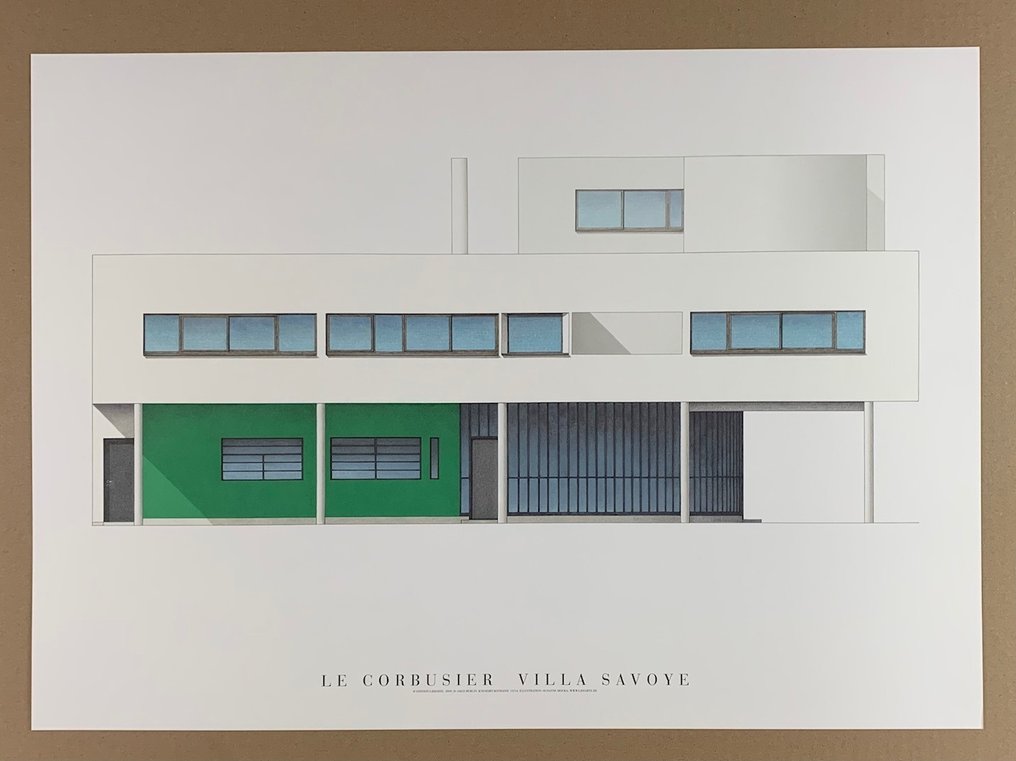
Le Corbusier - Villa Savoye, 1931 - Architectural Drawing Artprint - 50 x 70 cm




Opens 11:00
Starting bid
€ 1
Add to your favourites to get an alert when the auction starts.

Expert
Selected by Annick van Itallie
Graduated in art history with over 25 years' experience in antiques and applied arts appraisal.
Estimate € 150 - € 200
Catawiki Buyer Protection
Your payment’s safe with us until you receive your object.View details
Trustpilot 4.4 | 121798 reviews
Rated Excellent on Trustpilot.
Description from the seller
A beautiful, expressive art print of a motif by Le Corbusier, measuring 50 x 70 cm, entitled Villa Savoye. The work is a high-quality offset print on heavy paper and is in very good condition.
Printed and published by the art publisher from 2000 onwards.
Artist/Architect: Le Corbusier
Title: Villa Savoye
Type: Architecture Poster Art Print
Technology: Offset printing
Originality: Reproduction
Sheet dimensions: 50 x 70 cm
Condition: Like new
Origin: Art Publishing
Era: Modern Art
Nationality: French Art
Le Corbusier:
Le Corbusier, born Charles-Édouard Jeanneret-Gris on October 6, 1887, in La Chaux-de-Fonds, Switzerland, and died on August 27, 1965, in Roquebrune-Cap-Martin, France, was one of the most influential architects of the 20th century. As a pioneer of modern architecture and urban design, Le Corbusier shaped the architectural landscape worldwide with his innovative ideas and buildings.
Le Corbusier began his career as a furniture designer and painter before turning to architecture. In the early years of his career, he worked with Auguste Perret in Paris and later with Peter Behrens in Berlin, where he also met the young Ludwig Mies van der Rohe. These encounters with the leading architects of the time significantly influenced his future work. Behrens was also an important mentor to Walter Gropius, the founder of the Bauhaus, whose principles and aesthetic ideals influenced Le Corbusier's work and were, in turn, influenced by him.
A central component of Le Corbusier's philosophy was the concept of the "machine for living" (machines à habiter), which he presented in his book "Vers une architecture" (1923). He advocated for functional and rationally planned buildings that met the needs of modern society. His five points of the new architecture—the columns (pilotis), the flat roof, the open floor plan, the horizontal window front, and the free facade design—became cornerstones of modern building. These ideas influenced architects such as Richard Neutra, who became known for his functional and aesthetically pleasing residential buildings.
One of the best-known examples of his implementation of these principles is the Villa Savoye (1929-1931) in Poissy, France. With its clear, cubic form and long horizontal windows, the Villa Savoye embodies the idea of modern living and is often considered a masterpiece of modern architecture. The Villa Savoye had a lasting influence on architects such as Alvar Aalto and Marcel Breuer, who both implemented similar principles in their own work.
Le Corbusier was also a visionary urban planner. His "Plan Voisin" (1925) for Paris proposed demolishing large parts of the historic center and replacing them with high-rise buildings in a grid pattern. Although this plan was never implemented, his ideas profoundly influenced 20th-century urban planning and architecture. His concept of the functional city was later realized in various forms in cities such as Brasília, designed by Oscar Niemeyer and Lúcio Costa. Niemeyer's work, particularly its curved, sculptural forms, demonstrates Le Corbusier's influence on modern urban planning and architecture.
Another significant work by Le Corbusier is the Unité d'Habitation (1947-1952) in Marseille, France. This residential building represented a radical approach to solving the housing problems following World War II. It was conceived as a vertical village, integrating all necessary amenities such as shops, schools, and recreational spaces within the building itself. The Unité d'Habitation influenced architects worldwide and served as a model for similar housing complexes in Berlin, Nantes, and other cities. Architects such as Moshe Safdie, known for his Habitat 67 project in Montreal, were inspired by Le Corbusier's ideas and developed them further.
Le Corbusier's influence extended to religious architecture. The Chapelle Notre-Dame-du-Haut (1950–1955) in Ronchamp, France, is an outstanding example of his ability to integrate spiritual and emotional qualities into his architecture. With its curved, sculptural forms and interplay of light and shadow, the chapel is a masterpiece of modern sacred architecture. The Chapelle Notre-Dame-du-Haut also inspired contemporary architects such as Tadao Ando, who is known for his spiritually charged spaces and masterful use of light.
Le Corbusier also left his mark in India. The planning of Chandigarh (1951-1965), a new capital for the Indian state of Punjab, was one of his most ambitious projects. Le Corbusier designed the city's overall plan as well as several important buildings, including the Secretariat, the Supreme Court, and the Parliament building. Chandigarh is now considered one of the most significant examples of modern urban planning. These projects also influenced architects such as Balkrishna Doshi, who worked under Le Corbusier and later became a prominent architect in India himself.
Le Corbusier's influence on architecture is enormous and extends far beyond his own works. Architects such as Richard Meier, Renzo Piano, and Norman Foster have adopted and further developed his principles in their own work. Meier's rigorous geometry and clear forms, Piano's high-tech architecture, and Foster's innovative structural concepts each reflect aspects of Le Corbusier's vision and principles. Meier's Getty Center in Los Angeles and Foster's Gherkin in London are examples of modern buildings that reflect Le Corbusier's influence.
Le Corbusier's ideas and works were also embraced by the Brutalist movement, which emerged in the 1950s and 1960s. Architects such as Alison and Peter Smithson, as well as Ernő Goldfinger, were inspired by Le Corbusier's use of exposed concrete and his clean, functional forms. Brutalism, known for its robust and monumental structures, reflects Le Corbusier's influence on modern architecture. Goldfinger's Trellick Tower in London is a prominent example of this architectural style.
His works and theories remain an important reference for contemporary architects and urban planners. Le Corbusier's vision of a functional, rational, and humane architecture revolutionized the way we think about buildings and cities. His extensive body of work, encompassing numerous buildings, urban designs, and theoretical writings, remains a central source of inspiration and study for architects worldwide. Architects such as Zaha Hadid and Santiago Calatrava have integrated Le Corbusier's principles and visionary approaches into their own avant-garde designs.
Le Corbusier remains a prominent figure in the history of architecture, whose influence and vision continue to shape the design of our built environment. His innovative spirit and commitment to architecture that is both functional and aesthetically pleasing make him an indispensable pioneer of modern architecture.
Shipping information:
We roll prints onto solid cardboard cores, wrap them with corrugated cardboard, and ship them in specially designed, very sturdy boxes. The shipment is sent with a tracking number for parcel tracking.
- Shipping to the Canary Islands is not possible -
About us
We have been active in the art dealing industry for over 20 years and possess extensive experience in the professional handling and shipping of artworks.
Seller's Story
We have been operating several online shops in the art trade for over 20 years. On the one hand, we specialize in rare art prints, exhibition posters and collectible reproductions, and on the other hand, we trade in art editions and originals by well-known contemporary artists.
The works we offer all come from the respective publishers, art galleries and institutions such as museums that published them in close cooperation with the artists. The works you find with us are often several decades old, in perfect or good condition and without a previous private owner.
We place particular emphasis on professional packaging. Nothing is more annoying than purchasing a rare print that arrives damaged due to poor or inadequate packaging.
If you have any questions about the works on offer, we are always happy to help you!
Translated by Google Translate
A beautiful, expressive art print of a motif by Le Corbusier, measuring 50 x 70 cm, entitled Villa Savoye. The work is a high-quality offset print on heavy paper and is in very good condition.
Printed and published by the art publisher from 2000 onwards.
Artist/Architect: Le Corbusier
Title: Villa Savoye
Type: Architecture Poster Art Print
Technology: Offset printing
Originality: Reproduction
Sheet dimensions: 50 x 70 cm
Condition: Like new
Origin: Art Publishing
Era: Modern Art
Nationality: French Art
Le Corbusier:
Le Corbusier, born Charles-Édouard Jeanneret-Gris on October 6, 1887, in La Chaux-de-Fonds, Switzerland, and died on August 27, 1965, in Roquebrune-Cap-Martin, France, was one of the most influential architects of the 20th century. As a pioneer of modern architecture and urban design, Le Corbusier shaped the architectural landscape worldwide with his innovative ideas and buildings.
Le Corbusier began his career as a furniture designer and painter before turning to architecture. In the early years of his career, he worked with Auguste Perret in Paris and later with Peter Behrens in Berlin, where he also met the young Ludwig Mies van der Rohe. These encounters with the leading architects of the time significantly influenced his future work. Behrens was also an important mentor to Walter Gropius, the founder of the Bauhaus, whose principles and aesthetic ideals influenced Le Corbusier's work and were, in turn, influenced by him.
A central component of Le Corbusier's philosophy was the concept of the "machine for living" (machines à habiter), which he presented in his book "Vers une architecture" (1923). He advocated for functional and rationally planned buildings that met the needs of modern society. His five points of the new architecture—the columns (pilotis), the flat roof, the open floor plan, the horizontal window front, and the free facade design—became cornerstones of modern building. These ideas influenced architects such as Richard Neutra, who became known for his functional and aesthetically pleasing residential buildings.
One of the best-known examples of his implementation of these principles is the Villa Savoye (1929-1931) in Poissy, France. With its clear, cubic form and long horizontal windows, the Villa Savoye embodies the idea of modern living and is often considered a masterpiece of modern architecture. The Villa Savoye had a lasting influence on architects such as Alvar Aalto and Marcel Breuer, who both implemented similar principles in their own work.
Le Corbusier was also a visionary urban planner. His "Plan Voisin" (1925) for Paris proposed demolishing large parts of the historic center and replacing them with high-rise buildings in a grid pattern. Although this plan was never implemented, his ideas profoundly influenced 20th-century urban planning and architecture. His concept of the functional city was later realized in various forms in cities such as Brasília, designed by Oscar Niemeyer and Lúcio Costa. Niemeyer's work, particularly its curved, sculptural forms, demonstrates Le Corbusier's influence on modern urban planning and architecture.
Another significant work by Le Corbusier is the Unité d'Habitation (1947-1952) in Marseille, France. This residential building represented a radical approach to solving the housing problems following World War II. It was conceived as a vertical village, integrating all necessary amenities such as shops, schools, and recreational spaces within the building itself. The Unité d'Habitation influenced architects worldwide and served as a model for similar housing complexes in Berlin, Nantes, and other cities. Architects such as Moshe Safdie, known for his Habitat 67 project in Montreal, were inspired by Le Corbusier's ideas and developed them further.
Le Corbusier's influence extended to religious architecture. The Chapelle Notre-Dame-du-Haut (1950–1955) in Ronchamp, France, is an outstanding example of his ability to integrate spiritual and emotional qualities into his architecture. With its curved, sculptural forms and interplay of light and shadow, the chapel is a masterpiece of modern sacred architecture. The Chapelle Notre-Dame-du-Haut also inspired contemporary architects such as Tadao Ando, who is known for his spiritually charged spaces and masterful use of light.
Le Corbusier also left his mark in India. The planning of Chandigarh (1951-1965), a new capital for the Indian state of Punjab, was one of his most ambitious projects. Le Corbusier designed the city's overall plan as well as several important buildings, including the Secretariat, the Supreme Court, and the Parliament building. Chandigarh is now considered one of the most significant examples of modern urban planning. These projects also influenced architects such as Balkrishna Doshi, who worked under Le Corbusier and later became a prominent architect in India himself.
Le Corbusier's influence on architecture is enormous and extends far beyond his own works. Architects such as Richard Meier, Renzo Piano, and Norman Foster have adopted and further developed his principles in their own work. Meier's rigorous geometry and clear forms, Piano's high-tech architecture, and Foster's innovative structural concepts each reflect aspects of Le Corbusier's vision and principles. Meier's Getty Center in Los Angeles and Foster's Gherkin in London are examples of modern buildings that reflect Le Corbusier's influence.
Le Corbusier's ideas and works were also embraced by the Brutalist movement, which emerged in the 1950s and 1960s. Architects such as Alison and Peter Smithson, as well as Ernő Goldfinger, were inspired by Le Corbusier's use of exposed concrete and his clean, functional forms. Brutalism, known for its robust and monumental structures, reflects Le Corbusier's influence on modern architecture. Goldfinger's Trellick Tower in London is a prominent example of this architectural style.
His works and theories remain an important reference for contemporary architects and urban planners. Le Corbusier's vision of a functional, rational, and humane architecture revolutionized the way we think about buildings and cities. His extensive body of work, encompassing numerous buildings, urban designs, and theoretical writings, remains a central source of inspiration and study for architects worldwide. Architects such as Zaha Hadid and Santiago Calatrava have integrated Le Corbusier's principles and visionary approaches into their own avant-garde designs.
Le Corbusier remains a prominent figure in the history of architecture, whose influence and vision continue to shape the design of our built environment. His innovative spirit and commitment to architecture that is both functional and aesthetically pleasing make him an indispensable pioneer of modern architecture.
Shipping information:
We roll prints onto solid cardboard cores, wrap them with corrugated cardboard, and ship them in specially designed, very sturdy boxes. The shipment is sent with a tracking number for parcel tracking.
- Shipping to the Canary Islands is not possible -
About us
We have been active in the art dealing industry for over 20 years and possess extensive experience in the professional handling and shipping of artworks.
Seller's Story
We have been operating several online shops in the art trade for over 20 years. On the one hand, we specialize in rare art prints, exhibition posters and collectible reproductions, and on the other hand, we trade in art editions and originals by well-known contemporary artists.
The works we offer all come from the respective publishers, art galleries and institutions such as museums that published them in close cooperation with the artists. The works you find with us are often several decades old, in perfect or good condition and without a previous private owner.
We place particular emphasis on professional packaging. Nothing is more annoying than purchasing a rare print that arrives damaged due to poor or inadequate packaging.
If you have any questions about the works on offer, we are always happy to help you!
Translated by Google TranslateDetails
Artist
Le Corbusier
Title of artwork
Villa Savoye, 1931 - Architectural Drawing Artprint - 50 x 70 cm
Technique
Offset print
Signature
Not signed
Country of Origin
Germany
Year
1931
Condition
Excellent condition
Height
50 cm
Width
70 cm
Style
Modern
Period
19th century
Sold with frame
No