Crab - Fossil skeleton - 105 mm - 90 mm (No Reserve Price)



11
days
08
hours
10
minutes
09
seconds

No bids placed
Catawiki Buyer Protection
Your payment’s safe with us until you receive your object.View details
Trustpilot 4.4 | 121899 reviews
Rated Excellent on Trustpilot.
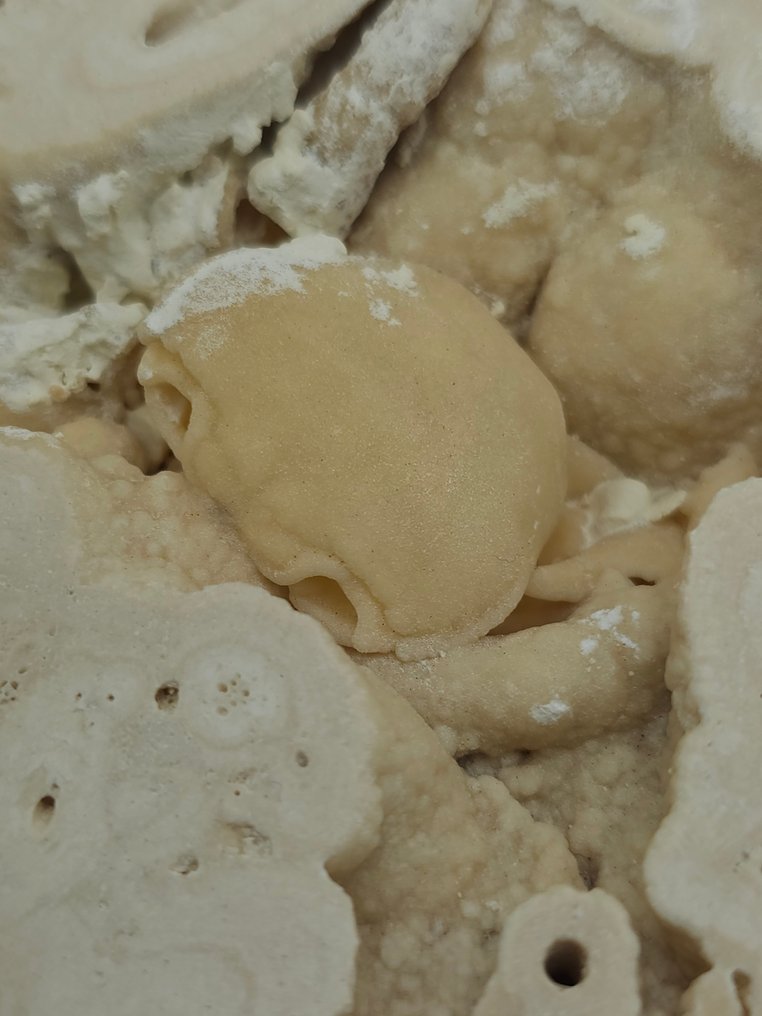
Potamon sp., crab specimen from the Pleistocene (Quaternary) period, natural condition.
AI-assisted summary
Description from the seller
Rare example.
SPECIES
Potamon sp.
AGE
Pleistocene (400.000+ years)
LOCATION
Denizli Basin, Southwest Turkey
FORMATION
Travertine Deposits
WEIGHT 284 Gr.
SIZE
Crab 50 mm * 30 mm * 14 mm
Rock 105 mm x 90 mm x 16 mm
This is a spectacular fossil freshwater crab (Potamon sp) preserved in travertine from the Denizli Basin in Southwest Turkey. The crab itself is 5 cm wide and exhibits amazingly detailed, 3d preservation. It's totally coated and preserved as a three-dimensional outer cast within a natural cavity of a white travertine matrix. It is covered by an inorganic film of calcium carbonate.
Travertine is a type of limestone that forms around mineral springs. It is often quarried for use as a building material, and that is how these crabs were discovered, during the quarrying of the stone slabs. The travertine deposits in the Denizli Basin are Pleistocene in age, having been formed within the past 400,000 years.
Rare example.
SPECIES
Potamon sp.
AGE
Pleistocene (400.000+ years)
LOCATION
Denizli Basin, Southwest Turkey
FORMATION
Travertine Deposits
WEIGHT 284 Gr.
SIZE
Crab 50 mm * 30 mm * 14 mm
Rock 105 mm x 90 mm x 16 mm
This is a spectacular fossil freshwater crab (Potamon sp) preserved in travertine from the Denizli Basin in Southwest Turkey. The crab itself is 5 cm wide and exhibits amazingly detailed, 3d preservation. It's totally coated and preserved as a three-dimensional outer cast within a natural cavity of a white travertine matrix. It is covered by an inorganic film of calcium carbonate.
Travertine is a type of limestone that forms around mineral springs. It is often quarried for use as a building material, and that is how these crabs were discovered, during the quarrying of the stone slabs. The travertine deposits in the Denizli Basin are Pleistocene in age, having been formed within the past 400,000 years.
Details
Specimen
Crab
Country of Origin
Turkey
Geological Period
Quaternary, Pleistocene (2.58 - 0.0117 million years)
Condition
Natural
Weight
284 g
Height
105 mm
Width
90 mm
Depth
16 mm
Sold by