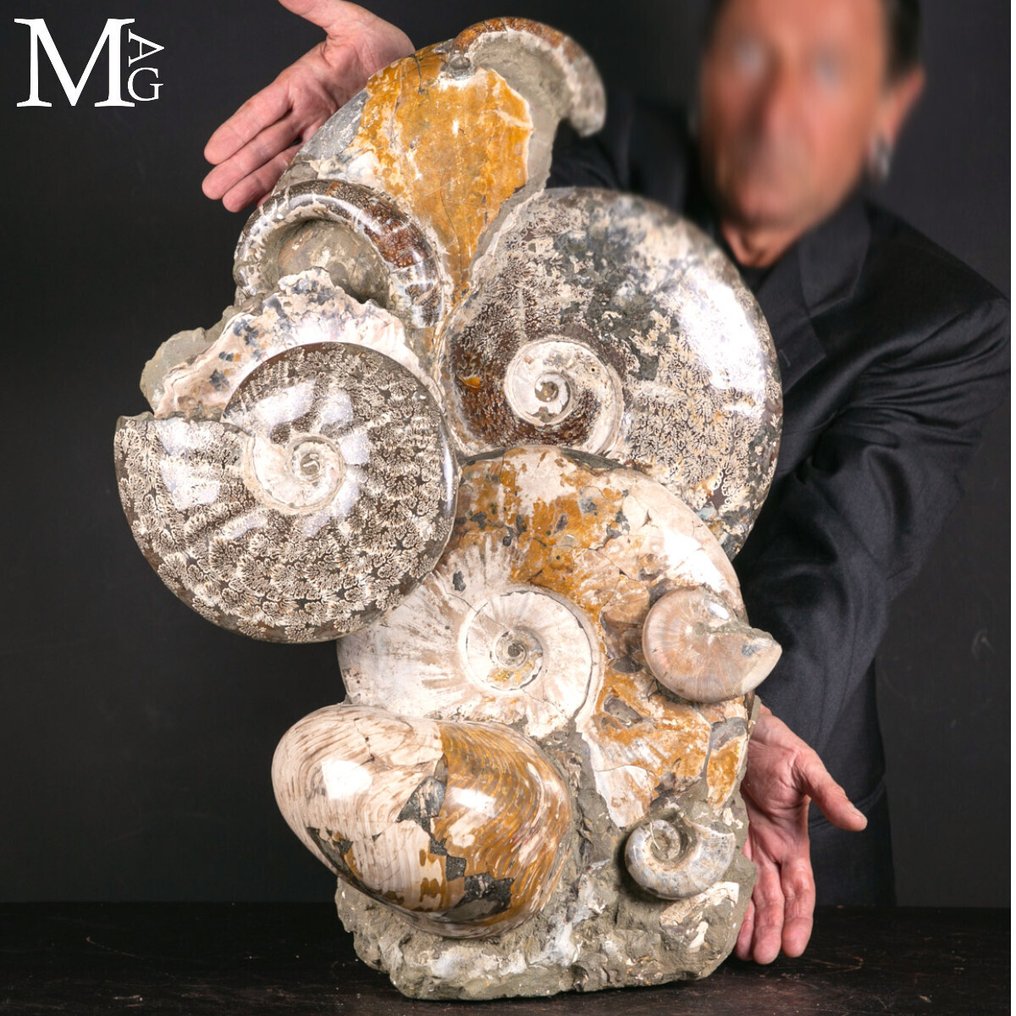
Large fossil block with ammonites and a nautiloid – Madagascar - Height: 635 mm - Width: 435 mm- 40.2 kg



02
days
02
hours
44
minutes
19
seconds
Current bid
€ 500
Reserve price not met

Expert
Selected by Georgia Foteinou
Holds BSc in geology and post-graduate qualifications in geochemistry.
Estimate € 7,200 - € 8,000
8 other people are watching this object
 Bidder 7215 Bidder 7215 | €500 |
|---|
Catawiki Buyer Protection
Your payment’s safe with us until you receive your object.View details
Trustpilot 4.4 | 122813 reviews
Rated Excellent on Trustpilot.
Large fossil block with ammonites and a nautiloid from Madagascar, dating to the Cretaceous and weighing 40.2 kg with dimensions 635 mm by 435 mm by 245 mm.
AI-assisted summary
Description from the seller
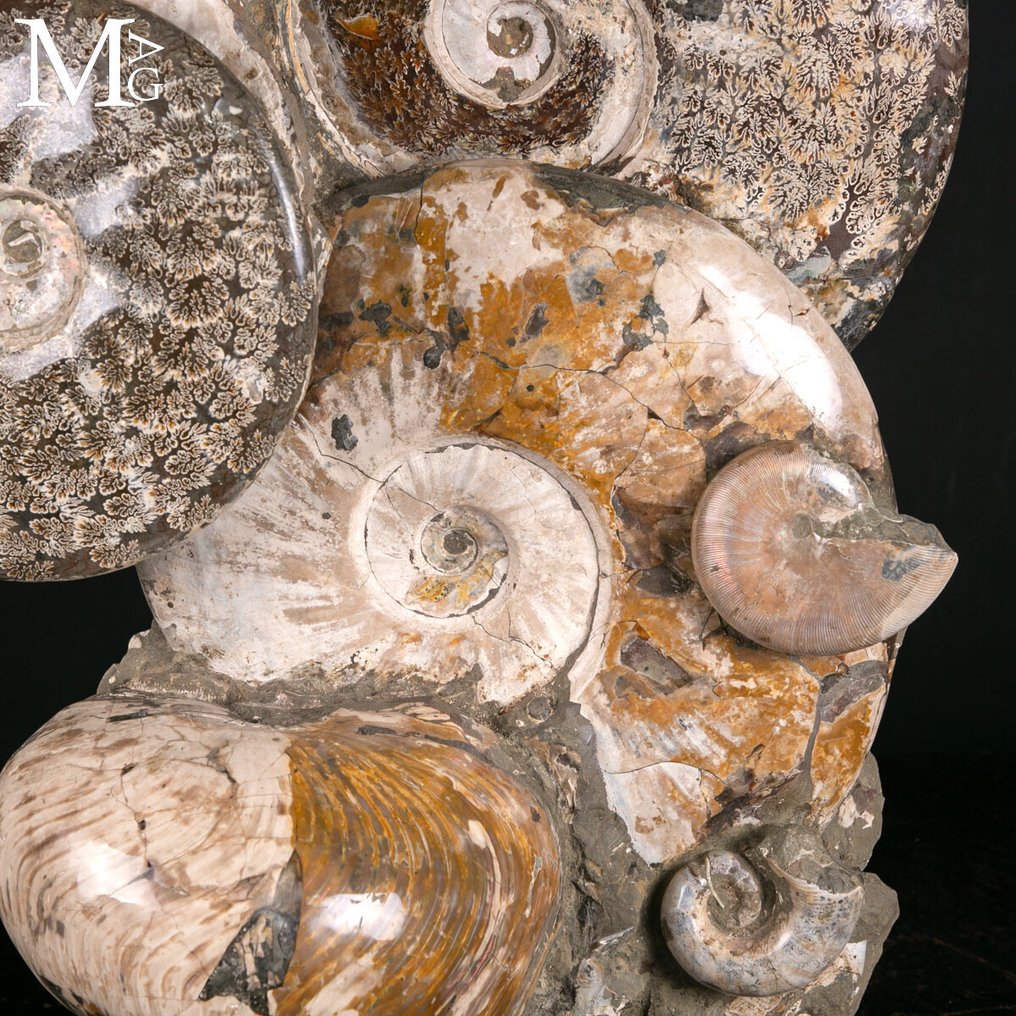
A natural Cretaceous sculpture in its original matrix. This large fossil block is an extraordinary example of the natural aggregation of ammonites and nautiloids preserved within their original matrix. It is a find rich in species: a true section of a seabed from about 100 million years ago, transformed into rock through fossilization processes. An intact fossil community preserved for millions of years, most of the specimens in the block belong to the genus Cleoniceras, one of the most iconic ammonites of the Middle Cretaceous from Madagascar. Their shells, once polished, reveal the complex dendritic suture lines, which here appear in an exceptionally intricate form: very thin branches that resemble plant motifs or organic patterns, but in reality represent the junctions between the internal septa of the shell. Next to the Cleoniceras, a large Cymatoceras nautiloid stands out, contrasting sharply with the ammonites; the nautiloid has a simpler, more massive structure, with a smooth suture and less articulated internal chambers.
Seller's Story
The Mineral Art Gallery offers minerals, fossils, shells and natural elements.
Born in Italy in 2017, today she collaborates with international galleries and collectors, she is a direct importer of large minerals and naturalistic collectible elements; deals with the processing to insert them inside the living space. A section of the gallery was dedicated to the Wunderkammer, "chamber of wonders or cabinet of curiosities" in which Mirabilia elements are presented: naturalia and italiania, a union between "the present is the past".
All lots are shipped via DHL Express and Fercam couriers, with insured parcel and tracking.
Translated by Google TranslateA natural Cretaceous sculpture in its original matrix. This large fossil block is an extraordinary example of the natural aggregation of ammonites and nautiloids preserved within their original matrix. It is a find rich in species: a true section of a seabed from about 100 million years ago, transformed into rock through fossilization processes. An intact fossil community preserved for millions of years, most of the specimens in the block belong to the genus Cleoniceras, one of the most iconic ammonites of the Middle Cretaceous from Madagascar. Their shells, once polished, reveal the complex dendritic suture lines, which here appear in an exceptionally intricate form: very thin branches that resemble plant motifs or organic patterns, but in reality represent the junctions between the internal septa of the shell. Next to the Cleoniceras, a large Cymatoceras nautiloid stands out, contrasting sharply with the ammonites; the nautiloid has a simpler, more massive structure, with a smooth suture and less articulated internal chambers.
Seller's Story
The Mineral Art Gallery offers minerals, fossils, shells and natural elements.
Born in Italy in 2017, today she collaborates with international galleries and collectors, she is a direct importer of large minerals and naturalistic collectible elements; deals with the processing to insert them inside the living space. A section of the gallery was dedicated to the Wunderkammer, "chamber of wonders or cabinet of curiosities" in which Mirabilia elements are presented: naturalia and italiania, a union between "the present is the past".
All lots are shipped via DHL Express and Fercam couriers, with insured parcel and tracking.
Translated by Google TranslateDetails
Mineral Form
Large fossil block with ammonites and a nautiloid – Madagascar
Weight
40.2 kg
Country of Origin
Madagascar
Height
635 mm
Width
435 mm
Depth
245 mm
Sold by