Ulysse Valentin - Originele technische tekening – “Cycle à quatre temps”- c1910/20



06
days
13
hours
43
minutes
23
seconds

No bids placed
Catawiki Buyer Protection
Your payment’s safe with us until you receive your object.View details
Trustpilot 4.4 | 122813 reviews
Rated Excellent on Trustpilot.
Hand-signed original technical drawing by Ulysse Valentin showing the four-stroke cycle, ca. 1910–1920, perfect for framing and automotive history display.
AI-assisted summary
Description from the seller
Original technical drawing – 'Four-stroke cycle' – École Professionnelle de Mécanique, ca. 1910–1920
Beautiful and educational example of an original, hand-drawn technical lesson plate from the early 20th century, originating from the École Professionnelle de Mécanique (O. Hautcoeur, E. Thys, U. Valentin & Cie), under the direction of Ulysse Valentin, professor of auto mechanics in Huy (Belgium).
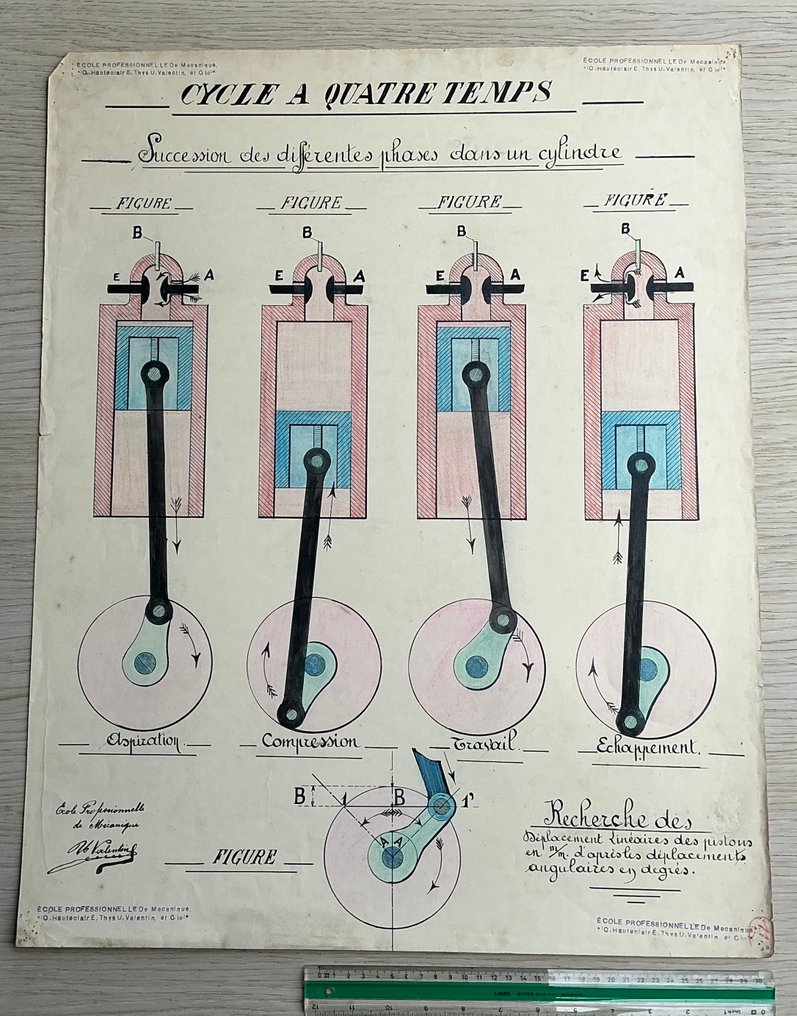
This diagram illustrates the operation of the four-stroke engine (cycle à quatre temps) with the sequence of the four phases in a cylinder:
Aspiration (suction)
Compression
Work (labor / burning)
Exhaust (tailpipe)
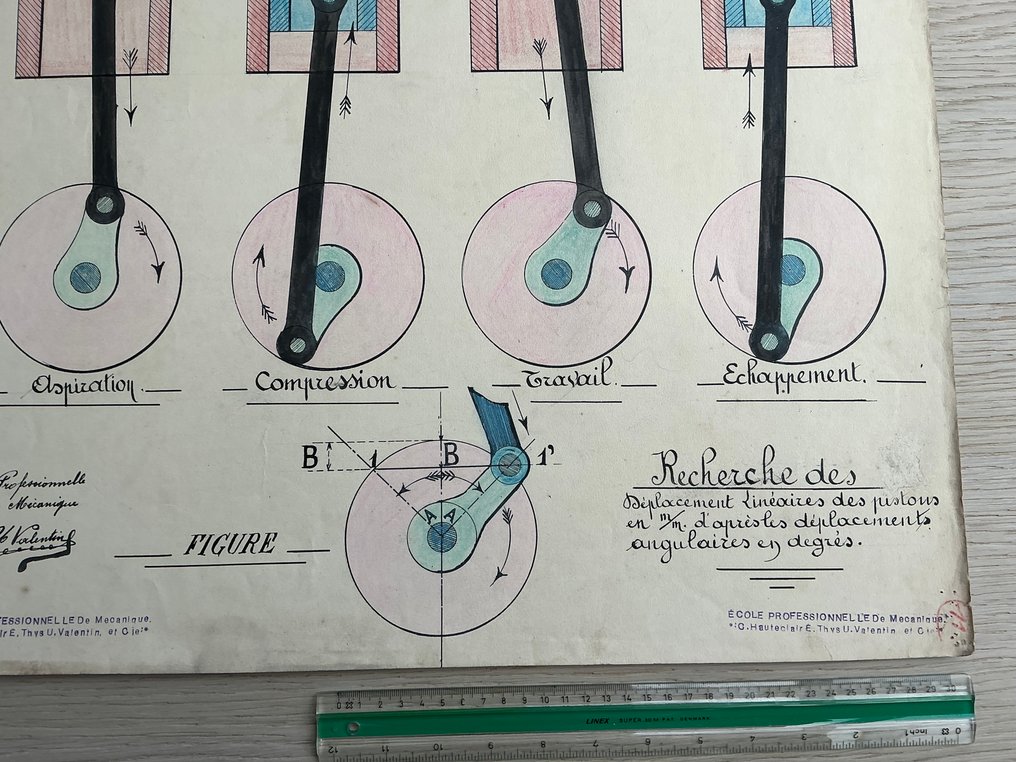
Each phase is precisely depicted with a cross-section of the cylinder, piston, connecting rod, and crankshaft, along with corresponding arrow directions for the gas flows and movements. At the bottom, a diagram is included that links the linear displacement of the piston to the angular rotation of the crankshaft (research of the linear displacements of the pistons as a function of the angular displacements).
The colors – pink, blue, black, and soft red – are applied with watercolor and outlined in Indian ink, with a beautiful calligraphic title and inscriptions.
Four-stroke cycle – Sequence of the different phases within a cylinder
Period: ca. 1910–1920
Origin: École Professionnelle de Mécanique, Huy, Belgium
Author: Ulysse Valentin, Professor of Automotive Mechanics
Technique: East Indian ink and watercolor on drawing cardboard.
Dimensions: approximately 70 × 50 cm
Condition: very good – slight signs of aging, minor edge spots, no folds or tears (see photos).
Details
Original technical drawing, hand-drawn and signed.
Artistically executed schematic representation of the four-stroke engine.
Rare early 20th-century technical education document
Aesthetically appealing – ideal for framing.
This drawing was part of the auto mechanics lessons by Ulysse Valentin, a pioneer in technical education in Wallonia.
It was used to help students understand how internal combustion engines work, even before the introduction of modern pressure techniques.
A remarkable piece of technical heritage reflecting the rise of the automobile in the early 20th century – where technology and art come together.
Short biography of Ulysse Valentin
Ulysse Valentin (active from the early 20th century) was a professor of automotive engineering in Hoei and Marchin (Liège province, Belgium). He trained young technicians and driver-mechanics during a time when the automobile was still in full development. Valentin was known for his didactic approach, producing large and precise diagrams that helped students understand the workings of engines and vehicles.
His education reflects the transition from horse-drawn carriages to cars. The signatures and stamps on his students' drawings and diplomas make these documents valuable testimonies of the early history of motorsport in Wallonia.
Original technical drawing – 'Four-stroke cycle' – École Professionnelle de Mécanique, ca. 1910–1920
Beautiful and educational example of an original, hand-drawn technical lesson plate from the early 20th century, originating from the École Professionnelle de Mécanique (O. Hautcoeur, E. Thys, U. Valentin & Cie), under the direction of Ulysse Valentin, professor of auto mechanics in Huy (Belgium).
This diagram illustrates the operation of the four-stroke engine (cycle à quatre temps) with the sequence of the four phases in a cylinder:
Aspiration (suction)
Compression
Work (labor / burning)
Exhaust (tailpipe)
Each phase is precisely depicted with a cross-section of the cylinder, piston, connecting rod, and crankshaft, along with corresponding arrow directions for the gas flows and movements. At the bottom, a diagram is included that links the linear displacement of the piston to the angular rotation of the crankshaft (research of the linear displacements of the pistons as a function of the angular displacements).
The colors – pink, blue, black, and soft red – are applied with watercolor and outlined in Indian ink, with a beautiful calligraphic title and inscriptions.
Four-stroke cycle – Sequence of the different phases within a cylinder
Period: ca. 1910–1920
Origin: École Professionnelle de Mécanique, Huy, Belgium
Author: Ulysse Valentin, Professor of Automotive Mechanics
Technique: East Indian ink and watercolor on drawing cardboard.
Dimensions: approximately 70 × 50 cm
Condition: very good – slight signs of aging, minor edge spots, no folds or tears (see photos).
Details
Original technical drawing, hand-drawn and signed.
Artistically executed schematic representation of the four-stroke engine.
Rare early 20th-century technical education document
Aesthetically appealing – ideal for framing.
This drawing was part of the auto mechanics lessons by Ulysse Valentin, a pioneer in technical education in Wallonia.
It was used to help students understand how internal combustion engines work, even before the introduction of modern pressure techniques.
A remarkable piece of technical heritage reflecting the rise of the automobile in the early 20th century – where technology and art come together.
Short biography of Ulysse Valentin
Ulysse Valentin (active from the early 20th century) was a professor of automotive engineering in Hoei and Marchin (Liège province, Belgium). He trained young technicians and driver-mechanics during a time when the automobile was still in full development. Valentin was known for his didactic approach, producing large and precise diagrams that helped students understand the workings of engines and vehicles.
His education reflects the transition from horse-drawn carriages to cars. The signatures and stamps on his students' drawings and diplomas make these documents valuable testimonies of the early history of motorsport in Wallonia.
Details
Artist
Ulysse Valentin
Sold by
Owner or reseller
Edition
Original
Title of artwork
Originele technische tekening – “Cycle à quatre temps”- c1910/20
Technique
Ink
Signature
Hand signed
Country of Origin
Belgium
Condition
Good condition
Height
70 cm
Width
50 cm
Period
1910-1920
Sold by