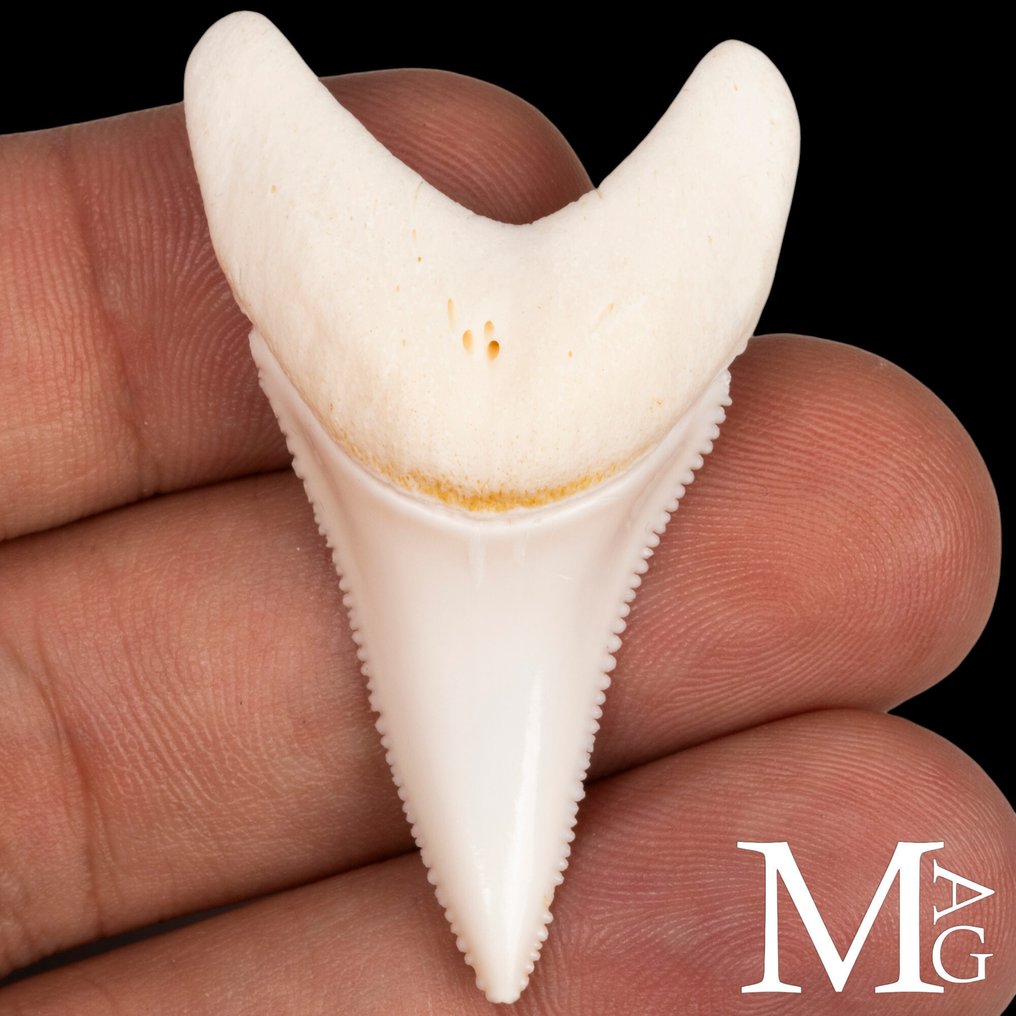
Shark Set of teeth - Carcharodon Carcharias - 51 mm - 49 mm - 30 mm- CITES Appendix II - Annex B in the EU - (1)




Opens 19:00
Starting bid
€ 1
Add to your favourites to get an alert when the auction starts.

Expert
Selected by Jonas Rathaj
Has worked with taxidermy since childhood and gained retailer experience.
Estimate € 550 - € 630
Catawiki Buyer Protection
Your payment’s safe with us until you receive your object.View details
Trustpilot 4.4 | 122630 reviews
Rated Excellent on Trustpilot.
Description from the seller
Tooth belonging to the great white shark (Carcharodon carcharias), corresponding to the left anterior lateral dentition of the upper jaw. The specimen measures 51 mm and exhibits a well-defined distal curvature, with a geometry slightly inclined outward, typical of teeth positioned immediately after the centrals in the functional series.
The crown is elongated, pointed, and slightly compressed, with finely serrated edges extending along the entire blade. The enamel appears smooth, compact, and shiny, with a splendid natural ivory hue and a visible transition zone between the crown and the base. The latter is wide and robust, with bilateral symmetry and regular porosity, of a light beige color with a fine yellow mineral patina along the crown edge, indicating natural origin.
The anterolateral positioning and the structure of the tooth indicate its primary function: to grasp, shear, and tear portions of meat during biting, working in combination with the central and posterior teeth of the jaw. This type of tooth works synergistically with the rotational movements of the skull to maximize cutting force.
The great white shark is one of the most evolved marine predators on the planet, and its teeth represent a pinnacle in predator biomechanics among vertebrates. A tooth like this is a perfect example of the level of functional specialization achieved by the species, sought after by collectors for its symmetry, integrity, and glazed shine.
Seller's Story
The Mineral Art Gallery offers minerals, fossils, shells and natural elements.
Born in Italy in 2017, today she collaborates with international galleries and collectors, she is a direct importer of large minerals and naturalistic collectible elements; deals with the processing to insert them inside the living space. A section of the gallery was dedicated to the Wunderkammer, "chamber of wonders or cabinet of curiosities" in which Mirabilia elements are presented: naturalia and italiania, a union between "the present is the past".
All lots are shipped via DHL Express and Fercam couriers, with insured parcel and tracking.
Translated by Google TranslateTooth belonging to the great white shark (Carcharodon carcharias), corresponding to the left anterior lateral dentition of the upper jaw. The specimen measures 51 mm and exhibits a well-defined distal curvature, with a geometry slightly inclined outward, typical of teeth positioned immediately after the centrals in the functional series.
The crown is elongated, pointed, and slightly compressed, with finely serrated edges extending along the entire blade. The enamel appears smooth, compact, and shiny, with a splendid natural ivory hue and a visible transition zone between the crown and the base. The latter is wide and robust, with bilateral symmetry and regular porosity, of a light beige color with a fine yellow mineral patina along the crown edge, indicating natural origin.
The anterolateral positioning and the structure of the tooth indicate its primary function: to grasp, shear, and tear portions of meat during biting, working in combination with the central and posterior teeth of the jaw. This type of tooth works synergistically with the rotational movements of the skull to maximize cutting force.
The great white shark is one of the most evolved marine predators on the planet, and its teeth represent a pinnacle in predator biomechanics among vertebrates. A tooth like this is a perfect example of the level of functional specialization achieved by the species, sought after by collectors for its symmetry, integrity, and glazed shine.
Seller's Story
The Mineral Art Gallery offers minerals, fossils, shells and natural elements.
Born in Italy in 2017, today she collaborates with international galleries and collectors, she is a direct importer of large minerals and naturalistic collectible elements; deals with the processing to insert them inside the living space. A section of the gallery was dedicated to the Wunderkammer, "chamber of wonders or cabinet of curiosities" in which Mirabilia elements are presented: naturalia and italiania, a union between "the present is the past".
All lots are shipped via DHL Express and Fercam couriers, with insured parcel and tracking.
Translated by Google TranslateDetails
Era
After 2000
Specimen
Shark
Scientific Name
Carcharodon Carcharias
No. of items
1
Country of Origin
Middle America and Caribbean
CITES relevancy
CITES Appendix II - Annex B in the EU
Condition
Good condition
Year
2023
Weight
8 g
Depth
30 mm
Height
51 mm
Width
49 mm
Sold by