Divers - Coran manuscrit persan, moghol, Safavide, Reliure originale, enluminé d’or, et 2 feuillets doubles.. - 1620


02
days
12
hours
07
minutes
46
seconds

48 other people are watching this object
 Bidder 2978 Bidder 2978 | €160 | |
|---|---|---|
 Bidder 9749 Bidder 9749 | €150 | |
| Bidder 2978 | €148 | |
Catawiki Buyer Protection
Your payment’s safe with us until you receive your object.View details
Trustpilot 4.4 | 121798 reviews
Rated Excellent on Trustpilot.
Coran manuscript in Arabic, from the Persian/Moghul Safavid sphere, circa 1620–1680, with original binding, gold illumination and two double frontispieces, 14 pages, 21.5 × 15 cm.
AI-assisted summary
Description from the seller
Persian/Mughal manuscript Quran (Safavid), circa 1620–1680 – Original binding, double illuminated frontispiece in gold, and 2 double leaves with manuscripts on recto and verso – Saved from an ancient fire.
Manuscript of the Quran – Persia / Mughal India (Safavid) – circa 1620–1680
Rare ensemble including the original binding, decorated internally.
The double frontispiece at the beginning of the Quran (full-page illumination).
Two double-sided manuscript pages with text written in Naskh script.
Historical provenance, manuscript saved from a fire, authentic heat traces.
This manuscript presents all the characteristics of late Safavid (Isfahan) or Mughal (Lahore/Delhi) productions in the 17th century.
Chiffon laid paper, carefully glazed.
Black and red ink.
Gold rosettes marking the verses.
Golden frames with black fillets.
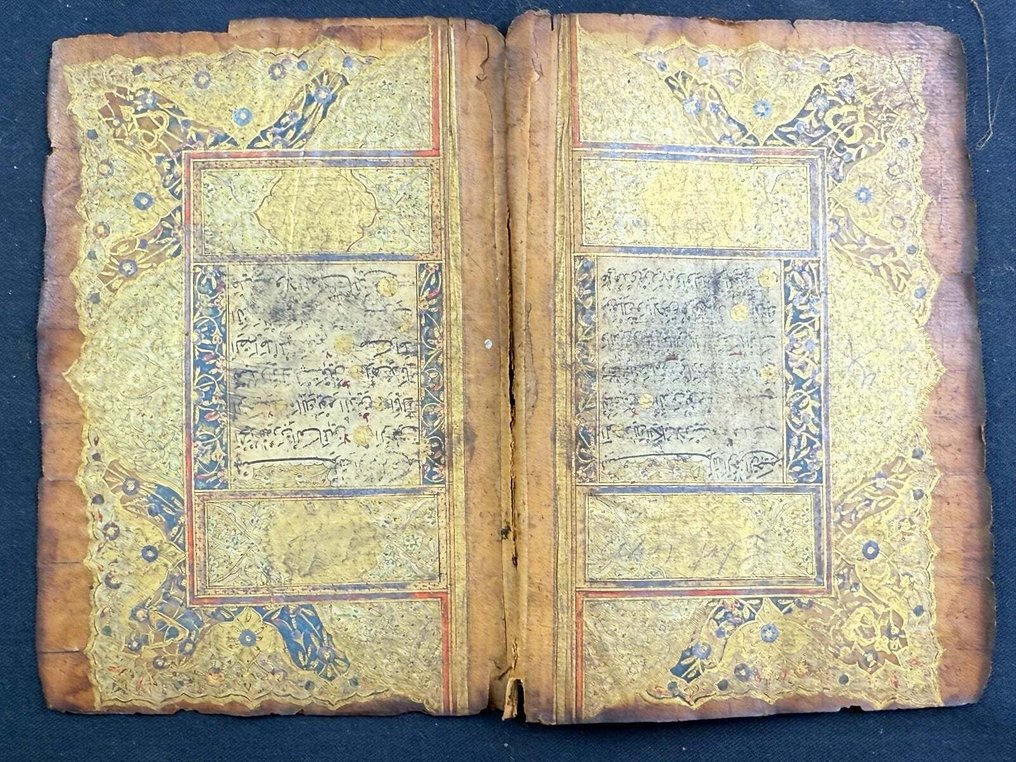
Double opening frontispiece entirely adorned with burnished gold, floral motifs inspired by Safavid art, in lapis lazuli blue and cinnabar red.
Estimated dating circa 1620–1680.
Persian Naskh script, elegant and regular, 11 to 13 lines per page. Fine gold framing.
Verse separators in the shape of golden rosettes. Pedagogical and phonetic markings in red ink.
The identified pages correspond to the surahs An-Nūr (24) and Al-Furqān (25), located in the second third of the Quran (Juz’ 18–20).
The double frontispiece features a gold background. Blue and red floral motifs, complex vegetal networks. Multiple frames (gold, blue, red). A symmetrical composition characteristic of the luxury Qurans of the Safavid and Mughal periods.
It is the most precious element of the manuscript.
Manuscript saved from a fire.
This set comes from a Quran that was completely saved from an ancient fire.
Visible traces, borders browned by heat. Discolorations and soot. Ink sometimes swollen. Some pages well preserved in the central area. Despite the alterations, the vast majority of the texts remain legible and the overall piece retains significant historical and artistic value.
Sheets of the same format, chiffon textured paper, glazed watermarked paper.
Original binding (recto/verso)
2. Double illuminated frontispiece with gold.
3. 2 leaves, double-sided manuscripts, well preserved.
Cover pages with Persian inscriptions (old owner notes).
Illuminated Quran manuscript, early 17th century.
Arabic manuscript on smooth laid paper, brown ink, gold punctuation and ornaments, mineral pigments in blue and red.
Format 21.5cm × 15cm.
Written surface, 10.5cm × 6cm.
Visible traces, heated paper, browned edges, and water halos corroborate this event. Fragmentary manuscript, significant wear, paper deterioration (burns, humidity, missing parts). An authentic ancient manuscript, manually decorated with gold.
Support smooth laid paper, handmade.
Laid paper with visible watermarks
Polished surface, probably polished with an agate stone burnisher.
Dating 1600–1650
Conservation tips, as it is very fragile.
Keep flat
Acid-free folder (without acid)
No direct light
Stable hygrometry: 50–55%
Temperature approximately 18–21°C
Never humidify gold → immediate loss.
Very rare.
Shipping via Chronopost or another method depending on the country, with insurance.
Persian/Mughal manuscript Quran (Safavid), circa 1620–1680 – Original binding, double illuminated frontispiece in gold, and 2 double leaves with manuscripts on recto and verso – Saved from an ancient fire.
Manuscript of the Quran – Persia / Mughal India (Safavid) – circa 1620–1680
Rare ensemble including the original binding, decorated internally.
The double frontispiece at the beginning of the Quran (full-page illumination).
Two double-sided manuscript pages with text written in Naskh script.
Historical provenance, manuscript saved from a fire, authentic heat traces.
This manuscript presents all the characteristics of late Safavid (Isfahan) or Mughal (Lahore/Delhi) productions in the 17th century.
Chiffon laid paper, carefully glazed.
Black and red ink.
Gold rosettes marking the verses.
Golden frames with black fillets.
Double opening frontispiece entirely adorned with burnished gold, floral motifs inspired by Safavid art, in lapis lazuli blue and cinnabar red.
Estimated dating circa 1620–1680.
Persian Naskh script, elegant and regular, 11 to 13 lines per page. Fine gold framing.
Verse separators in the shape of golden rosettes. Pedagogical and phonetic markings in red ink.
The identified pages correspond to the surahs An-Nūr (24) and Al-Furqān (25), located in the second third of the Quran (Juz’ 18–20).
The double frontispiece features a gold background. Blue and red floral motifs, complex vegetal networks. Multiple frames (gold, blue, red). A symmetrical composition characteristic of the luxury Qurans of the Safavid and Mughal periods.
It is the most precious element of the manuscript.
Manuscript saved from a fire.
This set comes from a Quran that was completely saved from an ancient fire.
Visible traces, borders browned by heat. Discolorations and soot. Ink sometimes swollen. Some pages well preserved in the central area. Despite the alterations, the vast majority of the texts remain legible and the overall piece retains significant historical and artistic value.
Sheets of the same format, chiffon textured paper, glazed watermarked paper.
Original binding (recto/verso)
2. Double illuminated frontispiece with gold.
3. 2 leaves, double-sided manuscripts, well preserved.
Cover pages with Persian inscriptions (old owner notes).
Illuminated Quran manuscript, early 17th century.
Arabic manuscript on smooth laid paper, brown ink, gold punctuation and ornaments, mineral pigments in blue and red.
Format 21.5cm × 15cm.
Written surface, 10.5cm × 6cm.
Visible traces, heated paper, browned edges, and water halos corroborate this event. Fragmentary manuscript, significant wear, paper deterioration (burns, humidity, missing parts). An authentic ancient manuscript, manually decorated with gold.
Support smooth laid paper, handmade.
Laid paper with visible watermarks
Polished surface, probably polished with an agate stone burnisher.
Dating 1600–1650
Conservation tips, as it is very fragile.
Keep flat
Acid-free folder (without acid)
No direct light
Stable hygrometry: 50–55%
Temperature approximately 18–21°C
Never humidify gold → immediate loss.
Very rare.
Shipping via Chronopost or another method depending on the country, with insurance.
Details
Number of Books
1
Author/ Illustrator
Divers
Book Title
Coran manuscrit persan, moghol, Safavide, Reliure originale, enluminé d’or, et 2 feuillets doubles..
Subject
Quran
Condition
Good
Language
Arabic
Publication year oldest item
1620
Original language
Yes
Binding/ Material
Single page
Publication year youngest item
1680
Extras
Hand coloured illustrations, Limited edition
Height
21 cm
Number of pages
14
Width
15 cm
Signature
Not signed
Has Certificate of Authenticity
No