A Fragment of Showa Nostalgia: Vintage Enamel Membership Plaque from Japan's Minato Acupuncture & - Enamel sign - Enamel


00
days
07
hours
34
minutes
33
seconds
Current bid
€ 2
No reserve price

Expert
Selected by Ashley Calvert
He has 15 years of experience trading 20th century glass and antiques.
Estimate € 140 - € 200
31 other people are watching this object
 Bidder 8917 Bidder 8917 | €2 | |
|---|---|---|
| Bidder 7617 | €1 |
Catawiki Buyer Protection
Your payment’s safe with us until you receive your object.View details
Trustpilot 4.4 | 122813 reviews
Rated Excellent on Trustpilot.
This Showa enamel membership plaque from the Minato Acupuncture & Massage Practitioners' Association offers tangible history and a durable display piece for signage enthusiasts.
AI-assisted summary
Description from the seller
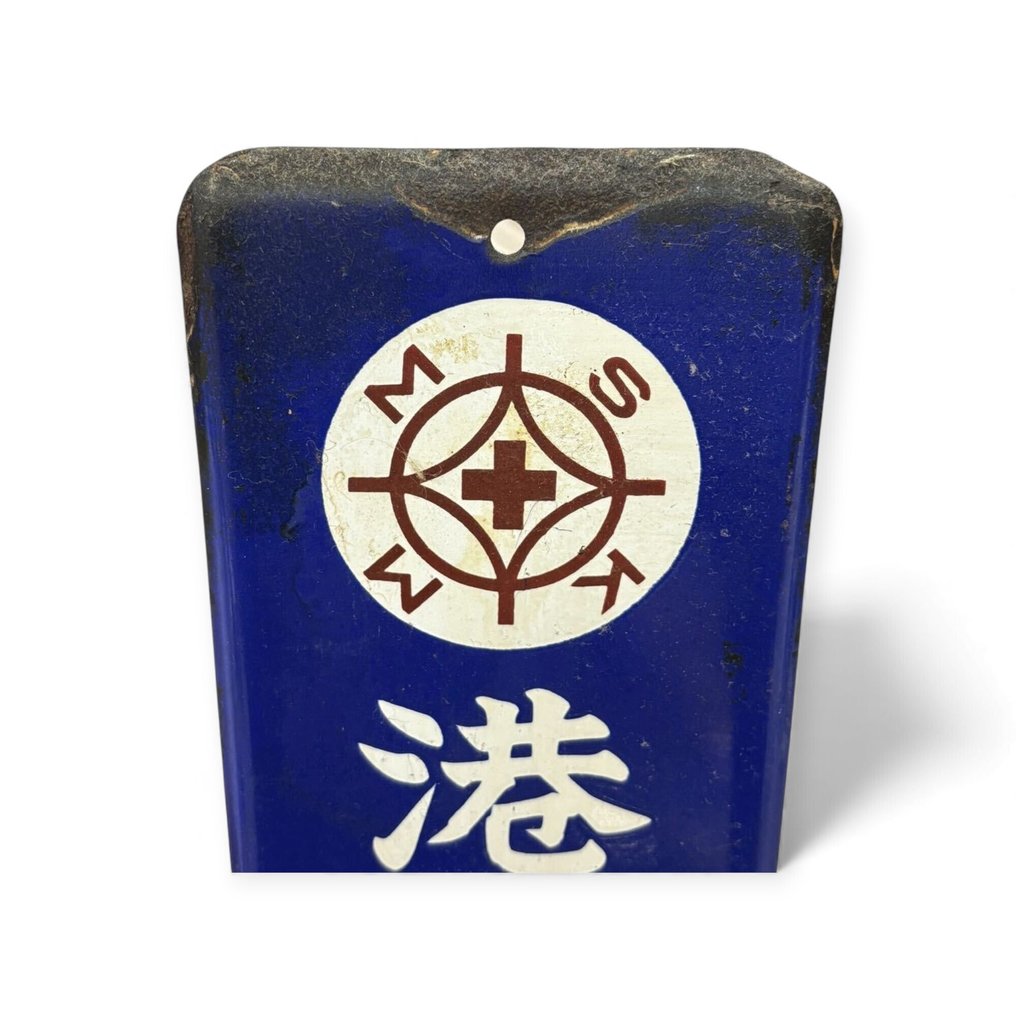
Some objects transcend their original purpose to become archaeology of daily life—tangible connections to vanished worlds we can only glimpse through photographs and fading memories. This porcelain-enamelled membership plaque from the Minato (港) Acupuncture & Massage Practitioners' Association represents precisely that kind of cultural artefact: a humble piece of administrative signage transformed by time and rarity into something collectors passionately seek.
Discovered during a clearance of a shuttered traditional practice in Osaka, this sign arrived layered in the honest patina of decades spent fulfilling its modest duty. Unlike the advertising behemoths that trumpet soft drinks and cigarettes, professional association plaques remained quietly understated—dignified markers of qualification and membership rather than commercial seduction. That restraint makes surviving examples surprisingly rare. When practices closed or relocated, these small enamel signs were typically discarded without sentiment. Why preserve administrative paperwork? Yet that disposability makes survivors valuable—what everyone threw away, almost nobody kept.
Measuring approximately 45 by 12 centimetres, the sign employs the classic hōrō (琺瑯/ホーロー) porcelain-enamel technique that dominated Japanese commercial signage throughout the Showa period (1926–1989). The process involved fusing powdered glass to steel substrate through high-temperature firing, creating surfaces that could withstand rain, sun, and decades of exposure whilst maintaining legibility. The technology arrived in Japan during the Meiji Restoration as part of rapid Western industrialization, but Japanese manufacturers quickly refined it to extraordinary levels of durability and colour fidelity.
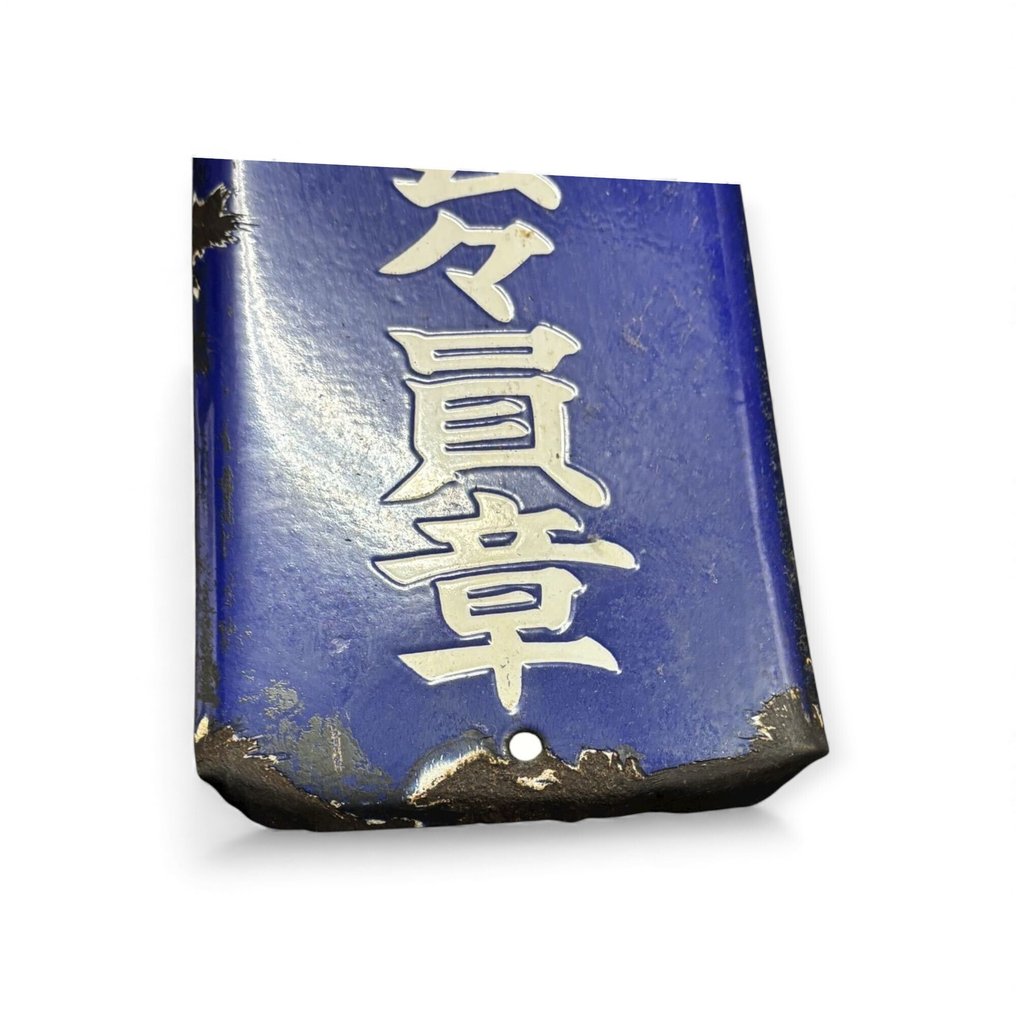
This particular example displays characteristic Showa-era design sensibility: straightforward composition, clear hierarchy of information, and restrained colour palette. The kanji characters announcing "Minato Acupuncture & Massage Association Member" sit within a simple border, prioritizing function over decoration. There's no attempt at the whimsical illustration or Art Deco flourishes that distinguish advertising signs from the same period. Professional guilds wanted dignity, not flash. That sobriety makes these plaques particularly appealing in contemporary interiors—they carry historical weight without visual noise.
Condition reflects authentic age and outdoor service. The enamel surface shows rust bloom, edge wear, and the kind of weathering that instantly distinguishes genuine vintage enamel from reproduction attempts. Modern manufacturers can replicate colours and fonts, but they struggle to fake decades of oxidation patterns and UV fade. Collectors specifically seek this "as-found" state because aggressive restoration destroys what makes these signs valuable—their status as unmediated time capsules. Think of it as the difference between a pristine vintage Levi's jacket and one that's been artificially distressed. Both might look similar in photographs, but serious denim collectors instantly spot the difference.
The sign's geographic specificity adds collecting appeal. "Minato" likely refers to one of several Japanese port districts—perhaps Minato-ku in Tokyo, historically home to embassies and international trade, or possibly another Minato district in Kobe, Yokohama, or Nagasaki. These port neighbourhoods developed sophisticated cultures where traditional Japanese medicine practitioners served both local communities and international residents seeking alternatives to Western medicine. During the Showa period, acupuncture and massage occupied interesting cultural territory—ancient practices gaining increasing scientific legitimacy whilst remaining outside mainstream medical hierarchies. Professional associations like this one worked to establish standards, lobby for recognition, and create community among practitioners often working in isolation.
For Western collectors, Japanese enamel signs have become increasingly desirable as design communities recognize their aesthetic sophistication and historical importance. Unlike Western porcelain enamel advertising, which often leaned toward aggressive commercialism, Japanese examples tend toward restraint and craft quality. Major auction houses now regularly feature Showa-era signage in Asian Art & Design sales, with rare examples achieving prices that would astonish anyone who remembers when these were purely nostalgic ephemera rather than collectible design objects.
Display possibilities are remarkably versatile. Industrial-chic loft apartments benefit from the urban archaeology vibe these signs naturally radiate—imagine this mounted on exposed brick between vintage factory lighting and mid-century furniture. Scandinavian-influenced interiors appreciate the minimalist typography and honest materiality. Maximalist collectors incorporate enamel signs into dense salon-style walls where different periods and origins create visual energy through juxtaposition. Medical professionals occasionally collect these as nods to their professions' histories—a GP's consulting room gains instant character when a vintage practitioners' sign hangs beside modern diplomas.
Authentication with Showa enamel signs requires understanding manufacturing techniques. Genuine period pieces show hand-painted or stencilled typography with subtle irregularities impossible to achieve through modern digital printing. Enamel surfaces should feel genuinely glassy—smooth yet slightly textured—rather than printed vinyl masquerading as porcelain enamel. Rust patterns should follow predictable paths where steel substrate meets edges and mounting holes. This example demonstrates all correct markers of authenticity.
Condition-appropriate mounting becomes important with weathered enamel. Purpose-made brass or copper wire hangers preserve vintage character whilst providing secure attachment. Some collectors prefer shadow-box framing that protects whilst allowing the sign to remain visible from all angles. Others simply lean signs against walls on shelves, embracing the casual attitude that suits their utilitarian origins.
Shipping & Handling
We ship worldwide via DHL or EMS with full insurance and tracking. Enamel signs travel sandwiched between rigid cardboard sheets, wrapped in protective foam, and secured in appropriately sized cartons. Despite substantial enamel and steel construction, we treat these as fragile given their age and existing patina. Professional packing ensures safe arrival; combined shipping available for multiple wins. Local customs duties are the buyer's responsibility.
Seller Guarantee
We specialise in authentic Showa-era Japanese enamel signage and advertising ephemera, and guarantee this piece's period authenticity based on manufacturing techniques, materials, and weathering patterns consistent with genuine post-war production. Questions welcome—we reply within 24 hours.
1134
Seller's Story
Hello, and thank you for visiting my page. I primarily handle Japanese antiques, as well as Western antiques, art pieces, and pre-loved items that have been cherished in Japan. Growing up in a family of historians—my grandfather was a historian and my father was an archaeologist—I have always been captivated by the eras and stories these historic objects and works of art carry with them.
My listings feature collections from both Japan and the West, pieces that have stood the test of time and remained beloved through the ages. Through these rare treasures, I hope to share with you the delight of ownership and discovery. As a professional, I strive for honest and sincere transactions to ensure customer satisfaction, always leveraging my experience and eye for quality.
I strongly believe in not letting buyers down, so I describe items as accurately and thoroughly as possible, prioritizing secure and careful packaging. If you have any questions or concerns, please feel free to reach out. It would be my pleasure to help enrich your collecting experience.
Thank you for your interest, and I look forward to doing business with you.
Some objects transcend their original purpose to become archaeology of daily life—tangible connections to vanished worlds we can only glimpse through photographs and fading memories. This porcelain-enamelled membership plaque from the Minato (港) Acupuncture & Massage Practitioners' Association represents precisely that kind of cultural artefact: a humble piece of administrative signage transformed by time and rarity into something collectors passionately seek.
Discovered during a clearance of a shuttered traditional practice in Osaka, this sign arrived layered in the honest patina of decades spent fulfilling its modest duty. Unlike the advertising behemoths that trumpet soft drinks and cigarettes, professional association plaques remained quietly understated—dignified markers of qualification and membership rather than commercial seduction. That restraint makes surviving examples surprisingly rare. When practices closed or relocated, these small enamel signs were typically discarded without sentiment. Why preserve administrative paperwork? Yet that disposability makes survivors valuable—what everyone threw away, almost nobody kept.
Measuring approximately 45 by 12 centimetres, the sign employs the classic hōrō (琺瑯/ホーロー) porcelain-enamel technique that dominated Japanese commercial signage throughout the Showa period (1926–1989). The process involved fusing powdered glass to steel substrate through high-temperature firing, creating surfaces that could withstand rain, sun, and decades of exposure whilst maintaining legibility. The technology arrived in Japan during the Meiji Restoration as part of rapid Western industrialization, but Japanese manufacturers quickly refined it to extraordinary levels of durability and colour fidelity.
This particular example displays characteristic Showa-era design sensibility: straightforward composition, clear hierarchy of information, and restrained colour palette. The kanji characters announcing "Minato Acupuncture & Massage Association Member" sit within a simple border, prioritizing function over decoration. There's no attempt at the whimsical illustration or Art Deco flourishes that distinguish advertising signs from the same period. Professional guilds wanted dignity, not flash. That sobriety makes these plaques particularly appealing in contemporary interiors—they carry historical weight without visual noise.
Condition reflects authentic age and outdoor service. The enamel surface shows rust bloom, edge wear, and the kind of weathering that instantly distinguishes genuine vintage enamel from reproduction attempts. Modern manufacturers can replicate colours and fonts, but they struggle to fake decades of oxidation patterns and UV fade. Collectors specifically seek this "as-found" state because aggressive restoration destroys what makes these signs valuable—their status as unmediated time capsules. Think of it as the difference between a pristine vintage Levi's jacket and one that's been artificially distressed. Both might look similar in photographs, but serious denim collectors instantly spot the difference.
The sign's geographic specificity adds collecting appeal. "Minato" likely refers to one of several Japanese port districts—perhaps Minato-ku in Tokyo, historically home to embassies and international trade, or possibly another Minato district in Kobe, Yokohama, or Nagasaki. These port neighbourhoods developed sophisticated cultures where traditional Japanese medicine practitioners served both local communities and international residents seeking alternatives to Western medicine. During the Showa period, acupuncture and massage occupied interesting cultural territory—ancient practices gaining increasing scientific legitimacy whilst remaining outside mainstream medical hierarchies. Professional associations like this one worked to establish standards, lobby for recognition, and create community among practitioners often working in isolation.
For Western collectors, Japanese enamel signs have become increasingly desirable as design communities recognize their aesthetic sophistication and historical importance. Unlike Western porcelain enamel advertising, which often leaned toward aggressive commercialism, Japanese examples tend toward restraint and craft quality. Major auction houses now regularly feature Showa-era signage in Asian Art & Design sales, with rare examples achieving prices that would astonish anyone who remembers when these were purely nostalgic ephemera rather than collectible design objects.
Display possibilities are remarkably versatile. Industrial-chic loft apartments benefit from the urban archaeology vibe these signs naturally radiate—imagine this mounted on exposed brick between vintage factory lighting and mid-century furniture. Scandinavian-influenced interiors appreciate the minimalist typography and honest materiality. Maximalist collectors incorporate enamel signs into dense salon-style walls where different periods and origins create visual energy through juxtaposition. Medical professionals occasionally collect these as nods to their professions' histories—a GP's consulting room gains instant character when a vintage practitioners' sign hangs beside modern diplomas.
Authentication with Showa enamel signs requires understanding manufacturing techniques. Genuine period pieces show hand-painted or stencilled typography with subtle irregularities impossible to achieve through modern digital printing. Enamel surfaces should feel genuinely glassy—smooth yet slightly textured—rather than printed vinyl masquerading as porcelain enamel. Rust patterns should follow predictable paths where steel substrate meets edges and mounting holes. This example demonstrates all correct markers of authenticity.
Condition-appropriate mounting becomes important with weathered enamel. Purpose-made brass or copper wire hangers preserve vintage character whilst providing secure attachment. Some collectors prefer shadow-box framing that protects whilst allowing the sign to remain visible from all angles. Others simply lean signs against walls on shelves, embracing the casual attitude that suits their utilitarian origins.
Shipping & Handling
We ship worldwide via DHL or EMS with full insurance and tracking. Enamel signs travel sandwiched between rigid cardboard sheets, wrapped in protective foam, and secured in appropriately sized cartons. Despite substantial enamel and steel construction, we treat these as fragile given their age and existing patina. Professional packing ensures safe arrival; combined shipping available for multiple wins. Local customs duties are the buyer's responsibility.
Seller Guarantee
We specialise in authentic Showa-era Japanese enamel signage and advertising ephemera, and guarantee this piece's period authenticity based on manufacturing techniques, materials, and weathering patterns consistent with genuine post-war production. Questions welcome—we reply within 24 hours.
1134
Seller's Story
Hello, and thank you for visiting my page. I primarily handle Japanese antiques, as well as Western antiques, art pieces, and pre-loved items that have been cherished in Japan. Growing up in a family of historians—my grandfather was a historian and my father was an archaeologist—I have always been captivated by the eras and stories these historic objects and works of art carry with them.
My listings feature collections from both Japan and the West, pieces that have stood the test of time and remained beloved through the ages. Through these rare treasures, I hope to share with you the delight of ownership and discovery. As a professional, I strive for honest and sincere transactions to ensure customer satisfaction, always leveraging my experience and eye for quality.
I strongly believe in not letting buyers down, so I describe items as accurately and thoroughly as possible, prioritizing secure and careful packaging. If you have any questions or concerns, please feel free to reach out. It would be my pleasure to help enrich your collecting experience.
Thank you for your interest, and I look forward to doing business with you.
Details
Era
1900-2000
No. of items
1
Title
A Fragment of Showa Nostalgia: Vintage Enamel Membership Plaque from Japan's Minato Acupuncture &
Country of Origin
Japan
Material
Enamel
Qualification
Original/official
Condition
Fair condition - heavily used & with possibly minor parts missing
Height
45 cm
Width
11.7 cm
Estimated Period
1960-1970
Sold by