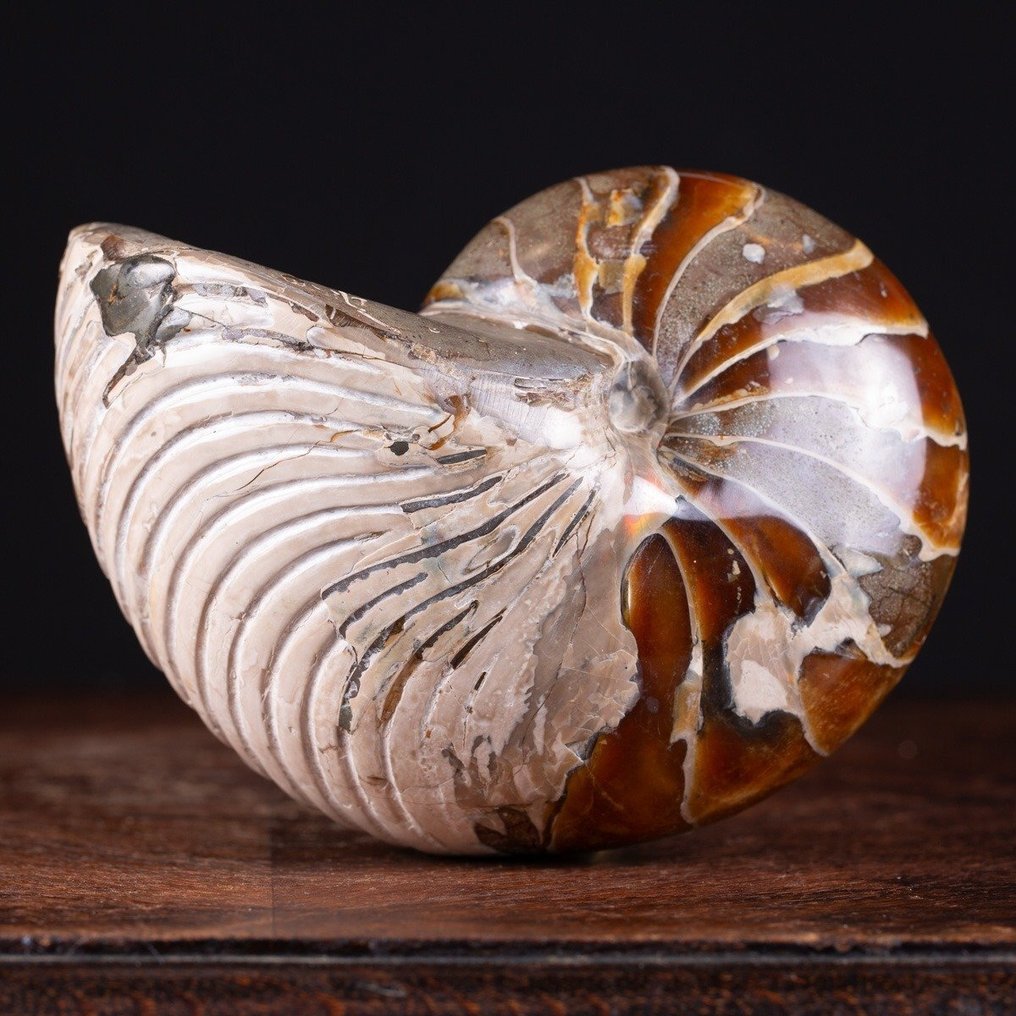
Fossil Nautilo - Cymatoceras Sp. - Opalization on Shell - Fossil fragment - Perfect State of Preservation - 165 mm - 120 mm


Opens tomorrow
Starting bid
€ 1
Add to your favourites to get an alert when the auction starts.

Catawiki Buyer Protection
Your payment’s safe with us until you receive your object.View details
Trustpilot 4.4 | 122986 reviews
Rated Excellent on Trustpilot.
Description from the seller
Fossil nautilus - Cymatoceras species
"Cymatoceras" is a genus of extinct cephalopods, described by Hyatt in 1884. They are known for their coiled shells and are part of the family Cymatoceratidae. These extinct marine organisms lived from the late Jurassic to the late Oligocene and represent an interesting subject of study for paleontologists to understand the evolutionary history of cephalopods and the marine environment in the past.
Nautilus fossils are known for their rich caramel and brown colors displayed in intricate striped patterns. These fascinating colors are the result of an intriguing process that occurred during fossilization.
The original organic material present in the living Nautilus has been gradually replaced by colorful calcite minerals over millions of years. This process, known as permineralization, involves the slow infiltration of minerals into the microscopic pores and cavities within the fossilized shell. As the minerals replace the organic material, they can impart a wide range of colors and patterns to the fossilized shell, resulting in the beautiful shades of caramel and brown with intricate streaks that are often observed in Nautilus fossils.
Seller's Story
The Mineral Art Gallery offers minerals, fossils, shells and natural elements.
Born in Italy in 2017, today she collaborates with international galleries and collectors, she is a direct importer of large minerals and naturalistic collectible elements; deals with the processing to insert them inside the living space. A section of the gallery was dedicated to the Wunderkammer, "chamber of wonders or cabinet of curiosities" in which Mirabilia elements are presented: naturalia and italiania, a union between "the present is the past".
All lots are shipped via DHL Express and Fercam couriers, with insured parcel and tracking.
Translated by Google TranslateFossil nautilus - Cymatoceras species
"Cymatoceras" is a genus of extinct cephalopods, described by Hyatt in 1884. They are known for their coiled shells and are part of the family Cymatoceratidae. These extinct marine organisms lived from the late Jurassic to the late Oligocene and represent an interesting subject of study for paleontologists to understand the evolutionary history of cephalopods and the marine environment in the past.
Nautilus fossils are known for their rich caramel and brown colors displayed in intricate striped patterns. These fascinating colors are the result of an intriguing process that occurred during fossilization.
The original organic material present in the living Nautilus has been gradually replaced by colorful calcite minerals over millions of years. This process, known as permineralization, involves the slow infiltration of minerals into the microscopic pores and cavities within the fossilized shell. As the minerals replace the organic material, they can impart a wide range of colors and patterns to the fossilized shell, resulting in the beautiful shades of caramel and brown with intricate streaks that are often observed in Nautilus fossils.
Seller's Story
The Mineral Art Gallery offers minerals, fossils, shells and natural elements.
Born in Italy in 2017, today she collaborates with international galleries and collectors, she is a direct importer of large minerals and naturalistic collectible elements; deals with the processing to insert them inside the living space. A section of the gallery was dedicated to the Wunderkammer, "chamber of wonders or cabinet of curiosities" in which Mirabilia elements are presented: naturalia and italiania, a union between "the present is the past".
All lots are shipped via DHL Express and Fercam couriers, with insured parcel and tracking.
Translated by Google TranslateDetails
Specimen
Fossil Nautilo - Cymatoceras Sp. - Opalization on Shell
Scientific name
Perfect State of Preservation
Country of Origin
Madagascar
Geological Period
Cretaceous, Lower (145 - 100.5 million years)
Condition
Natural
Weight
2570 g
Height
165 mm
Width
120 mm
Depth
140 mm
Sold by