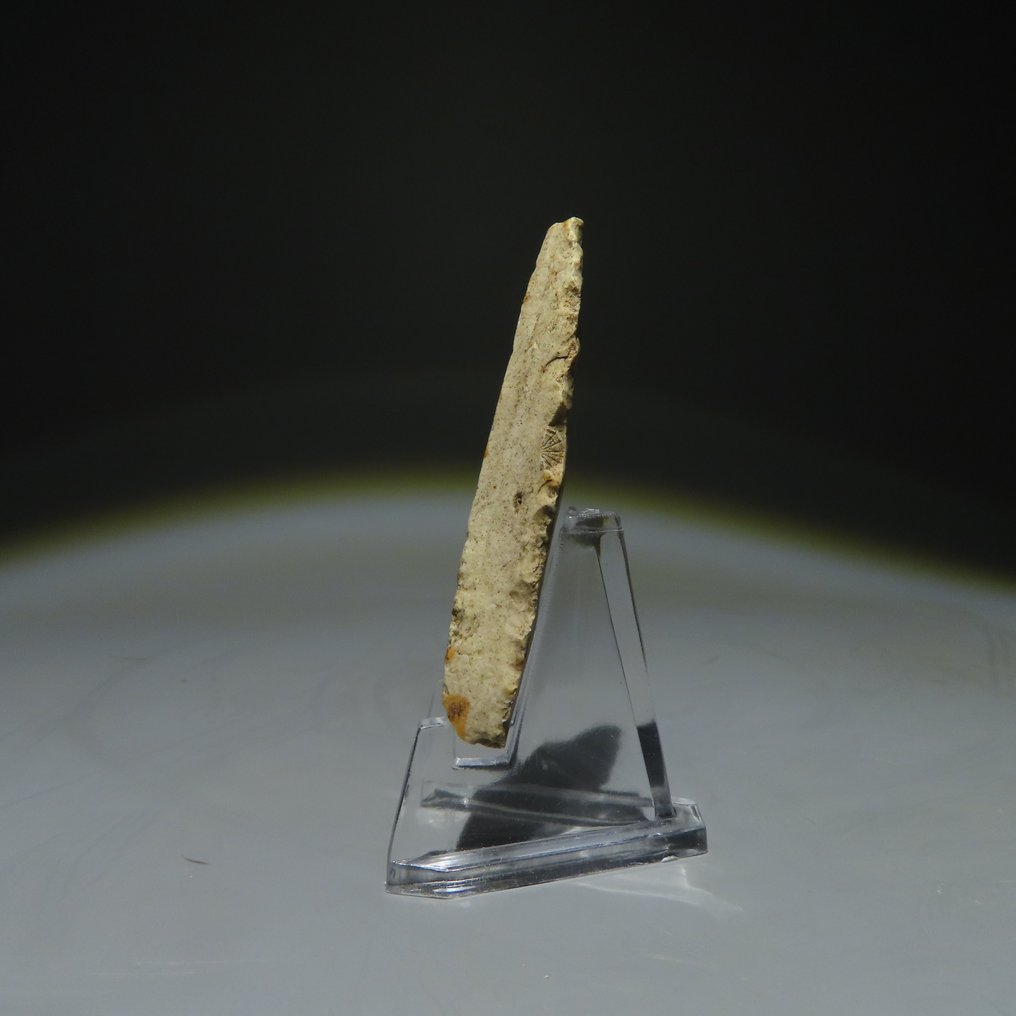
Neolithic Flint Flint tool. Michelsberg Culture (found in Spiennes, Mons, Belgium). Neolithic Period, circa (No Reserve Price)



02
days
22
hours
54
minutes
09
seconds
Current bid
€ 1
No reserve price

Expert
Selected by Peter Reynaers
Has nearly 30 years’ experience and moderated multiple online art research groups.
Estimate € 150 - € 200
4 other people are watching this object
 Bidder 2978 Bidder 2978 | €1 |
|---|
Catawiki Buyer Protection
Your payment’s safe with us until you receive your object.View details
Trustpilot 4.4 | 121899 reviews
Rated Excellent on Trustpilot.
A Neolithic Michelsberg culture flint tool from Spiennes, Belgium, with documented provenance and a richly documented mining site context that adds bid appeal.
AI-assisted summary
Description from the seller
Flint tool
Michelsberg Culture (found in Spiennes, Mons, Belgium).
Neolithic Period, circa 4500-3500 B.C.
Height 6 cm H
PROVENANCE:
- Found in 1979 at Camp-à-Cayaux, near Spiennes (Mons), Belgium.
- Then in the holdings of a private museum in Amersfoort, the Netherlands.
- Acquired from this by the Dutch antique dealer W. Stormbroek.
- Acquired as a group when it closed down in 2010. Since then in the inventory of the Galerie Alte Römer, Germany.
- Spanish private collection.
CONDITION: Unrestored, as found.
PARALLELS: For similar material see Centre de Recherche Archéologique du Camp à Cayaux (Spiennes, Belgique).
DOCUMENTS:
- Export license issued by the Ministry of Culture, Madrid, Spain.
DESCRIPCTION:
The Michelsberg culture belongs to the Central European Late Neolithic. Its distribution covered much of West Central Europe, along both sides of the Rhine. A detailed chronology, based on pottery, was produced in the 1960s by the German archaeologist Jens Lüning. Its dates are c. 4400–3500 BC. Its conventional name is derived from that of an important excavated site on Michelsberg (short for Michaelsberg) hill near Untergrombach, between Karlsruhe and Heidelberg (Baden-Württemberg).
The Neolithic Flint Mines of Spiennes occupy two chalk plateaux located to the south-east of the city of Mons. They cover an area essentially devoted to agriculture. The site appears on the surface as a large area of meadows and fields strewn with millions of scraps of worked flint. Underground, the site is an immense network of galleries linked to the surface by vertical shafts dug by Neolithic populations.
The Neolithic Flint Mines of Spiennes are the largest and earliest concentration of ancient mines of north-west Europe. The mines were in operation for many centuries and the remains vividly illustrate the development and adaptation of mining techniques employed by prehistoric populations in order to exploit large deposits of a material that was essential for the production of tools and cultural evolution generally. They are also remarkable by the diversity of technical mining solutions implemented and by the fact that they are directly linked to a habitat contemporary to them.
In the Neolithic period, (from the last third of the 5th millennium until the first half of the 3rd millennium), the site was the centre of intensive flint mining present underground. Different techniques were used, the most spectacular and characteristic of which was the digging out of shafts of 0.8 to 1.20m in diameter with a depth down to 16 metres. Neolithic populations could thus pass below levels made up of large blocks of flint (up to 2m in length) that they extracted using a particular technique called ‘striking’ (freeing from below with support of a central chalk wall, shoring up of the block, removal of the wall, removal of the props and lowering of the block). The density of the shafts is important, as many as 5,000 in the zone called Petit Spiennes (14 ha), leading to criss-crossing of pits and shafts in some sectors.
The neolithic flint mines near Spienne in Belgium are part of UNESCO's world heritage since the year 2000 (Id. N°: 1006). With the second half of the 5. Millenium BC stone from the Spienne mine was worked in socially increasingly complex neolithic groups in that region. No doubt a source of wealth to that cultures.
The groups of that area are refered to as Michaelsberg culture. They flourished from the mid 5th Millenium BC until the mid 4th Millenium BC in middle Europe. Their culture streched from Germany, northern France to Belgium. Around Spienne, it was finally replaced by the Seine-Oise-Marne culture, which did not use the nearby mine anymore
Notes:
The seller guarantees that he acquired this piece according to all national and international laws related to the ownership of cultural property. Provenance statement seen by Catawiki.
The piece includes authenticity certificate.
The piece includes Spanish Export License (Passport for European Union) - If the piece is destined outside the European Union a substitution of the export permit should be requested. This process could take between 1 and 2 months.
Seller's Story
Gallery of Ancient Art - Archeology based in Barcelona with more than fifteen years of experience. Specialized in classical art, Egyptian art, Asian art and pre-Columbian art. It guarantees the authenticity of all its pieces. It participates in the most important art fairs in Spain, such as Feriarte, as well as in fairs abroad, BRAFA, Parcours des Mondes, Cultures Brussels.
All the pieces are sent with an Export Permit issued by the Spanish Ministry of Culture.
We are quick to ship via DHL Express or Direct Art Transport.
Translated by Google TranslateFlint tool
Michelsberg Culture (found in Spiennes, Mons, Belgium).
Neolithic Period, circa 4500-3500 B.C.
Height 6 cm H
PROVENANCE:
- Found in 1979 at Camp-à-Cayaux, near Spiennes (Mons), Belgium.
- Then in the holdings of a private museum in Amersfoort, the Netherlands.
- Acquired from this by the Dutch antique dealer W. Stormbroek.
- Acquired as a group when it closed down in 2010. Since then in the inventory of the Galerie Alte Römer, Germany.
- Spanish private collection.
CONDITION: Unrestored, as found.
PARALLELS: For similar material see Centre de Recherche Archéologique du Camp à Cayaux (Spiennes, Belgique).
DOCUMENTS:
- Export license issued by the Ministry of Culture, Madrid, Spain.
DESCRIPCTION:
The Michelsberg culture belongs to the Central European Late Neolithic. Its distribution covered much of West Central Europe, along both sides of the Rhine. A detailed chronology, based on pottery, was produced in the 1960s by the German archaeologist Jens Lüning. Its dates are c. 4400–3500 BC. Its conventional name is derived from that of an important excavated site on Michelsberg (short for Michaelsberg) hill near Untergrombach, between Karlsruhe and Heidelberg (Baden-Württemberg).
The Neolithic Flint Mines of Spiennes occupy two chalk plateaux located to the south-east of the city of Mons. They cover an area essentially devoted to agriculture. The site appears on the surface as a large area of meadows and fields strewn with millions of scraps of worked flint. Underground, the site is an immense network of galleries linked to the surface by vertical shafts dug by Neolithic populations.
The Neolithic Flint Mines of Spiennes are the largest and earliest concentration of ancient mines of north-west Europe. The mines were in operation for many centuries and the remains vividly illustrate the development and adaptation of mining techniques employed by prehistoric populations in order to exploit large deposits of a material that was essential for the production of tools and cultural evolution generally. They are also remarkable by the diversity of technical mining solutions implemented and by the fact that they are directly linked to a habitat contemporary to them.
In the Neolithic period, (from the last third of the 5th millennium until the first half of the 3rd millennium), the site was the centre of intensive flint mining present underground. Different techniques were used, the most spectacular and characteristic of which was the digging out of shafts of 0.8 to 1.20m in diameter with a depth down to 16 metres. Neolithic populations could thus pass below levels made up of large blocks of flint (up to 2m in length) that they extracted using a particular technique called ‘striking’ (freeing from below with support of a central chalk wall, shoring up of the block, removal of the wall, removal of the props and lowering of the block). The density of the shafts is important, as many as 5,000 in the zone called Petit Spiennes (14 ha), leading to criss-crossing of pits and shafts in some sectors.
The neolithic flint mines near Spienne in Belgium are part of UNESCO's world heritage since the year 2000 (Id. N°: 1006). With the second half of the 5. Millenium BC stone from the Spienne mine was worked in socially increasingly complex neolithic groups in that region. No doubt a source of wealth to that cultures.
The groups of that area are refered to as Michaelsberg culture. They flourished from the mid 5th Millenium BC until the mid 4th Millenium BC in middle Europe. Their culture streched from Germany, northern France to Belgium. Around Spienne, it was finally replaced by the Seine-Oise-Marne culture, which did not use the nearby mine anymore
Notes:
The seller guarantees that he acquired this piece according to all national and international laws related to the ownership of cultural property. Provenance statement seen by Catawiki.
The piece includes authenticity certificate.
The piece includes Spanish Export License (Passport for European Union) - If the piece is destined outside the European Union a substitution of the export permit should be requested. This process could take between 1 and 2 months.
Seller's Story
Gallery of Ancient Art - Archeology based in Barcelona with more than fifteen years of experience. Specialized in classical art, Egyptian art, Asian art and pre-Columbian art. It guarantees the authenticity of all its pieces. It participates in the most important art fairs in Spain, such as Feriarte, as well as in fairs abroad, BRAFA, Parcours des Mondes, Cultures Brussels.
All the pieces are sent with an Export Permit issued by the Spanish Ministry of Culture.
We are quick to ship via DHL Express or Direct Art Transport.
Translated by Google TranslateDetails
Culture
Neolithic
Century/ Timeframe
Neolithic Period, circa 4500-3500 B.C.
Name of object
Flint tool. Michelsberg Culture (found in Spiennes, Mons, Belgium). Neolithic Period, circa
Acquired from
Auction house
Year acquired
2020
Material
Flint
Country acquired from
Belgium
Condition
Good
Previous owner acquired from
Private collection
Previous owner - year acquired
1980
Previous owner - country acquired from
Germany
I verify that I have obtained this object legally and that I am allowed to sell it
Yes
Disclaimer
The seller was informed by Catawiki about documentation requirements and guarantees the following: - the object was legally obtained, - the seller has the right to sell and/or export the object, as relevant, - the seller will provide the necessary provenance information and arrange required documentation and permits/licenses, as applicable and as per local laws, - the seller will notify the buyer of any delays in obtaining permits/licenses. By bidding, you acknowledge that import documentation may be required depending on your country of residence and that obtaining permits/licenses may cause delays in the delivery of your object.
The seller was informed by Catawiki about documentation requirements and guarantees the following: - the object was legally obtained, - the seller has the right to sell and/or export the object, as relevant, - the seller will provide the necessary provenance information and arrange required documentation and permits/licenses, as applicable and as per local laws, - the seller will notify the buyer of any delays in obtaining permits/licenses. By bidding, you acknowledge that import documentation may be required depending on your country of residence and that obtaining permits/licenses may cause delays in the delivery of your object.
