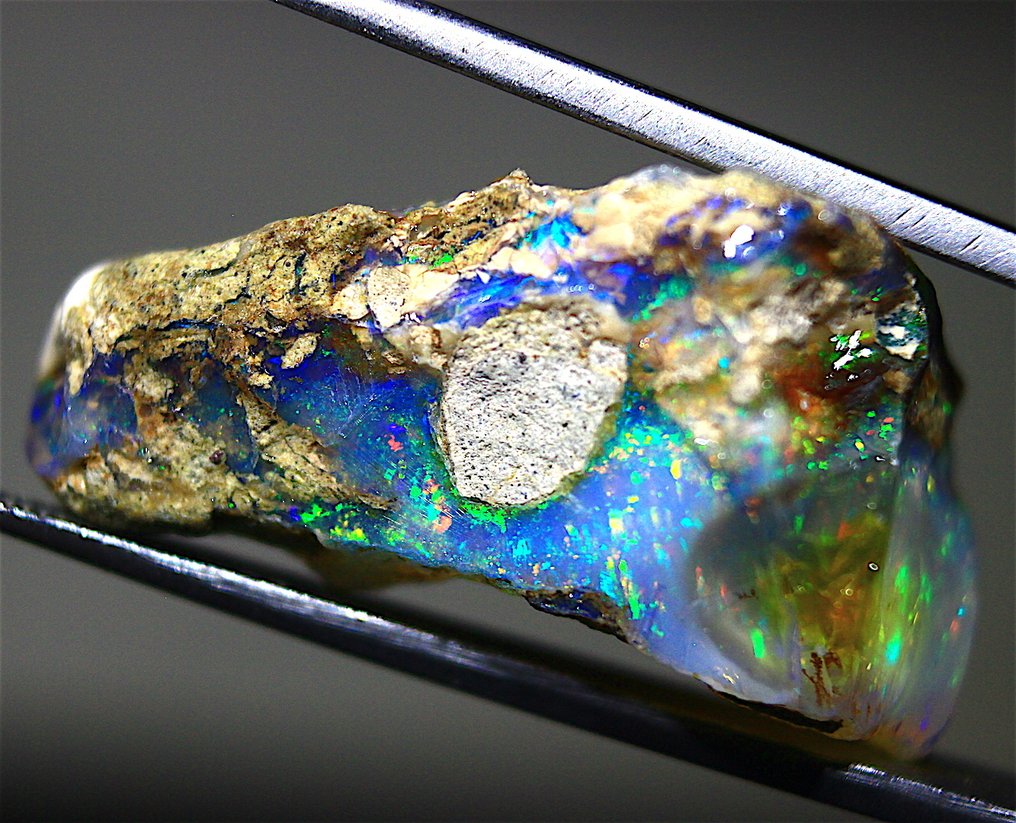
16.90 Ct. Ethiopian Opal Rough - Height: 28 mm - Width: 15 mm- 3.38 g


Opens tomorrow
Starting bid
€ 1
Add to your favourites to get an alert when the auction starts.

Catawiki Buyer Protection
Your payment’s safe with us until you receive your object.View details
Trustpilot 4.4 | 121980 reviews
Rated Excellent on Trustpilot.
Description from the seller
Excellent natural Ethiopian rough opal. White base with multicolour fire. Top stone for collectors.
All pictures are taken with a high-resolution camera on dry bone material and on different backgrounds to depict the opal as realistically as possible.
Worldwide shipping with registered mail and tracking number.
An opal is a hydrated form of silica with a water content ranging from 3 to 21%. Indeed, it is this permeability to water that makes it a hydrophile.
Opals are deposited at a relatively low temperature and may occur in the fissures of almost any kind of rock, being most commonly found with limonite, sandstone, rhyolite, marl, and basalt. Only precious opals show a variable interplay of internal colors.
At microscopic scales, precious opal is composed of silica spheres approximately 150 to 300 nm in diameter arranged in a hexagonal or cubic close-packed lattice. These ordered silica spheres produce the internal colors by causing interference and diffraction of light passing through the microstructure of the opal.
Excellent natural Ethiopian rough opal. White base with multicolour fire. Top stone for collectors.
All pictures are taken with a high-resolution camera on dry bone material and on different backgrounds to depict the opal as realistically as possible.
Worldwide shipping with registered mail and tracking number.
An opal is a hydrated form of silica with a water content ranging from 3 to 21%. Indeed, it is this permeability to water that makes it a hydrophile.
Opals are deposited at a relatively low temperature and may occur in the fissures of almost any kind of rock, being most commonly found with limonite, sandstone, rhyolite, marl, and basalt. Only precious opals show a variable interplay of internal colors.
At microscopic scales, precious opal is composed of silica spheres approximately 150 to 300 nm in diameter arranged in a hexagonal or cubic close-packed lattice. These ordered silica spheres produce the internal colors by causing interference and diffraction of light passing through the microstructure of the opal.
Details
Main Mineral
16.90 Ct. Ethiopian Opal
Mineral Form
Rough
Weight
3.38 g
Origin (Region/ City)
Hello
Country of Origin
Ethiopia
Height
28 mm
Width
15 mm
Depth
12 mm