Divers - 1 feuillet double recto verso d'un Coran manuscrit persan, moghol, Safavide. - 1620-1680



09
days
19
hours
13
minutes
14
seconds

7 other people are watching this object
 Bidder 9588 Bidder 9588 | €1 |
|---|
Catawiki Buyer Protection
Your payment’s safe with us until you receive your object.View details
Trustpilot 4.4 | 121899 reviews
Rated Excellent on Trustpilot.
Book title: 1 feuillet double recto verso d'un Coran manuscrit persan, moghol, Safavide; Country of origin: Persian/Mughal Safavid era manuscript.
AI-assisted summary
Description from the seller
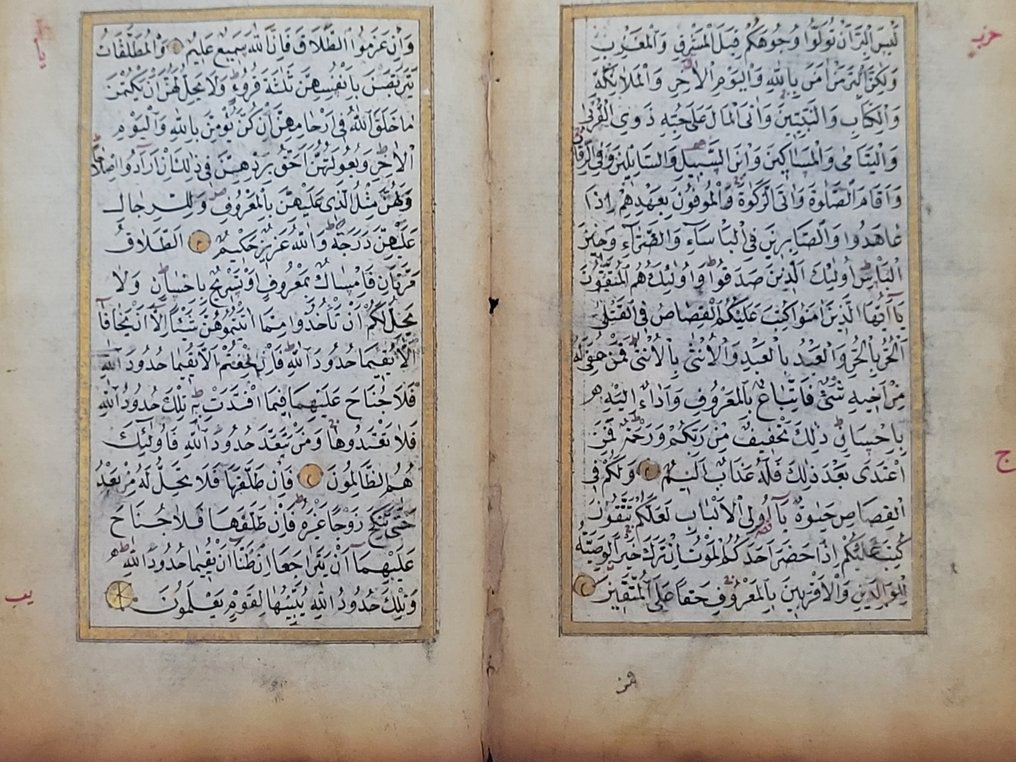
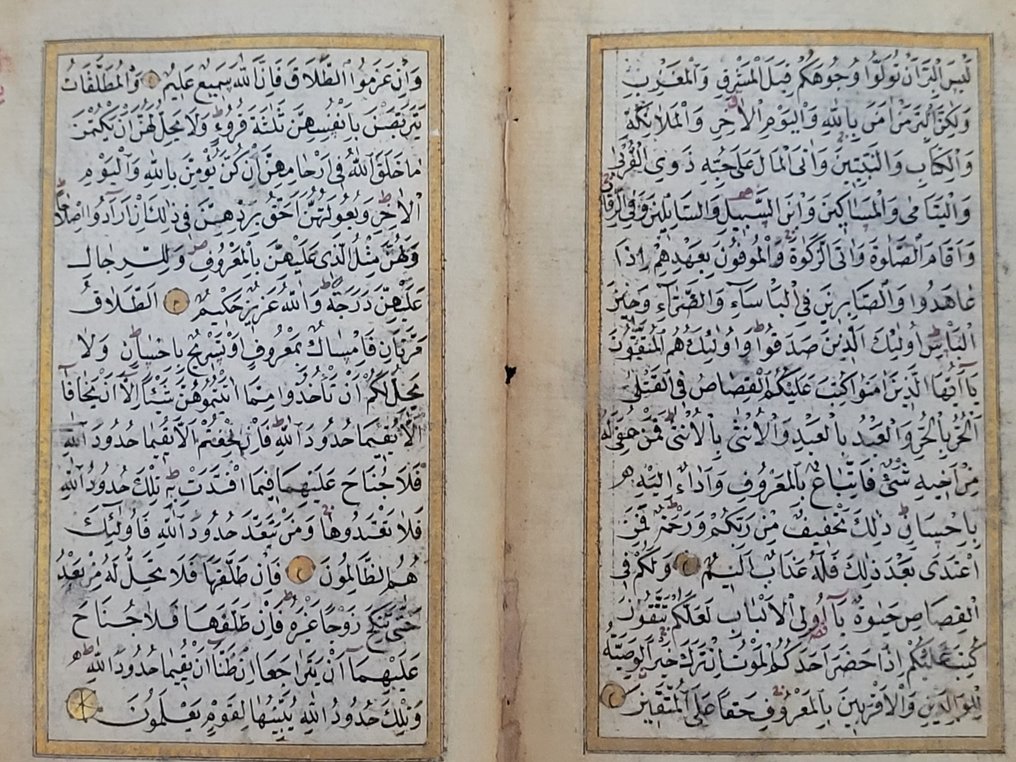
One double leaf, recto and verso, of the Persian/Mughal manuscript of the Quran (Safavid), circa 1620–1680 – illuminated in gold, saved from an ancient fire.
Manuscript of the Quran – Persia / Mughal India (Safavid) – circa 1620–1680
Rare ensemble including the original binding, decorated internally.
The double frontispiece at the beginning of the Quran (full-page illumination).
One double manuscript leaf, recto and verso, with text in Naskh script.
Historical provenance, manuscript saved from a fire, authentic heat traces.
This manuscript presents all the characteristics of late Safavid (Isfahan) or Mughal (Lahore/Delhi) productions in the 17th century.
Chiffon laid paper, carefully glazed.
Black and red ink.
Gold rosettes marking the verses.
Golden frames with black fillets.
Estimated dating circa 1620–1680.
Persian Naskh script, elegant and regular, 11 to 13 lines per page. Fine gold framing.
The identified pages correspond to the surahs and contain passages from two parts of the Quran.
1. Surah Al-Baqarah (The Cow) — verses around 177 to 283.
Sourate At-Talaq (The Divorce) — beginning of the chapter.
Page 1 – Summary of the translation
Surah Al-Baqarah verses 177–182
True piety does not consist in turning towards the East or the West, but in believing in God, the angels, the prophets, and the Day of Judgment.
It also involves giving a share of one's possessions to relatives, orphans, the poor, travelers, and freeing slaves.
Page 2 – Summary of the translation
(Surah Al-Baqarah verses 182–200)
If a testator changes his will out of injustice or favoritism, the one who corrects it towards fairness commits no sin.
Fasting prescription: believers must fast like the peoples before them, to acquire piety.
Page 3 – Translation Summary
(Surah Al-Baqarah, verses approximately 200–212)
Once the rites of pilgrimage are completed, believers must invoke God abundantly.
Page 4 – Translation summary
(Surah At-Talaq – The Divorce – verses 1 to 5)
Instructions on divorce
When a man divorces his wife, he must observe the legal waiting period ('iddah).
These rules have been revealed to protect families and establish justice.
Characteristic symmetrical composition of luxury Corans from Safavid and Mughal contexts.
It is the most precious element of the manuscript.
Manuscript saved from a fire.
This set comes from a Quran that was completely saved from an ancient fire.
Visible traces, borders browned by heat. Discolorations and soot. Ink sometimes swollen. Some pages well preserved in the central area. Despite the alterations, the vast majority of the texts remain legible and the overall piece retains significant historical and artistic value.
Sheets of the same format, chiffon textured paper, glazed watermarked paper.
Illuminated Quran manuscript, early 17th century.
Arabic manuscript on smooth laid paper, brown ink, gold punctuation and ornaments, mineral pigments in blue and red.
Format 21.5cm × 15cm.
Written surface, 10.5cm × 6cm.
Visible traces, heated paper, browned edges, and water halos corroborate this event. Fragmentary manuscript, significant wear, paper deterioration (burns, humidity, missing parts). An authentic ancient manuscript, manually decorated with gold.
Support smooth laid paper, handmade.
Polished surface, probably polished with an agate stone burnisher.
Dating 1620–1680
Conservation tips, as it is very fragile.
Keep flat
Acid-free folder (without acid)
No direct light
Stable hygrometry: 50–55%
Temperature approximately 18–21°C
Never humidify gold → immediate loss.
Very rare.
I am attaching a photo copy of the original binding.
Shipping via Chronopost or another method depending on the country, with insurance.
One double leaf, recto and verso, of the Persian/Mughal manuscript of the Quran (Safavid), circa 1620–1680 – illuminated in gold, saved from an ancient fire.
Manuscript of the Quran – Persia / Mughal India (Safavid) – circa 1620–1680
Rare ensemble including the original binding, decorated internally.
The double frontispiece at the beginning of the Quran (full-page illumination).
One double manuscript leaf, recto and verso, with text in Naskh script.
Historical provenance, manuscript saved from a fire, authentic heat traces.
This manuscript presents all the characteristics of late Safavid (Isfahan) or Mughal (Lahore/Delhi) productions in the 17th century.
Chiffon laid paper, carefully glazed.
Black and red ink.
Gold rosettes marking the verses.
Golden frames with black fillets.
Estimated dating circa 1620–1680.
Persian Naskh script, elegant and regular, 11 to 13 lines per page. Fine gold framing.
The identified pages correspond to the surahs and contain passages from two parts of the Quran.
1. Surah Al-Baqarah (The Cow) — verses around 177 to 283.
Sourate At-Talaq (The Divorce) — beginning of the chapter.
Page 1 – Summary of the translation
Surah Al-Baqarah verses 177–182
True piety does not consist in turning towards the East or the West, but in believing in God, the angels, the prophets, and the Day of Judgment.
It also involves giving a share of one's possessions to relatives, orphans, the poor, travelers, and freeing slaves.
Page 2 – Summary of the translation
(Surah Al-Baqarah verses 182–200)
If a testator changes his will out of injustice or favoritism, the one who corrects it towards fairness commits no sin.
Fasting prescription: believers must fast like the peoples before them, to acquire piety.
Page 3 – Translation Summary
(Surah Al-Baqarah, verses approximately 200–212)
Once the rites of pilgrimage are completed, believers must invoke God abundantly.
Page 4 – Translation summary
(Surah At-Talaq – The Divorce – verses 1 to 5)
Instructions on divorce
When a man divorces his wife, he must observe the legal waiting period ('iddah).
These rules have been revealed to protect families and establish justice.
Characteristic symmetrical composition of luxury Corans from Safavid and Mughal contexts.
It is the most precious element of the manuscript.
Manuscript saved from a fire.
This set comes from a Quran that was completely saved from an ancient fire.
Visible traces, borders browned by heat. Discolorations and soot. Ink sometimes swollen. Some pages well preserved in the central area. Despite the alterations, the vast majority of the texts remain legible and the overall piece retains significant historical and artistic value.
Sheets of the same format, chiffon textured paper, glazed watermarked paper.
Illuminated Quran manuscript, early 17th century.
Arabic manuscript on smooth laid paper, brown ink, gold punctuation and ornaments, mineral pigments in blue and red.
Format 21.5cm × 15cm.
Written surface, 10.5cm × 6cm.
Visible traces, heated paper, browned edges, and water halos corroborate this event. Fragmentary manuscript, significant wear, paper deterioration (burns, humidity, missing parts). An authentic ancient manuscript, manually decorated with gold.
Support smooth laid paper, handmade.
Polished surface, probably polished with an agate stone burnisher.
Dating 1620–1680
Conservation tips, as it is very fragile.
Keep flat
Acid-free folder (without acid)
No direct light
Stable hygrometry: 50–55%
Temperature approximately 18–21°C
Never humidify gold → immediate loss.
Very rare.
I am attaching a photo copy of the original binding.
Shipping via Chronopost or another method depending on the country, with insurance.
Details
Number of Books
1
Subject
Incunabula & early printing
Book Title
1 feuillet double recto verso d'un Coran manuscrit persan, moghol, Safavide.
Author/ Illustrator
Divers
Condition
Good
Publication year oldest item
1620
Publication year youngest item
1680
Height
21 cm
Edition
1st Edition
Width
15 cm
Language
Arabic
Original language
Yes
Binding/ Material
Single page
Extras
Hand coloured illustrations
Number of pages
4