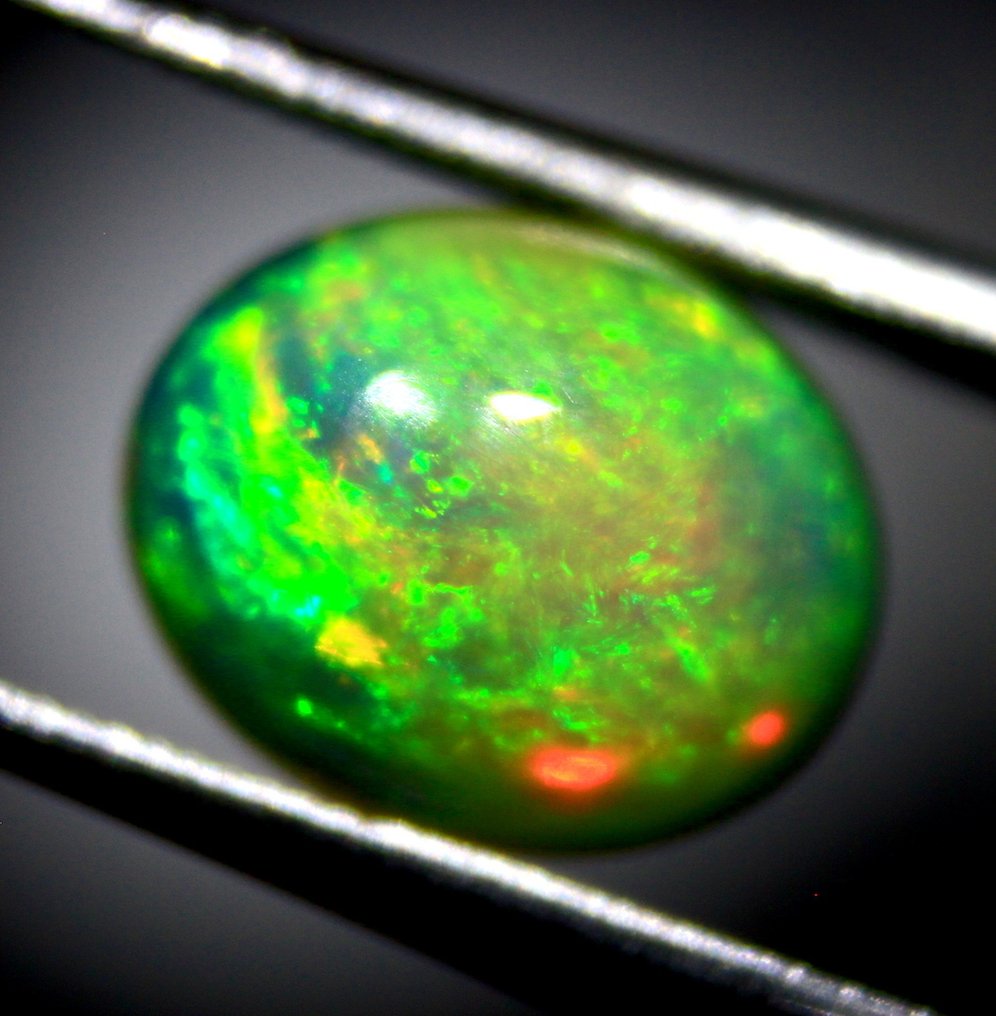
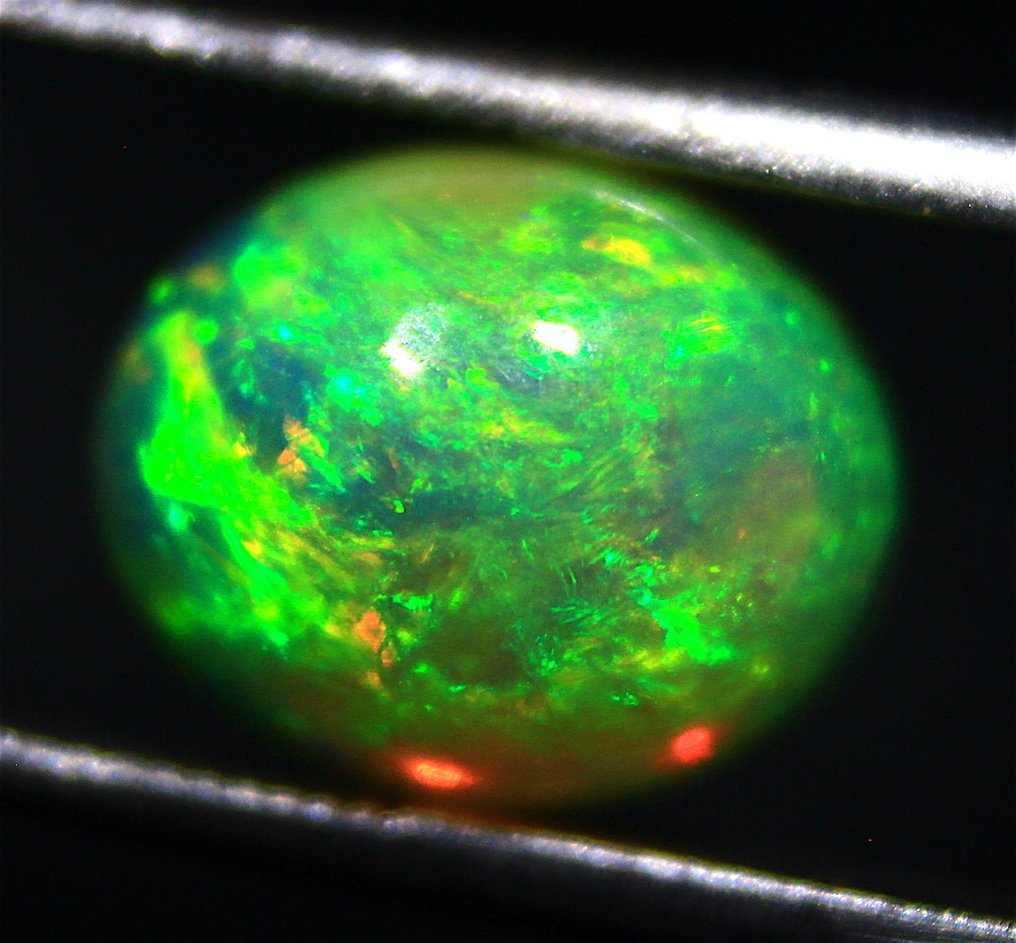
Cts. 1.80 Natural Ethiopian Opal Cabochon - Height: 10 mm - Width: 8 mm- 0.36 g



05
days
22
hours
40
minutes
24
seconds

No bids placed
Catawiki Buyer Protection
Your payment’s safe with us until you receive your object.View details
Trustpilot 4.4 | 122028 reviews
Rated Excellent on Trustpilot.
Natural Ethiopian Opal cabochon from Wello, Ethiopia, weighing 1.80 carats with dimensions 10 × 8 × 4 mm.
AI-assisted summary
Description from the seller
Natural Ethiopian Cab Opal
Clarity: from translucent to opaque.
Pictures taken with high resolution camera on different backgrounds in order to depict the items as realistically as possible.
Worldwide shipping with registered mail and tracking number.
Photography Settings
All items are photographed individually with a high-resolution camera in macro zoom mode indoors, using LED lighting at 5000 Kelvin, the color temperature closest to sunlight. The photos are not altered in any way, except for cropping.
Assistance
You can contact us at any time through Catawiki messaging for any further information about the item of your interest, and we will try to respond as soon as possible.
Shipping
Worldwide shipping with Registered Mail and tracking number. We offer combined shipping to ensure maximum savings on postal costs.
Restitution
We always strive to do our best, but if something is not to your liking, in accordance with regulatory provisions and our own conviction, we guarantee a refund to any customer who is not satisfied with their purchase, regardless of the reason.
Thank you for your attention and Happy bidding!
An opal is a hydrated form of silica with a water content ranging from 3 to 21%. Furthermore, it is this permeability to water that makes it a hydrophile.
Opals are deposited at relatively low temperatures and can occur in the fissures of almost any type of rock, most commonly found with limonite, sandstone, rhyolite, marl, and basalt. Precious opals display a variable interplay of internal colors.
At microscopic scales, precious opal is composed of silica spheres approximately 150 to 300 nm in diameter arranged in a hexagonal or cubic close-packed lattice. These ordered silica spheres produce the internal colors by causing interference and diffraction of light passing through the microstructure of the opal.
Natural Ethiopian Cab Opal
Clarity: from translucent to opaque.
Pictures taken with high resolution camera on different backgrounds in order to depict the items as realistically as possible.
Worldwide shipping with registered mail and tracking number.
Photography Settings
All items are photographed individually with a high-resolution camera in macro zoom mode indoors, using LED lighting at 5000 Kelvin, the color temperature closest to sunlight. The photos are not altered in any way, except for cropping.
Assistance
You can contact us at any time through Catawiki messaging for any further information about the item of your interest, and we will try to respond as soon as possible.
Shipping
Worldwide shipping with Registered Mail and tracking number. We offer combined shipping to ensure maximum savings on postal costs.
Restitution
We always strive to do our best, but if something is not to your liking, in accordance with regulatory provisions and our own conviction, we guarantee a refund to any customer who is not satisfied with their purchase, regardless of the reason.
Thank you for your attention and Happy bidding!
An opal is a hydrated form of silica with a water content ranging from 3 to 21%. Furthermore, it is this permeability to water that makes it a hydrophile.
Opals are deposited at relatively low temperatures and can occur in the fissures of almost any type of rock, most commonly found with limonite, sandstone, rhyolite, marl, and basalt. Precious opals display a variable interplay of internal colors.
At microscopic scales, precious opal is composed of silica spheres approximately 150 to 300 nm in diameter arranged in a hexagonal or cubic close-packed lattice. These ordered silica spheres produce the internal colors by causing interference and diffraction of light passing through the microstructure of the opal.
Details
Main Mineral
Cts. 1.80 Natural Ethiopian Opal
Mineral Form
Cabochon
Weight
0.36 g
Origin (Region/ City)
Hello
Country of Origin
Ethiopia
Height
10 mm
Width
8 mm
Depth
4 mm