Fossilised animal - Ámbar birmano - Milpiés muy raro - 16 mm - 16 mm


04
days
11
hours
02
minutes
28
seconds

9 other people are watching this object
 Bidder 3849 Bidder 3849 | €42 | |
|---|---|---|
 Bidder 7725 Bidder 7725 | €37 | |
| Bidder 3849 | €32 | |
Catawiki Buyer Protection
Your payment’s safe with us until you receive your object.View details
Trustpilot 4.4 | 122190 reviews
Rated Excellent on Trustpilot.
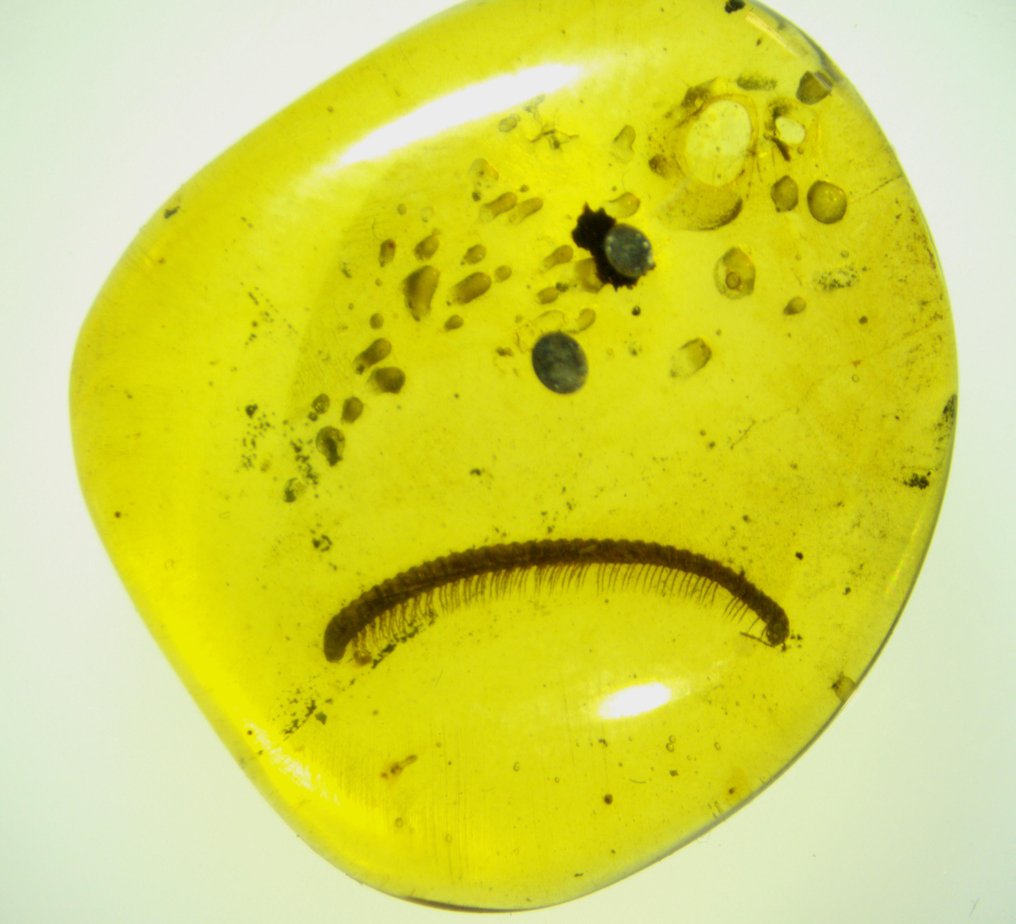
Amber Burmese - very rare millipede specimen, Burmanopetalum inexpectatum, Late Cretaceous Cenomanian, polished and in natural condition.
AI-assisted summary
Description from the seller
A spectacular specimen of Burmanopetalum, a very rare extinct genus of millipede from the Late Cretaceous (Cenomanian) of Myanmar. This rare millipede species is characterized by the presence of 35 cylindrical body segments with free sternites and fused tergites, among other features. This fully complete specimen allows for the detailed observation of all parts of the animal, including the delicate antennae and legs.
Amber piece dimensions: 16 x 16 mm
Burmanopetalum approximate length: 9-10 mm
Burmese amber, also known as burmite or Kachin amber, mainly comes from the Hukawng Valley in northern Myanmar. It dates back approximately 99 million years (Late Cretaceous – Cenomanian). This amber is of great paleontological interest due to the diversity of flora and fauna it contains, particularly arthropods such as insects and arachnids. Additionally, exceptional inclusions of birds, lizards, snakes, frogs, and fragmentary dinosaur remains have been found. The list of taxa studied from inclusions in Myanmar amber is extraordinarily high, with nearly 3,000 species described so far. The vast majority of these species are arthropods, primarily insects.
Amber-trapped fossils are believed to originate from a tropical rainforest near the coast, from where the resin was later transported to a shallow marine environment. During that period, flowering plants began to diversify, co-evolving alongside arthropods, especially insects. This is one of the most important periods in the evolution of life on Earth and in the development of modern flora and fauna.
A worthy specimen for a museum.
Plastic box included.
Note:
The classification of the inclusions has been carried out by specialists. However, there may be errors in the determinations. Many groups are still little studied. Sometimes, they may be new species to science.
- Some of the photos have been taken with a professional microscope and high magnifications.
Along with the specimen, an information sheet will be sent via email containing all the details about the amber and its inclusions, as well as the photos you can observe.
Please carefully review the size of the amber piece.
The authenticity of amber has been corroborated by various tests, such as ultraviolet light among others.
A spectacular specimen of Burmanopetalum, a very rare extinct genus of millipede from the Late Cretaceous (Cenomanian) of Myanmar. This rare millipede species is characterized by the presence of 35 cylindrical body segments with free sternites and fused tergites, among other features. This fully complete specimen allows for the detailed observation of all parts of the animal, including the delicate antennae and legs.
Amber piece dimensions: 16 x 16 mm
Burmanopetalum approximate length: 9-10 mm
Burmese amber, also known as burmite or Kachin amber, mainly comes from the Hukawng Valley in northern Myanmar. It dates back approximately 99 million years (Late Cretaceous – Cenomanian). This amber is of great paleontological interest due to the diversity of flora and fauna it contains, particularly arthropods such as insects and arachnids. Additionally, exceptional inclusions of birds, lizards, snakes, frogs, and fragmentary dinosaur remains have been found. The list of taxa studied from inclusions in Myanmar amber is extraordinarily high, with nearly 3,000 species described so far. The vast majority of these species are arthropods, primarily insects.
Amber-trapped fossils are believed to originate from a tropical rainforest near the coast, from where the resin was later transported to a shallow marine environment. During that period, flowering plants began to diversify, co-evolving alongside arthropods, especially insects. This is one of the most important periods in the evolution of life on Earth and in the development of modern flora and fauna.
A worthy specimen for a museum.
Plastic box included.
Note:
The classification of the inclusions has been carried out by specialists. However, there may be errors in the determinations. Many groups are still little studied. Sometimes, they may be new species to science.
- Some of the photos have been taken with a professional microscope and high magnifications.
Along with the specimen, an information sheet will be sent via email containing all the details about the amber and its inclusions, as well as the photos you can observe.
Please carefully review the size of the amber piece.
The authenticity of amber has been corroborated by various tests, such as ultraviolet light among others.
Details
Number of items
1
Scientific name
Ámbar birmano - Milpiés muy raro
Country of Origin
Burmanopetalum inexpectatum (Stoev, Moritz & Wesener, 2019)
Geological Period
Upper Cretaceous - Cenomanian (100.5 - 93.9 million years ago)
Condition
Natural
Treatment
Polished
Weight
2 g
Height
16 mm
Width
16 mm