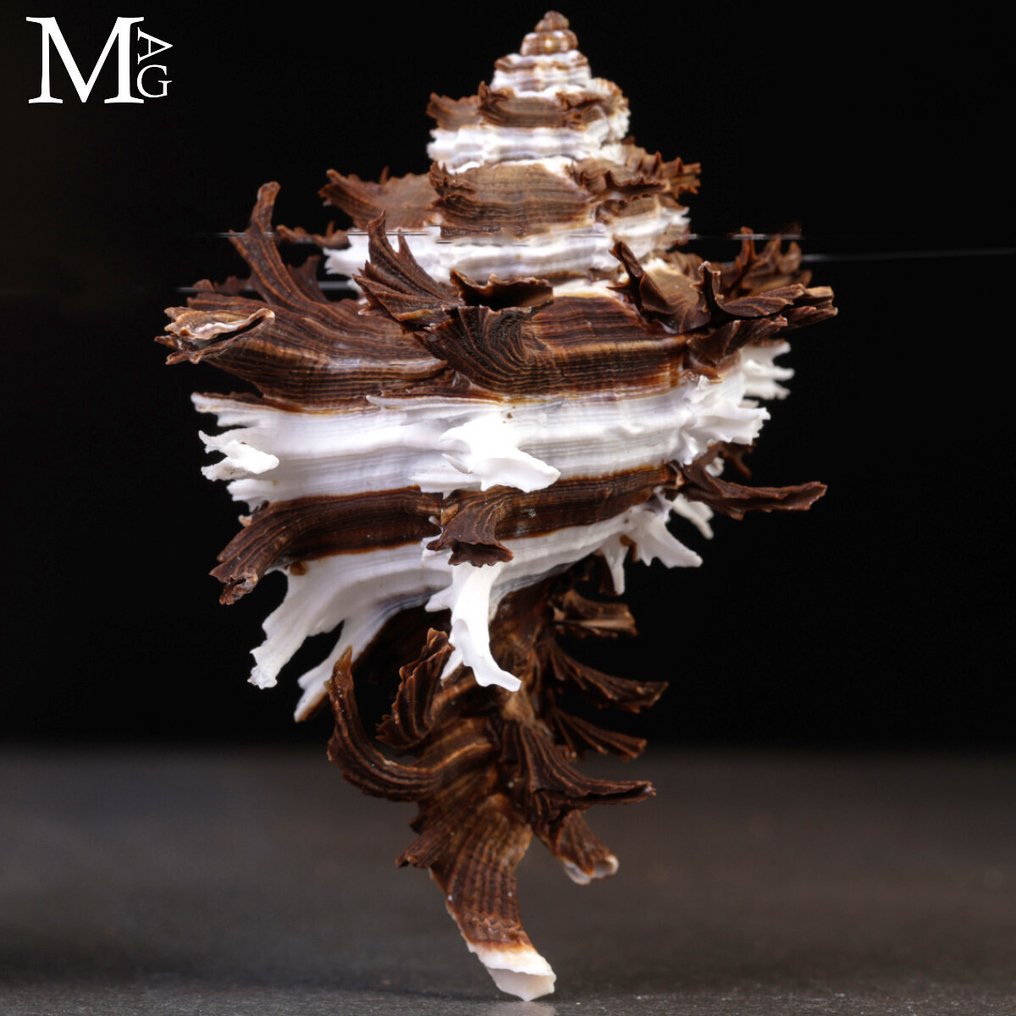
Beautiful collectible shell. Hexaplex cichoreum f. endivia (Lamarck, 1822) - Height: 100 mm - Width: 75 mm- 48 g



04
days
17
hours
20
minutes
45
seconds
Starting bid
€ 1
No reserve price

Expert
Selected by Jonas Rathaj
Has worked with taxidermy since childhood and gained retailer experience.
Estimate € 150 - € 200
No bids placed
Catawiki Buyer Protection
Your payment’s safe with us until you receive your object.View details
Trustpilot 4.4 | 122028 reviews
Rated Excellent on Trustpilot.
Specimen: Hexaplex cichoreum f. endivia (Lamarck, 1822).
AI-assisted summary
Description from the seller
Hexaplex cichoreum f. endivia (Lamarck, 1822)
This particular form of Hexaplex cichoreum is found in tropical waters.
of the Indo-Pacific, with specific reports in the Philippines, Taiwan, the Moluccas archipelago, and the South China Sea.
It mainly inhabits sandy and rocky seabeds, between 5 and 40 meters deep, often near coral reefs, where it finds refuge among algae and corals.
Sizes range from 50 to 120 mm, with some specimens that can exceed 130 mm.
Shape: Solid, fusiform, and massive, with an elongated profile and thick ribs.
Shell sculpture: It features marked axial ribs, adorned with prominent, elongated, and curved spines, a distinctive characteristic of the endive shape.
Coloration: The shell is cream-white with spines of dark brown or blackish color, often more evident at the tips of the ribs.
Opening: Wide, oval-shaped, with a smooth interior and variable tones ranging from cream to brown. The edge is scalloped and slightly thickened.
Operculum: It is corneal and oval in shape, with dark brown coloration and lighter reflections along the edges.
The endive form was initially described as Murex endivia by Jean-Baptiste Lamarck in 1822, considering it a distinct species. Subsequent studies determined that it is a morphological variation of Hexaplex cichoreum and not an autonomous species. Today, it is recognized as a natural form, appreciated in malacology for its particularly ornate sculpture.
Seller's Story
The Mineral Art Gallery offers minerals, fossils, shells and natural elements.
Born in Italy in 2017, today she collaborates with international galleries and collectors, she is a direct importer of large minerals and naturalistic collectible elements; deals with the processing to insert them inside the living space. A section of the gallery was dedicated to the Wunderkammer, "chamber of wonders or cabinet of curiosities" in which Mirabilia elements are presented: naturalia and italiania, a union between "the present is the past".
All lots are shipped via DHL Express and Fercam couriers, with insured parcel and tracking.
Translated by Google TranslateHexaplex cichoreum f. endivia (Lamarck, 1822)
This particular form of Hexaplex cichoreum is found in tropical waters.
of the Indo-Pacific, with specific reports in the Philippines, Taiwan, the Moluccas archipelago, and the South China Sea.
It mainly inhabits sandy and rocky seabeds, between 5 and 40 meters deep, often near coral reefs, where it finds refuge among algae and corals.
Sizes range from 50 to 120 mm, with some specimens that can exceed 130 mm.
Shape: Solid, fusiform, and massive, with an elongated profile and thick ribs.
Shell sculpture: It features marked axial ribs, adorned with prominent, elongated, and curved spines, a distinctive characteristic of the endive shape.
Coloration: The shell is cream-white with spines of dark brown or blackish color, often more evident at the tips of the ribs.
Opening: Wide, oval-shaped, with a smooth interior and variable tones ranging from cream to brown. The edge is scalloped and slightly thickened.
Operculum: It is corneal and oval in shape, with dark brown coloration and lighter reflections along the edges.
The endive form was initially described as Murex endivia by Jean-Baptiste Lamarck in 1822, considering it a distinct species. Subsequent studies determined that it is a morphological variation of Hexaplex cichoreum and not an autonomous species. Today, it is recognized as a natural form, appreciated in malacology for its particularly ornate sculpture.
Seller's Story
The Mineral Art Gallery offers minerals, fossils, shells and natural elements.
Born in Italy in 2017, today she collaborates with international galleries and collectors, she is a direct importer of large minerals and naturalistic collectible elements; deals with the processing to insert them inside the living space. A section of the gallery was dedicated to the Wunderkammer, "chamber of wonders or cabinet of curiosities" in which Mirabilia elements are presented: naturalia and italiania, a union between "the present is the past".
All lots are shipped via DHL Express and Fercam couriers, with insured parcel and tracking.
Translated by Google TranslateDetails
Main Mineral
Beautiful collectible shell.
Mineral Form
Hexaplex cichoreum f. endivia (Lamarck, 1822)
Weight
48 g
Country of Origin
Moluccas Archipelago
Height
100 mm
Width
75 mm
Depth
55 mm
Sold by