Missioni Home T&J Vestor - Missoni - Arlequine - Rug - 231.5 cm - 163.5 cm


03
days
09
hours
02
minutes
21
seconds
Current bid
€ 150
Reserve price not met

Expert
Selected by Richard Ebbers
Certified appraiser at Federation TMV with 30 years' professional antiques experience.
Estimate € 400 - € 450
16 other people are watching this object
 Bidder 4751 Bidder 4751 | €150 | |
|---|---|---|
| Bidder 4751 | €120 | |
| Bidder 4751 | €100 | |
Catawiki Buyer Protection
Your payment’s safe with us until you receive your object.View details
Trustpilot 4.4 | 122529 reviews
Rated Excellent on Trustpilot.
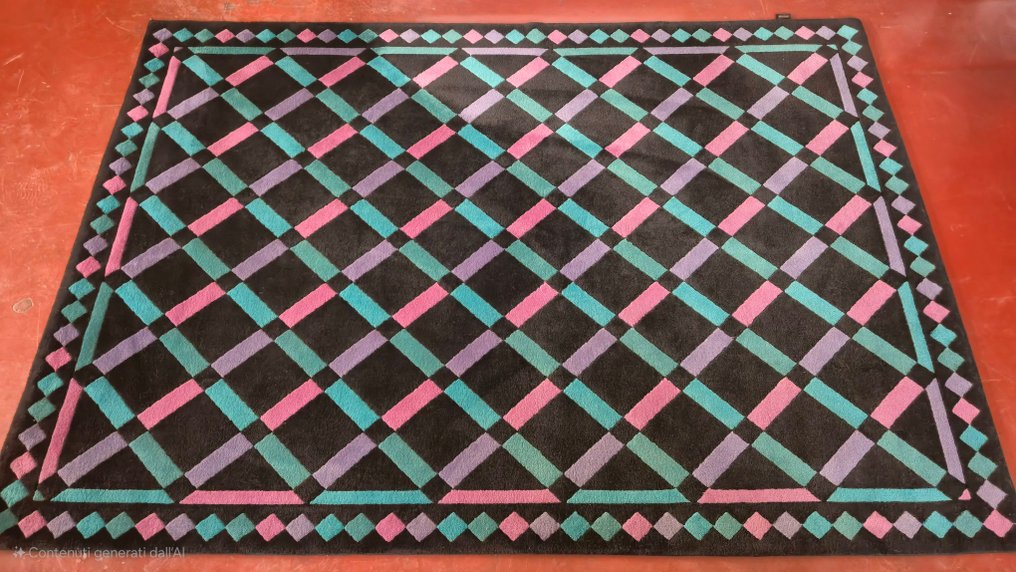
Missoni Arlequine rug, country of origin Italy, model Arlequine, dimensions 231.5 cm by 163.5 cm, material virgin wool, in very good condition.
AI-assisted summary
Description from the seller
Missoni Carpet – In Praise of Chromatic Geometry
Critical analysis and technical-esthetic description.
Translate to English. Return only the translation:
1. Introduction
This rug, signed Missoni, presents itself as a masterful exercise in balancing geometric rhythm and chromatic experimentation. It is a design object that speaks to the eye through a rigorous yet lively construction, where every detail is calibrated to become part of a coherent and sophisticated visual language.
Translate to English. Return only the translation:
General Visual Structure
The composition is based on a dark background – a deep, velvety black – serving as a stage on which colors and shapes can shine with maximum clarity. The entire perimeter of the rug is defined by a pronounced frame that encloses and organizes the internal pattern, giving the piece a compact appearance and almost a 'picture' quality, as if it were a piece of applied art rather than a mere functional object.
Translate to English. Return only the translation:
The Frame: Order and Rhythm
The outer edge is adorned with a regular sequence of small diamonds alternated, each colored with touches of pink, turquoise, blue, and violet. This series creates a continuous, almost musical rhythm that introduces the viewer to the aesthetic grammar of the rug.
The effect is that of a decorative micro-architecture that immediately brings Missoni's identity to life: geometric precision, color as a signature, and a harmonious play between repetition and variation.
Translate to English. Return only the translation:
The Central Plot: An Interweaving of Colorful Lines
The central part is a diagonal interlacing of chromatic ribbons crossing the entire surface, intersecting like structures of an abstract fabric.
The regular lines, of uniform thickness, follow an oblique grid pattern, creating a lattice that resembles a luminous network or a contemporary architectural pattern.
The colors – pink cyclamen, midnight blue, bright turquoise, and delicate violet – alternate with an almost painterly wisdom. There is no overload or dispersion: each shade finds its purpose, contributing to a controlled, balanced, and refined dynamism.
Translate to English. Return only the translation:
Missoni's Aesthetics: Color as Identity
This rug embodies one of the key principles of the Missoni house: color not as a simple ornament, but as a structural material of design.
The brand is historically recognized for its unique way of using intense tones and geometric patterns, and this piece is a particularly clear example of that.
The diagonals recall the iconic motifs of the house—traditionally zig-zag or flame-like—but are reinterpreted here in a more linear and architectural variant, almost a 'rationalization' of the famous Missoni aesthetic.
Translate to English. Return only the translation:
Aesthetic and Functional Impact
The overall effect is vibrant but never chaotic. The geometries create depth, while the color adds movement: a complex and perfectly achieved balance.
Although a functional object, it maintains a clearly artistic character. It is the kind of rug capable of defining a space on its own, transforming a simple area into a coherent visual composition full of personality.
Translate to English. Return only the translation:
7. Conclusion
The Missoni rug analyzed here is an emblematic example of Italian design's ability to combine rigor and fantasy, technique and emotion. Every detail – from the rhythmic frame to the crossed color ribbons – is designed to become part of a complex, elegant, and timeless decorative language.
An object that is not limited to being seen: it must be observed, interpreted, and experienced as an authentic fragment of applied contemporary art.
Missoni Carpet – In Praise of Chromatic Geometry
Critical analysis and technical-esthetic description.
Translate to English. Return only the translation:
1. Introduction
This rug, signed Missoni, presents itself as a masterful exercise in balancing geometric rhythm and chromatic experimentation. It is a design object that speaks to the eye through a rigorous yet lively construction, where every detail is calibrated to become part of a coherent and sophisticated visual language.
Translate to English. Return only the translation:
General Visual Structure
The composition is based on a dark background – a deep, velvety black – serving as a stage on which colors and shapes can shine with maximum clarity. The entire perimeter of the rug is defined by a pronounced frame that encloses and organizes the internal pattern, giving the piece a compact appearance and almost a 'picture' quality, as if it were a piece of applied art rather than a mere functional object.
Translate to English. Return only the translation:
The Frame: Order and Rhythm
The outer edge is adorned with a regular sequence of small diamonds alternated, each colored with touches of pink, turquoise, blue, and violet. This series creates a continuous, almost musical rhythm that introduces the viewer to the aesthetic grammar of the rug.
The effect is that of a decorative micro-architecture that immediately brings Missoni's identity to life: geometric precision, color as a signature, and a harmonious play between repetition and variation.
Translate to English. Return only the translation:
The Central Plot: An Interweaving of Colorful Lines
The central part is a diagonal interlacing of chromatic ribbons crossing the entire surface, intersecting like structures of an abstract fabric.
The regular lines, of uniform thickness, follow an oblique grid pattern, creating a lattice that resembles a luminous network or a contemporary architectural pattern.
The colors – pink cyclamen, midnight blue, bright turquoise, and delicate violet – alternate with an almost painterly wisdom. There is no overload or dispersion: each shade finds its purpose, contributing to a controlled, balanced, and refined dynamism.
Translate to English. Return only the translation:
Missoni's Aesthetics: Color as Identity
This rug embodies one of the key principles of the Missoni house: color not as a simple ornament, but as a structural material of design.
The brand is historically recognized for its unique way of using intense tones and geometric patterns, and this piece is a particularly clear example of that.
The diagonals recall the iconic motifs of the house—traditionally zig-zag or flame-like—but are reinterpreted here in a more linear and architectural variant, almost a 'rationalization' of the famous Missoni aesthetic.
Translate to English. Return only the translation:
Aesthetic and Functional Impact
The overall effect is vibrant but never chaotic. The geometries create depth, while the color adds movement: a complex and perfectly achieved balance.
Although a functional object, it maintains a clearly artistic character. It is the kind of rug capable of defining a space on its own, transforming a simple area into a coherent visual composition full of personality.
Translate to English. Return only the translation:
7. Conclusion
The Missoni rug analyzed here is an emblematic example of Italian design's ability to combine rigor and fantasy, technique and emotion. Every detail – from the rhythmic frame to the crossed color ribbons – is designed to become part of a complex, elegant, and timeless decorative language.
An object that is not limited to being seen: it must be observed, interpreted, and experienced as an authentic fragment of applied contemporary art.
Details
Era
1900-2000
Manufacturer/ Brand
Missioni Home T&J Vestor
Nr of items
1
Model
Arlequine
Length
231.5 cm
Width
163.5 cm
Designer/Artist/Maker
Missoni
Material
Pure Virgin Wool
Country of Origin
Italy
Condition
In very good condition
Professionally Cleaned
No
Manufacturing period
Late 20th century
Sold by