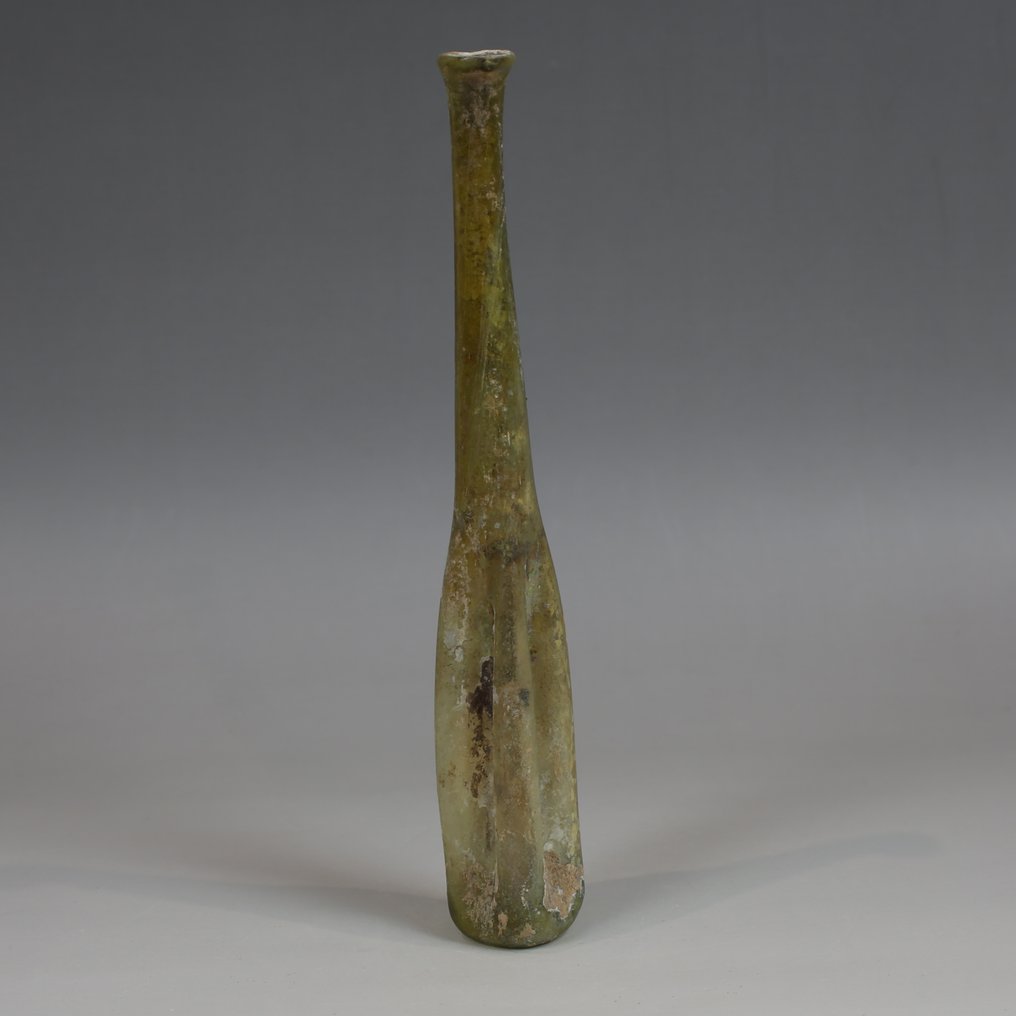
Ancient Roman Glass Flask.


01
day
11
hours
21
minutes
37
seconds
Current bid
€ 60
Reserve price not met

Expert
Selected by Ruth Garrido Vila
Directed the Ifergan Collection Museum, specialising in Phoenician and Mediterranean archaeology.
Estimate € 330 - € 400
10 other people are watching this object
 Bidder 6431 Bidder 6431 | €60 | |
|---|---|---|
 Bidder 1839 Bidder 1839 | €1 |
Catawiki Buyer Protection
Your payment’s safe with us until you receive your object.View details
Trustpilot 4.4 | 121798 reviews
Rated Excellent on Trustpilot.
Ancient Roman glass flask, 165 mm by 21 mm, dating to the 1st–3rd century A.D., in good condition, comes with a Certificate of Authenticity and an export license, provenance from a German private collection.
AI-assisted summary
Description from the seller
ITEM: Flask
MATERIAL: Glass
CULTURE: Roman
PERIOD: 1st - 3rd Century A.D
DIMENSIONS: 165 mm x 21 mm
CONDITION: Good condition
PROVENANCE: Ex German private collection, acquired before 2000s
Roman flasks were versatile and functional vessels used primarily for storing and transporting liquids such as oils, perfumes, and medicinal concoctions. These flasks, which were typically made from glass or ceramic, varied in size and shape, reflecting their diverse uses and the craftsmanship of the period. Glass flasks were particularly valued for their ability to contain and preserve aromatic oils and perfumes, which were essential in daily Roman life for personal grooming and religious rituals. Ceramic flasks, on the other hand, were often used for more practical purposes, such as storing cooking oils or vinegar.
The design of Roman flasks often included features that facilitated their use and storage. Many flasks had narrow necks to minimize spillage and maintain the quality of their contents. Some were equipped with handles or spouts to make pouring easier, while others had stoppers or lids to seal the contents securely. The artistic quality of these vessels varied from simple, utilitarian designs to more elaborate forms decorated with patterns or inscriptions. Inscriptions on flasks sometimes indicated the type of liquid contained or the name of the owner, adding a personalized touch to these everyday objects.
Roman flasks also provide valuable insights into trade and cultural exchanges within the Roman Empire. Glass production techniques, including the use of molds and blowing methods, were advanced during the Roman period, and Roman glassware was widely traded across the empire. The distribution of Roman flasks throughout various provinces reflects the extensive trade networks and the integration of different cultures within the empire. Additionally, the variety in flask designs and materials reveals the adaptability of Roman artisans to different regional tastes and technological innovations.
Comes with Certificate of Authenticity and Export license
If you bid outside the European Union and win the item, we will have to apply for an export licence for your country and shipping will take 3 to 5 weeks.
Seller's Story
Your Antiquarian offers ancient art and ancient coins. Our main objective is to offer the highest quality at the best price respecting and strictly complying with the laws of heritage protection and UNESCO heritage norms. Therefore, all the pieces that are published come from private collections in which the provenance can be checked or international auctions. All our antiquities and coins are accompanied by their Certificate of Authenticity. We have a no quibble 90 day return policy. At Your Antiquarian we are committed to helping disadvantaged groups and for this reason a portion of each purchase is donated to charities to help people in need.
Translated by Google TranslateITEM: Flask
MATERIAL: Glass
CULTURE: Roman
PERIOD: 1st - 3rd Century A.D
DIMENSIONS: 165 mm x 21 mm
CONDITION: Good condition
PROVENANCE: Ex German private collection, acquired before 2000s
Roman flasks were versatile and functional vessels used primarily for storing and transporting liquids such as oils, perfumes, and medicinal concoctions. These flasks, which were typically made from glass or ceramic, varied in size and shape, reflecting their diverse uses and the craftsmanship of the period. Glass flasks were particularly valued for their ability to contain and preserve aromatic oils and perfumes, which were essential in daily Roman life for personal grooming and religious rituals. Ceramic flasks, on the other hand, were often used for more practical purposes, such as storing cooking oils or vinegar.
The design of Roman flasks often included features that facilitated their use and storage. Many flasks had narrow necks to minimize spillage and maintain the quality of their contents. Some were equipped with handles or spouts to make pouring easier, while others had stoppers or lids to seal the contents securely. The artistic quality of these vessels varied from simple, utilitarian designs to more elaborate forms decorated with patterns or inscriptions. Inscriptions on flasks sometimes indicated the type of liquid contained or the name of the owner, adding a personalized touch to these everyday objects.
Roman flasks also provide valuable insights into trade and cultural exchanges within the Roman Empire. Glass production techniques, including the use of molds and blowing methods, were advanced during the Roman period, and Roman glassware was widely traded across the empire. The distribution of Roman flasks throughout various provinces reflects the extensive trade networks and the integration of different cultures within the empire. Additionally, the variety in flask designs and materials reveals the adaptability of Roman artisans to different regional tastes and technological innovations.
Comes with Certificate of Authenticity and Export license
If you bid outside the European Union and win the item, we will have to apply for an export licence for your country and shipping will take 3 to 5 weeks.
Seller's Story
Your Antiquarian offers ancient art and ancient coins. Our main objective is to offer the highest quality at the best price respecting and strictly complying with the laws of heritage protection and UNESCO heritage norms. Therefore, all the pieces that are published come from private collections in which the provenance can be checked or international auctions. All our antiquities and coins are accompanied by their Certificate of Authenticity. We have a no quibble 90 day return policy. At Your Antiquarian we are committed to helping disadvantaged groups and for this reason a portion of each purchase is donated to charities to help people in need.
Translated by Google TranslateDetails
Culture
Ancient Roman
Century/ Timeframe
1st - 3rd Century A.D
Name of object
Flask.
Acquired from
Private collection
Year acquired
2025
Material
Glass
Country acquired from
Germany
Condition
Good
Previous owner acquired from
Antique market
Previous owner - year acquired
2000
Previous owner - country acquired from
Germany
I verify that I have obtained this object legally and that I am allowed to sell it
Yes
Sold by
Disclaimer
The seller was informed by Catawiki about documentation requirements and guarantees the following: - the object was legally obtained, - the seller has the right to sell and/or export the object, as relevant, - the seller will provide the necessary provenance information and arrange required documentation and permits/licenses, as applicable and as per local laws, - the seller will notify the buyer of any delays in obtaining permits/licenses. By bidding, you acknowledge that import documentation may be required depending on your country of residence and that obtaining permits/licenses may cause delays in the delivery of your object.
The seller was informed by Catawiki about documentation requirements and guarantees the following: - the object was legally obtained, - the seller has the right to sell and/or export the object, as relevant, - the seller will provide the necessary provenance information and arrange required documentation and permits/licenses, as applicable and as per local laws, - the seller will notify the buyer of any delays in obtaining permits/licenses. By bidding, you acknowledge that import documentation may be required depending on your country of residence and that obtaining permits/licenses may cause delays in the delivery of your object.
