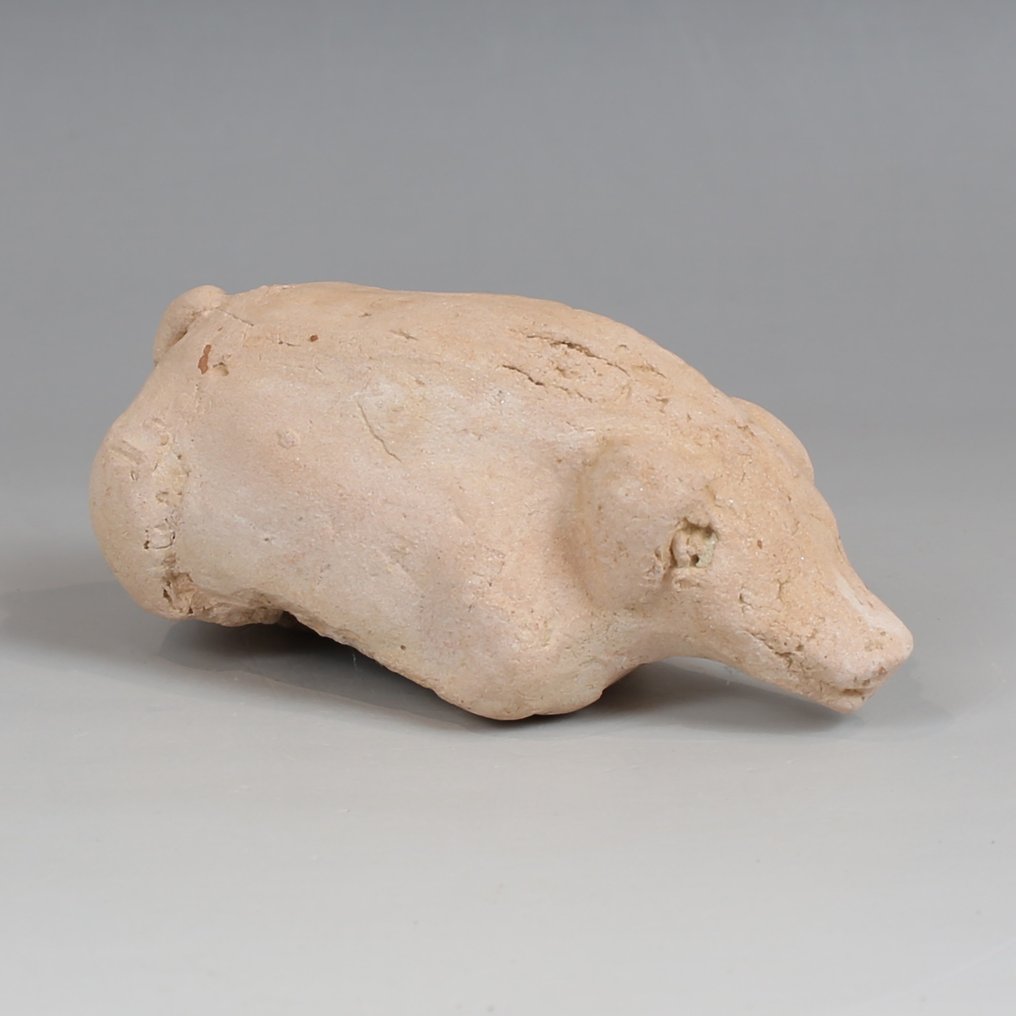
Ancient Chinese, Tang Dynasty Pottery Statuette of a piggy (No Reserve Price)


01
day
10
hours
36
minutes
30
seconds
Current bid
€ 35
No reserve price

Expert
Selected by Ruth Garrido Vila
Directed the Ifergan Collection Museum, specialising in Phoenician and Mediterranean archaeology.
Estimate € 330 - € 400
14 other people are watching this object
 Bidder 3578 Bidder 3578 | €35 | |
|---|---|---|
 Bidder 3735 Bidder 3735 | €30 | |
| Bidder 3578 | €30 | |
Catawiki Buyer Protection
Your payment’s safe with us until you receive your object.View details
Trustpilot 4.4 | 121899 reviews
Rated Excellent on Trustpilot.
Statuette of a piggy, a Tang Dynasty Chinese pottery sculpture (45 mm × 45 mm × 94 mm) acquired in 2025 from a German private collection, in good condition and accompanied by a Certificate of Authenticity and EU export license.
AI-assisted summary
Description from the seller
ITEM: Statuette of a piggy
MATERIAL: Pottery
CULTURE: Chinese
PERIOD: Tang dynasty, 618 - 907 A.D
DIMENSIONS: 45 mm x 45 mm x 94 mm
CONDITION: Good condition
PROVENANCE: Ex German private collection, F.B., acquired in European antiquities auctions between 2000 - 2009.
Comes with Certificate of Authenticity and European Union export license
If you bid outside European Union and win the item, we must request a new export license to your country and the shipment will delay between 3 - 5 weeks.
The Tang Dynasty (618–907 CE) succeeded the brief Sui Dynasty and is universally regarded as a Golden Age and a zenith of Chinese civilization, characterized by extraordinary political stability, economic prosperity, and cultural flourishing. Founded by Emperor Gaozu and solidified by his son, Emperor Taizong, the Tang state successfully refined the centralized bureaucracy and legal code inherited from the Sui, establishing a powerful and efficient government that would serve as a model for subsequent dynasties. The capital, Chang’an (modern Xi'an) , became the largest and most cosmopolitan city in the world, a vibrant hub of international exchange where merchants, clerics, and envoys from Central Asia, Persia, India, and Japan mingled freely.
The Tang era is best known for an unparalleled bloom in arts and literature. It is considered the classical age of Chinese poetry, producing masters like Li Bai and Du Fu, whose approximately 50,000 surviving works captured both the courtly splendor and the hardships of the time. The dynasty also saw significant technological advancements, including the widespread adoption of woodblock printing, which facilitated greater literacy and the circulation of texts, including the world's oldest dated complete printed book, the Diamond Sutra (868 CE). Other innovations, such as the initial development of gunpowder (initially for fireworks) and sophisticated clockwork mechanisms, cemented China's position as a technological leader.
The dynasty reached its territorial and cultural height under Emperor Xuanzong in the early 8th century, a period of peace and prosperity that was famously interrupted by the An Lushan Rebellion (755–763 CE). This devastating civil war severely weakened the central government, leading to the rise of powerful, semi-autonomous regional military governors (jiedushi). Although the Tang was restored, the dynasty never fully recovered its former power. The ensuing decline saw the increasing influence of court eunuchs and a series of rebellions, culminating in its final collapse in 907 CE. Despite its eventual end, the Tang left an enduring legacy, profoundly shaping the legal, administrative, and cultural norms of East Asia, including Japan and Korea.
Catawiki disclaimer: This piece has been dated based on style by the seller . No further tests, such as, a TL test, analysis of metals(XRF-test), lapidary tests, analysis of pigments or radiography scans have been conducted to check the integrity of the piece.
Seller's Story
Your Antiquarian offers ancient art and ancient coins. Our main objective is to offer the highest quality at the best price respecting and strictly complying with the laws of heritage protection and UNESCO heritage norms. Therefore, all the pieces that are published come from private collections in which the provenance can be checked or international auctions. All our antiquities and coins are accompanied by their Certificate of Authenticity. We have a no quibble 90 day return policy. At Your Antiquarian we are committed to helping disadvantaged groups and for this reason a portion of each purchase is donated to charities to help people in need.
Translated by Google TranslateITEM: Statuette of a piggy
MATERIAL: Pottery
CULTURE: Chinese
PERIOD: Tang dynasty, 618 - 907 A.D
DIMENSIONS: 45 mm x 45 mm x 94 mm
CONDITION: Good condition
PROVENANCE: Ex German private collection, F.B., acquired in European antiquities auctions between 2000 - 2009.
Comes with Certificate of Authenticity and European Union export license
If you bid outside European Union and win the item, we must request a new export license to your country and the shipment will delay between 3 - 5 weeks.
The Tang Dynasty (618–907 CE) succeeded the brief Sui Dynasty and is universally regarded as a Golden Age and a zenith of Chinese civilization, characterized by extraordinary political stability, economic prosperity, and cultural flourishing. Founded by Emperor Gaozu and solidified by his son, Emperor Taizong, the Tang state successfully refined the centralized bureaucracy and legal code inherited from the Sui, establishing a powerful and efficient government that would serve as a model for subsequent dynasties. The capital, Chang’an (modern Xi'an) , became the largest and most cosmopolitan city in the world, a vibrant hub of international exchange where merchants, clerics, and envoys from Central Asia, Persia, India, and Japan mingled freely.
The Tang era is best known for an unparalleled bloom in arts and literature. It is considered the classical age of Chinese poetry, producing masters like Li Bai and Du Fu, whose approximately 50,000 surviving works captured both the courtly splendor and the hardships of the time. The dynasty also saw significant technological advancements, including the widespread adoption of woodblock printing, which facilitated greater literacy and the circulation of texts, including the world's oldest dated complete printed book, the Diamond Sutra (868 CE). Other innovations, such as the initial development of gunpowder (initially for fireworks) and sophisticated clockwork mechanisms, cemented China's position as a technological leader.
The dynasty reached its territorial and cultural height under Emperor Xuanzong in the early 8th century, a period of peace and prosperity that was famously interrupted by the An Lushan Rebellion (755–763 CE). This devastating civil war severely weakened the central government, leading to the rise of powerful, semi-autonomous regional military governors (jiedushi). Although the Tang was restored, the dynasty never fully recovered its former power. The ensuing decline saw the increasing influence of court eunuchs and a series of rebellions, culminating in its final collapse in 907 CE. Despite its eventual end, the Tang left an enduring legacy, profoundly shaping the legal, administrative, and cultural norms of East Asia, including Japan and Korea.
Catawiki disclaimer: This piece has been dated based on style by the seller . No further tests, such as, a TL test, analysis of metals(XRF-test), lapidary tests, analysis of pigments or radiography scans have been conducted to check the integrity of the piece.
Seller's Story
Your Antiquarian offers ancient art and ancient coins. Our main objective is to offer the highest quality at the best price respecting and strictly complying with the laws of heritage protection and UNESCO heritage norms. Therefore, all the pieces that are published come from private collections in which the provenance can be checked or international auctions. All our antiquities and coins are accompanied by their Certificate of Authenticity. We have a no quibble 90 day return policy. At Your Antiquarian we are committed to helping disadvantaged groups and for this reason a portion of each purchase is donated to charities to help people in need.
Translated by Google TranslateDetails
Culture
Ancient Chinese, Tang Dynasty
Century/ Timeframe
618 - 907 A.D
Name of object
Statuette of a piggy
Acquired from
Private collection
Year acquired
2025
Material
Pottery
Country acquired from
Germany
Condition
Good
Previous owner acquired from
Antique market
Previous owner - year acquired
2000
Previous owner - country acquired from
Germany
I verify that I have obtained this object legally and that I am allowed to sell it
Yes
Sold by
Disclaimer
The seller was informed by Catawiki about documentation requirements and guarantees the following: - the object was legally obtained, - the seller has the right to sell and/or export the object, as relevant, - the seller will provide the necessary provenance information and arrange required documentation and permits/licenses, as applicable and as per local laws, - the seller will notify the buyer of any delays in obtaining permits/licenses. By bidding, you acknowledge that import documentation may be required depending on your country of residence and that obtaining permits/licenses may cause delays in the delivery of your object.
The seller was informed by Catawiki about documentation requirements and guarantees the following: - the object was legally obtained, - the seller has the right to sell and/or export the object, as relevant, - the seller will provide the necessary provenance information and arrange required documentation and permits/licenses, as applicable and as per local laws, - the seller will notify the buyer of any delays in obtaining permits/licenses. By bidding, you acknowledge that import documentation may be required depending on your country of residence and that obtaining permits/licenses may cause delays in the delivery of your object.
