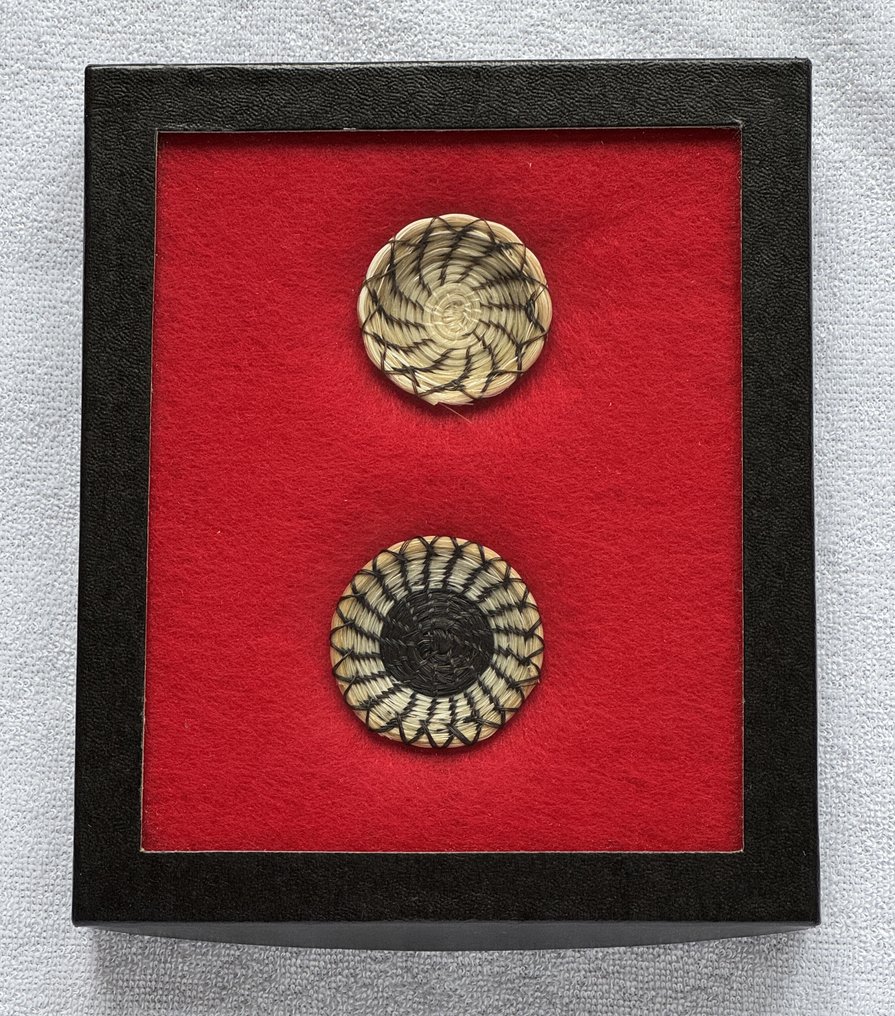
Two miniature baskets made of horsehair in a display case (rare) - Tohono O'Odham (Papago) - U.S. (No Reserve Price)


07
days
06
hours
59
minutes
49
seconds
Current bid
€ 3
No reserve price

Expert
Selected by Amy Wassing
Nearly 20 years' experience in Indonesian and Oceanian art with museum expertise.
Estimate € 150 - € 200
1 other person has their eye on this
 Bidder 2211 Bidder 2211 | €3 |
|---|
Catawiki Buyer Protection
Your payment’s safe with us until you receive your object.View details
Trustpilot 4.4 | 121980 reviews
Rated Excellent on Trustpilot.
Two miniature horsehair baskets in a display case, Lazy Stitch technique, made around 1990 by Tohono O'Odham artisans in the USA, provenance Privatsammlung, in fair condition, with diameters 3.5 cm and 4 cm, overall dimensions 13 cm wide, 15.5 cm deep and 2 cm high.
AI-assisted summary
Description from the seller
The current Tohono O'Odham Nation consists of descendants of two linguistically related but culturally distinct Native American tribal groups that once lived in the Sonora Desert in southwestern Arizona, USA, and in northwestern Sonora, Mexico. These are the Tohono O'Odham (Papago) ('People of the Desert'), officially recognized at the federal level as a tribe, and the Hia C-eḍ O'Odham (Sand Papago / Sand Pima) ('People of the Sand Dunes'), which is recognized only as part of the Tohono O'Odham Nation.
The current name Tohono O'Odham is the self-designation of the groups formerly commonly known as Papago, which in turn is a Spanish adaptation of an O'Odham word; the neighboring Akimel O'Odham referred to their relatives as Babawï O'Odham or Pahpah Au-Authm ('Tepary bean people') or Ba:bawĭkoʼa ('Tepary bean eaters').
The descendants of the Tohono O'Odham now live in several Indian Reservations in southern Arizona (derived from al ṣonag – "place of the small spring") west of Tucson or in one of the nearby towns.
The Tohono O'Odham, who today mainly live from cattle ranching and ground cultivation, are known for the art of basket weaving.
Two miniature baskets are offered in the display case:
1. A basket made of horsehair using lazy stitch technique, circa 1990.
It has a diameter of 3.5 cm.
2. A basket made of horsehair using lazy stitch technique, circa 1990.
It has a diameter of 4 cm.
The current Tohono O'Odham Nation consists of descendants of two linguistically related but culturally distinct Native American tribal groups that once lived in the Sonora Desert in southwestern Arizona, USA, and in northwestern Sonora, Mexico. These are the Tohono O'Odham (Papago) ('People of the Desert'), officially recognized at the federal level as a tribe, and the Hia C-eḍ O'Odham (Sand Papago / Sand Pima) ('People of the Sand Dunes'), which is recognized only as part of the Tohono O'Odham Nation.
The current name Tohono O'Odham is the self-designation of the groups formerly commonly known as Papago, which in turn is a Spanish adaptation of an O'Odham word; the neighboring Akimel O'Odham referred to their relatives as Babawï O'Odham or Pahpah Au-Authm ('Tepary bean people') or Ba:bawĭkoʼa ('Tepary bean eaters').
The descendants of the Tohono O'Odham now live in several Indian Reservations in southern Arizona (derived from al ṣonag – "place of the small spring") west of Tucson or in one of the nearby towns.
The Tohono O'Odham, who today mainly live from cattle ranching and ground cultivation, are known for the art of basket weaving.
Two miniature baskets are offered in the display case:
1. A basket made of horsehair using lazy stitch technique, circa 1990.
It has a diameter of 3.5 cm.
2. A basket made of horsehair using lazy stitch technique, circa 1990.
It has a diameter of 4 cm.
Details
No. of items
2
Ethnic group/ culture
Tohono O'Odham (Papago)
Country of Origin
U.S.
Period
Late 20th century
Material
horsehair
Condition
Fair condition
Title of artwork
Two miniature baskets made of horsehair in a display case (rare)
Height
2 cm
Width
13 cm
Depth
15.5 cm
Weight
160 g
Provenance
Private collection
Sold by