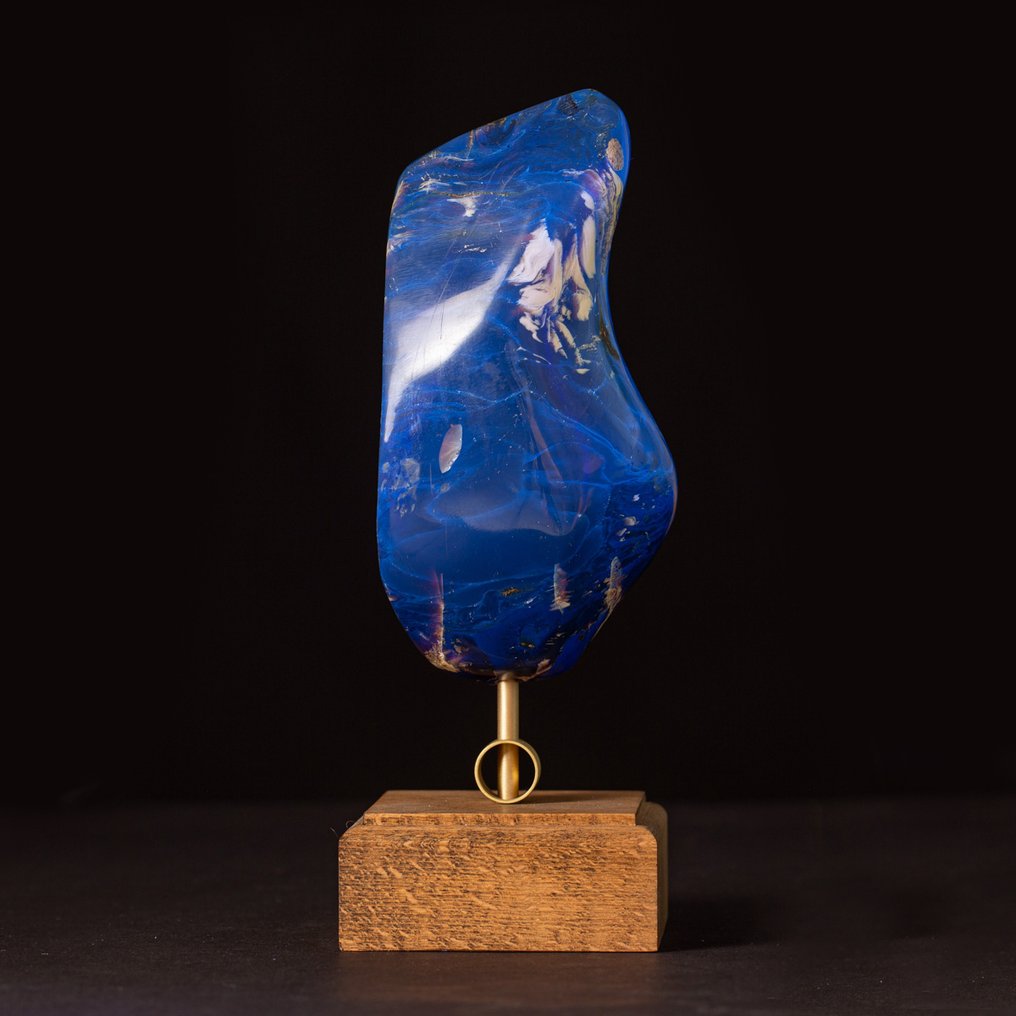
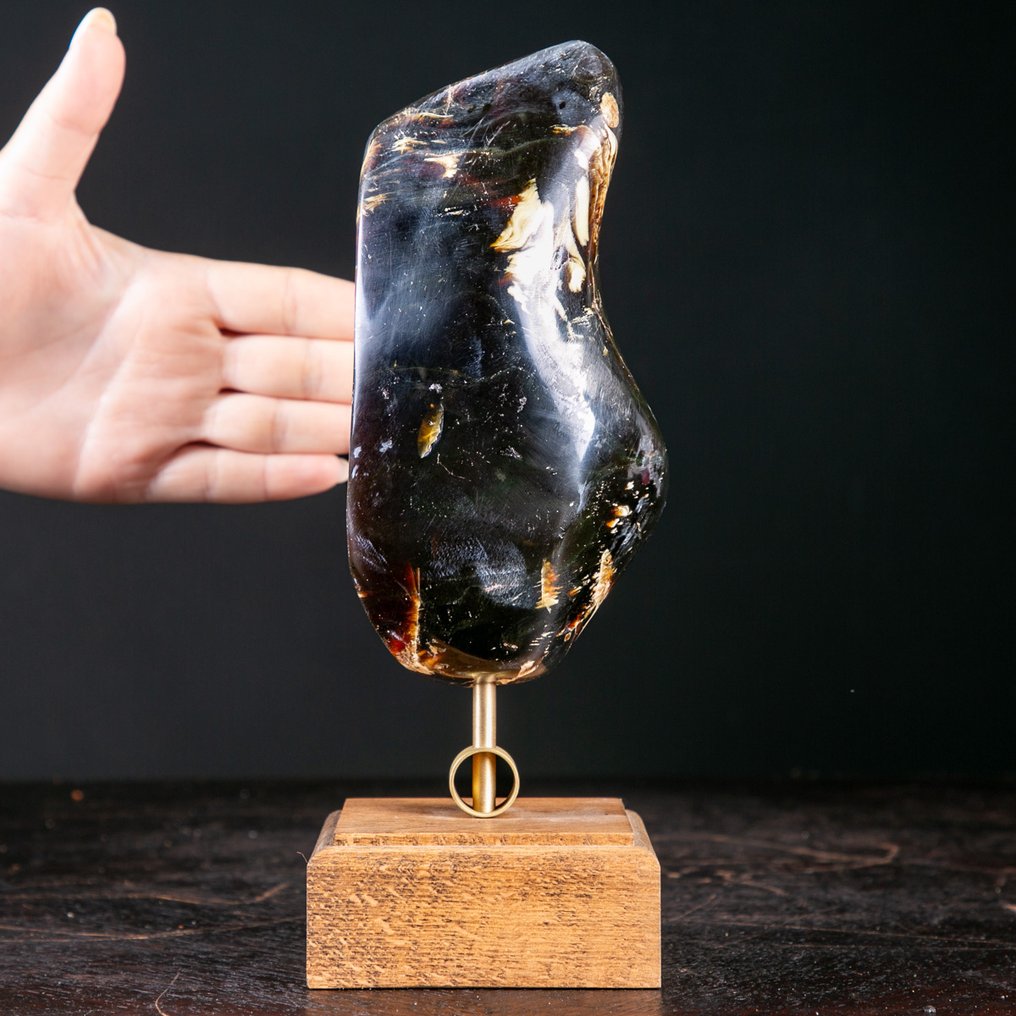
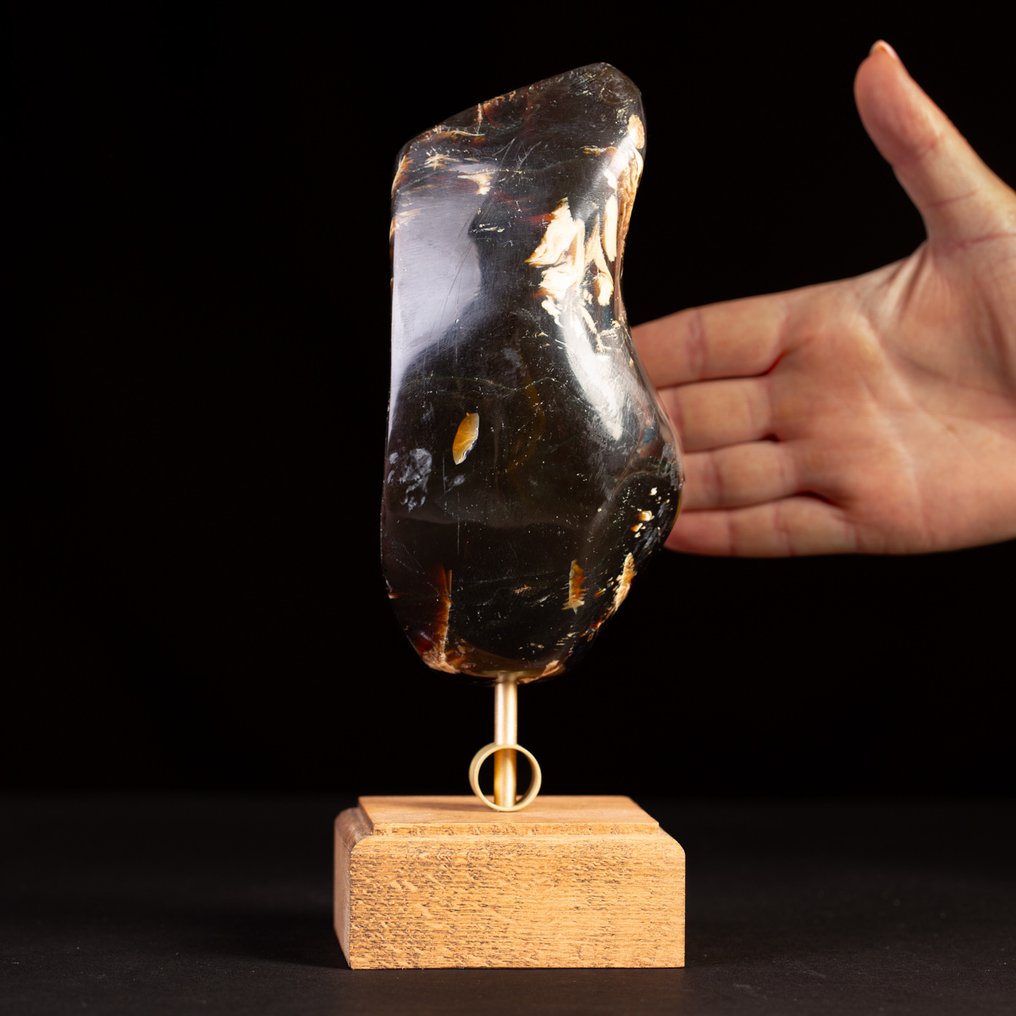
Fossil amber specimen from Sumatra - rare sample with extraordinary color contrasts - elegant wood - Height: 237 mm - Width: 87 mm- 696 g


Opens tomorrow
Starting bid
€ 1
Add to your favourites to get an alert when the auction starts.

Catawiki Buyer Protection
Your payment’s safe with us until you receive your object.View details
Trustpilot 4.4 | 121980 reviews
Rated Excellent on Trustpilot.
Description from the seller
Sumatra Fossil Amber: UV Fluorescence.
A specimen of fossil amber comes from the island of Sumatra, Indonesia, one of the main sources of amber in Southeast Asia. Sumatra amber was formed from fossilized plant resins dating back to the Miocene (about 23-5 million years ago). These resins, produced by now-extinct trees of the Dipterocarpaceae family, underwent a fossilization process through polymerization and hardening due to geological pressure and tropical environmental conditions.
The sample exhibits a predominant coloration ranging from beige to brown, with inclusions of blue and black hues visible under UV light. The intense blue fluorescence is a distinctive feature of Sumatra amber, caused by the presence of polycyclic aromatic hydrocarbons and the organic composition of the fossil resin.
The images of the sample highlight the typical fluorescence of Sumatran fossil amber under UV illumination. The UV light excites the organic molecules inside the amber, causing a luminescence reaction that manifests as intense blue and azure reflections. This phenomenon is used to distinguish authentic amber from modern or synthetic resins.
The sample is mounted on a decorative wooden base with a brass support, designed to enhance its natural shape. The support's design allows effective lighting from various angles, improving the visibility of distinctive features under natural and UV light.
Seller's Story
The Mineral Art Gallery offers minerals, fossils, shells and natural elements.
Born in Italy in 2017, today she collaborates with international galleries and collectors, she is a direct importer of large minerals and naturalistic collectible elements; deals with the processing to insert them inside the living space. A section of the gallery was dedicated to the Wunderkammer, "chamber of wonders or cabinet of curiosities" in which Mirabilia elements are presented: naturalia and italiania, a union between "the present is the past".
All lots are shipped via DHL Express and Fercam couriers, with insured parcel and tracking.
Translated by Google TranslateSumatra Fossil Amber: UV Fluorescence.
A specimen of fossil amber comes from the island of Sumatra, Indonesia, one of the main sources of amber in Southeast Asia. Sumatra amber was formed from fossilized plant resins dating back to the Miocene (about 23-5 million years ago). These resins, produced by now-extinct trees of the Dipterocarpaceae family, underwent a fossilization process through polymerization and hardening due to geological pressure and tropical environmental conditions.
The sample exhibits a predominant coloration ranging from beige to brown, with inclusions of blue and black hues visible under UV light. The intense blue fluorescence is a distinctive feature of Sumatra amber, caused by the presence of polycyclic aromatic hydrocarbons and the organic composition of the fossil resin.
The images of the sample highlight the typical fluorescence of Sumatran fossil amber under UV illumination. The UV light excites the organic molecules inside the amber, causing a luminescence reaction that manifests as intense blue and azure reflections. This phenomenon is used to distinguish authentic amber from modern or synthetic resins.
The sample is mounted on a decorative wooden base with a brass support, designed to enhance its natural shape. The support's design allows effective lighting from various angles, improving the visibility of distinctive features under natural and UV light.
Seller's Story
The Mineral Art Gallery offers minerals, fossils, shells and natural elements.
Born in Italy in 2017, today she collaborates with international galleries and collectors, she is a direct importer of large minerals and naturalistic collectible elements; deals with the processing to insert them inside the living space. A section of the gallery was dedicated to the Wunderkammer, "chamber of wonders or cabinet of curiosities" in which Mirabilia elements are presented: naturalia and italiania, a union between "the present is the past".
All lots are shipped via DHL Express and Fercam couriers, with insured parcel and tracking.
Translated by Google TranslateDetails
Mineral Form
Fossil amber specimen from Sumatra - rare sample with extraordinary color contrasts - elegant wood
Weight
696 g
Country of Origin
Italian Handmade Base - Indonesia
Height
237 mm
Width
87 mm
Depth
87 mm
Sold by