Esecutori delle Acque Venezia - 5 documenti aq aqe con note manoscritte - 1608



12
days
07
hours
45
minutes
14
seconds

No bids placed
Catawiki Buyer Protection
Your payment’s safe with us until you receive your object.View details
Trustpilot 4.4 | 121798 reviews
Rated Excellent on Trustpilot.
Five AQ AQe documents with manuscript notes from the Republic of Venice, originally in Italian, titled 5 documenti aq aqe con note manoscritte, size 29.5 × 20.5 cm, in Good condition, dating from 1608 to 1700.
AI-assisted summary
Description from the seller
Seller description
Republic of Venice
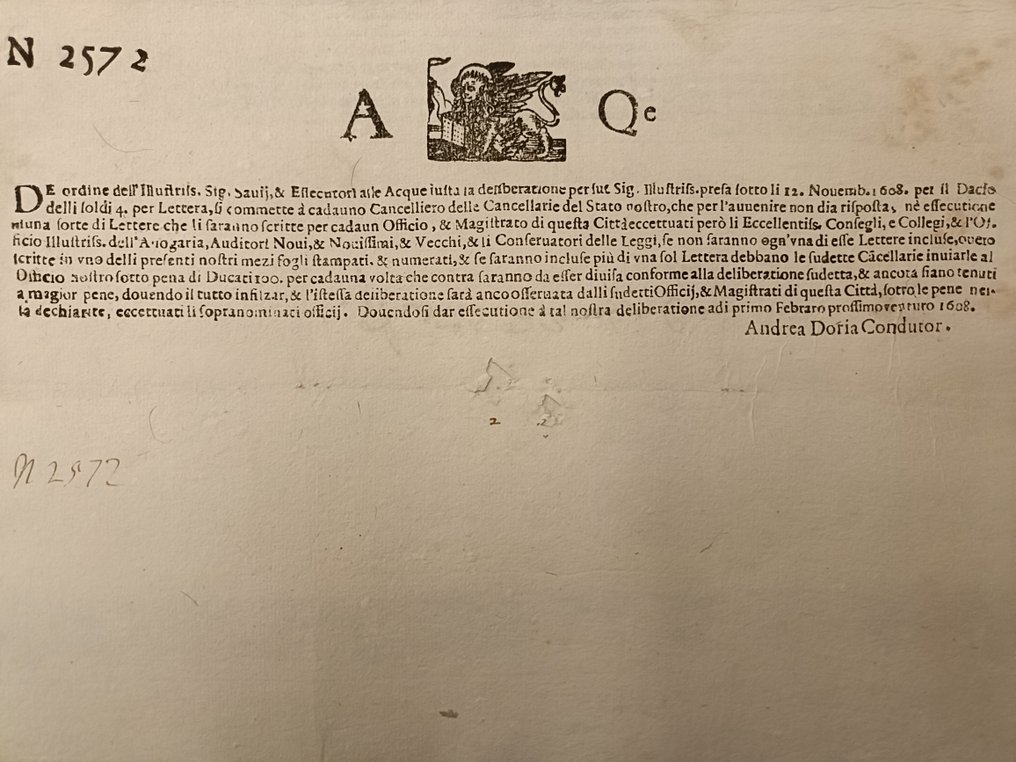
5 pieces as per photo AQ AQE with the winged lion 1 Giulio Zamperetti, conductor no. 6067, 2 Andrea Doria, conductor no. 2572, 3 Piero Gaurdini Dacio 1 no. 3062, 4 Nicolo Memo, conductor no. 5965, 5 Francesco Millo Dacio 1 no. 12998
from the early 1600s until the first half of the 1700s with a large handwritten note on the front and back. Some with the original document attached, sealed with lacquered wax.
29.5 cm x 20.5 cm
Centuries before Rowland Hill's postal reform, the Serenissima Republic of Venice was already taxing outgoing correspondence, that of its public offices.
The AQ can be considered the progenitor of the stamp and the entire postal system, 230 years before the Penny Black and the Mulready.
I anticipated a revolutionary idea: the payment of the amount due at the expense of the sender.
The name derives from the indication AQe, a truncation of the Latin word aquae; the document was indeed issued upon the request of the Savi Esecutori alle Acque.
It was a taxed 'letter', or rather a pre-taxed one: 'dacio of four soldi per letter', on which—the message to be communicated—had to be inserted either on or inside the letter.
It was provided to all the chancelleries of the state magistracies, which, with some exceptions, were required to use it for their postal correspondence, paying four soldi, in addition to postage and duty.
What might seem like an anomaly – the state taxing itself – was actually due to the fact that the public administration in Venice was managed by private individuals who received the position – almost always involving the collection of taxes – after winning a public tender in which they participated by paying out of their own pockets. They could then recover their expenses by collecting the duties they had won in the tender.
The AQ were therefore an additional surcharge on top of the port and duty, for the collection of which a collector, a customs officer, was responsible.
The amount of four coins per letter was used to finance the work of cleaning and clearing the beds of the Brenta, Muson, and Bottenigo rivers.
The AQ were pierced in the center, corresponding to the pin through which they were impaled and stacked, a rather widespread practice in Venice.
Shipping via tracked and insured courier.
Seller description
Republic of Venice
5 pieces as per photo AQ AQE with the winged lion 1 Giulio Zamperetti, conductor no. 6067, 2 Andrea Doria, conductor no. 2572, 3 Piero Gaurdini Dacio 1 no. 3062, 4 Nicolo Memo, conductor no. 5965, 5 Francesco Millo Dacio 1 no. 12998
from the early 1600s until the first half of the 1700s with a large handwritten note on the front and back. Some with the original document attached, sealed with lacquered wax.
29.5 cm x 20.5 cm
Centuries before Rowland Hill's postal reform, the Serenissima Republic of Venice was already taxing outgoing correspondence, that of its public offices.
The AQ can be considered the progenitor of the stamp and the entire postal system, 230 years before the Penny Black and the Mulready.
I anticipated a revolutionary idea: the payment of the amount due at the expense of the sender.
The name derives from the indication AQe, a truncation of the Latin word aquae; the document was indeed issued upon the request of the Savi Esecutori alle Acque.
It was a taxed 'letter', or rather a pre-taxed one: 'dacio of four soldi per letter', on which—the message to be communicated—had to be inserted either on or inside the letter.
It was provided to all the chancelleries of the state magistracies, which, with some exceptions, were required to use it for their postal correspondence, paying four soldi, in addition to postage and duty.
What might seem like an anomaly – the state taxing itself – was actually due to the fact that the public administration in Venice was managed by private individuals who received the position – almost always involving the collection of taxes – after winning a public tender in which they participated by paying out of their own pockets. They could then recover their expenses by collecting the duties they had won in the tender.
The AQ were therefore an additional surcharge on top of the port and duty, for the collection of which a collector, a customs officer, was responsible.
The amount of four coins per letter was used to finance the work of cleaning and clearing the beds of the Brenta, Muson, and Bottenigo rivers.
The AQ were pierced in the center, corresponding to the pin through which they were impaled and stacked, a rather widespread practice in Venice.
Shipping via tracked and insured courier.
Details
Number of Books
5
Author/ Illustrator
Esecutori delle Acque Venezia
Book Title
5 documenti aq aqe con note manoscritte
Condition
Good
Language
Italian
Publication year oldest item
1608
Original language
Yes
Publication year youngest item
1700
Height
30 cm
Number of pages
5
Width
20 cm
Sold by