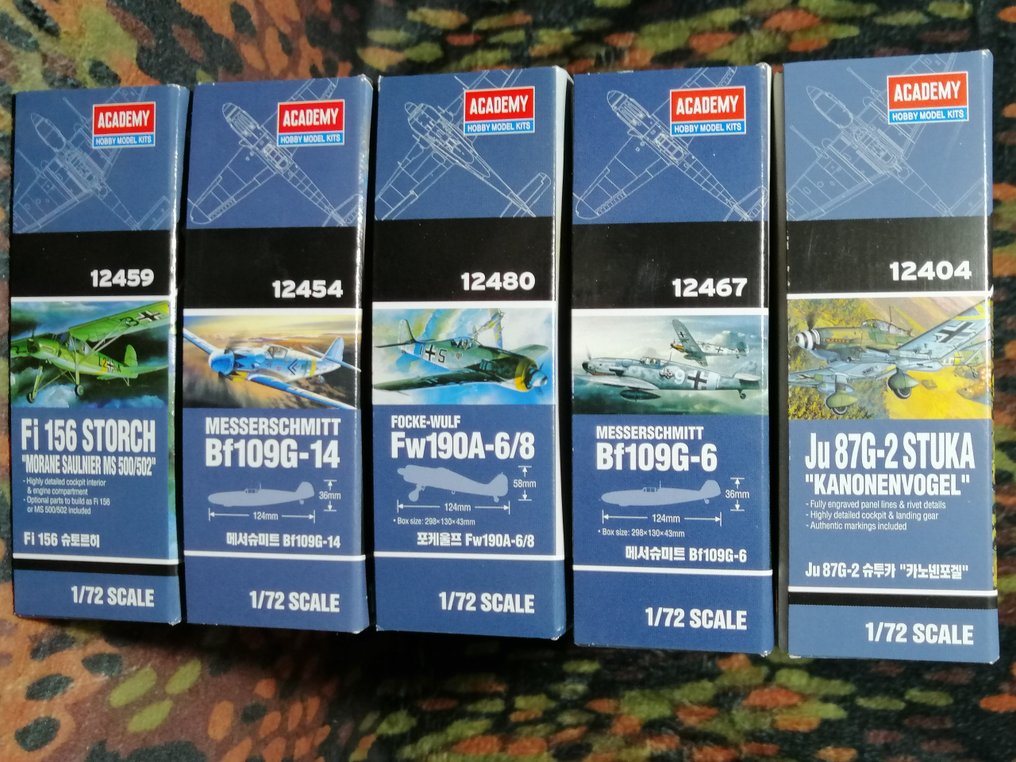
Academy - Toy Lotto 'Germania Luftwaffe 1939/1945' con 5 kit nuovi da assemblare scala 1:72 + 5 schede - 2000-2010




Opens tomorrow
Starting bid
€ 1
Add to your favourites to get an alert when the auction starts.

Catawiki Buyer Protection
Your payment’s safe with us until you receive your object.View details
Trustpilot 4.4 | 122290 reviews
Rated Excellent on Trustpilot.
Description from the seller
New Lotto set 'Germania Luftwaffe 1939-1945' with 5 plastic kits
To assemble and paint in 1:72 scale + 5 photographic sheets.
Static modeling of military aircraft allows you to immerse yourself in the history and technology of the vehicles used in warfare. You can faithfully reproduce the main aircraft used by the German armed forces, dedicating many hours to building models and using materials like plastic, etc. With this hobby, you can appreciate the beauty and complexity of these aircraft, as well as their strategic importance. Your collection of finished models will be a true miniature museum, telling the story of many conflicts and battles. Discover the pleasure of building your own miniature aircraft collection with static modeling, and immerse yourself in the history and technology of military planes.
Messerschmitt BF109G-6
Academy
- code: 12467
- scale: 1:72
World War II
- country: Germany
Type: fighter aircraft
new kit
sealed envelopes
Plastic kit to assemble and paint.
glue and colors not included
Focke-Wulf FW190A-6/8
Academy
- codice : 12480
- scale: 1:72
World War II
- country: Germany
- type: fighter/bomber aircraft
new kit
sealed envelopes
Plastic kit to assemble and paint.
glue and colors not included
3) Messerschmitt BF-109 G-14
Academy
- code: 12454
- scale: 1:72
World War II
- country: Germany
Type: fighter aircraft
new kit
sealed envelopes
Plastic kit to assemble and paint.
glue and colors not included
JU-87G-2 Stuka Cannon Bird
Academy
- code: 12404
- scale: 1:72
World War II
- country: Germany
Type: dive bomber
new kit
sealed envelopes
Plastic kit to assemble and paint.
glue and colors not included
FI-156 Storch
Academy
- code: 12459
- scale: 1:72
World War II
- country: Germany
- type: connection/reconnaissance aircraft
new kit
sealed envelopes
Plastic kit to assemble and paint.
glue and colors not included
Aviation in pictures
- Dornier DO 17 Z-1
photographic profile
- dimensions: 15 cm x 21 cm
used in good condition
Aviation in pictures
Junkers U 188 E-2
photographic profile
- dimensions: cm. 15 x 21
used in good condition
Aviation in pictures
Dornier Do 18 F
photographic profile
- dimensions: cm. 15 x 21
used in good condition
Aviation in Focus
Henschel Hs 122 V-2
photographic profile
- dimensions: cm. 15 x 21
used in good condition
Aviation in pictures
Focke-Wulf A28
photographic profile
- dimensions: 15 x 21 cm.
used in good condition
- The dive bomber JU-87 is certainly one of the most well-known and famous aircraft of World War II. This distinctive aircraft with a 'seagull' wing gained great fame at the start of the war and is considered, along with the Wehrmacht's Panzer Divisions, a symbol of the Blitzkrieg. During the war, new versions with different operational profiles were introduced. The Ju-87G was developed as an 'anti-tank' version of the famous Stuka to counter, on the Eastern Front after 1943, the impressive number of enemy armored vehicles. The renowned Stuka pilot Hans Ulrich Rudel suggested mounting two Flak 18 37 mm cannons in underwing pods to better confront this new threat. In this configuration, the Ju-87G 'Kanonenvogel' proved, in the hands of experienced pilots, to be extremely effective.
The BF-109 G was a natural evolution of the previous F model of the famous German fighter that dominated the skies in the early part of World War II. This version was equipped with a more powerful engine capable of increasing speed and operational altitude, as well as enhanced armament in some sub-versions designed for attacking large Allied bombers. From the end of 1943, the BF-109 G formed the backbone of Luftwaffe units.
- The Messerschmitt BF-109 is undoubtedly the most famous aircraft of World War II, alongside its British counterpart, the Spitfire. In July 1944, the G-14 appeared, equipped with a DB 605AM engine of 1775 HP, featuring the MW50 supercharging system as standard, which offered better acceleration and climb rate. At higher altitudes, and in skilled hands, it could match any Allied fighter and was a powerful interceptor against bombers and ground attack aircraft. The new Erla canopy had become standard equipment. A new FuG16-ZY radio included the recent Y-Verführung navigation system, enabling a certain all-weather capability. Like the latest versions of the G-6, the G-14 also extensively used the Werfer-Granate 21 rocket launchers, tubes mounted under the wings from which the pilot fired timed fragmentation rockets against bomber formations. While these reduced aircraft performance due to their air resistance and were imprecise, their explosive charge of 40 kg and range of 1200 meters made them a formidable anti-bomber weapon. In all its versions, the G was produced in approximately 5,500 units.
The Focke-Wulf Fw 190 was one of the best aircraft designed during World War II. Produced in over 20,000 units starting from 1941, it was, along with the Messerschmitt Bf 109, the most famous fighter of the Luftwaffe. The Focke-Wulf Fw 190 A-8 was equipped with a BMW 801 D-2 radial engine with a double star configuration and 14 cylinders producing 1,700 Hp, allowing it to reach a maximum speed of 653 km/h. It was heavily armed with 2 MG 131 machine guns and 4 MG 151 20 mm cannons. In the early months of 1944, the A-8 version entered production, characterized by an injection system capable of increasing the engine power to over 1,900 Hp for short periods. From 1944 until May 1945, more than 6,500 Fw 190 A-8s were produced across all Focke-Wulf factories to counter the increasingly frequent incursions of Allied bombers.
The Fieseler Fi 156 "Storch," produced in about 2,900 units, was a single-engine aircraft used for support, rescue, liaison, and observation with high wings, manufactured by the German company Gerhard-Fieseler-Werke GmbH between the 1930s and 1940s. It was primarily used by the Luftwaffe and the Axis air forces during World War II. The Fi 156 entered production in 1937 as a liaison and observation aircraft for the army. The prototype, which first flew in 1936, could take off in a headwind of 40 km/h. Production, initiated in Germany, France, and Czechoslovakia until the end of the war, totaled around 2,900 aircraft. Even after that date, they continued to be built in France as Morane-Saulnier MS-500 and its derivatives, and in Czechoslovakia as Mraz K-65 Cap.
The Storch could lift off in just 50 meters and land in 20, thanks to its hyper-boosters located on the leading edge and the slot on the trailing edge, a technique that allowed it to have a very low stall speed of only 50 km/h. Many high-ranking German officers, including Field Marshals Erwin Rommel and Albert Kesselring, had their personal Fi 156s.
Note: I attach great importance to the correct description and good photos of the lot.
The photos are part of the lot description and provide many details about the lot, including its condition and completeness. I always recommend carefully studying the numerous photos. Photos always take precedence over the written text.
Photos of the assembled and painted model are for illustrative purposes only.
Additional costs will be applied to non-continental destinations, including islands and overseas territories.
Tracked shipment
New Lotto set 'Germania Luftwaffe 1939-1945' with 5 plastic kits
To assemble and paint in 1:72 scale + 5 photographic sheets.
Static modeling of military aircraft allows you to immerse yourself in the history and technology of the vehicles used in warfare. You can faithfully reproduce the main aircraft used by the German armed forces, dedicating many hours to building models and using materials like plastic, etc. With this hobby, you can appreciate the beauty and complexity of these aircraft, as well as their strategic importance. Your collection of finished models will be a true miniature museum, telling the story of many conflicts and battles. Discover the pleasure of building your own miniature aircraft collection with static modeling, and immerse yourself in the history and technology of military planes.
Messerschmitt BF109G-6
Academy
- code: 12467
- scale: 1:72
World War II
- country: Germany
Type: fighter aircraft
new kit
sealed envelopes
Plastic kit to assemble and paint.
glue and colors not included
Focke-Wulf FW190A-6/8
Academy
- codice : 12480
- scale: 1:72
World War II
- country: Germany
- type: fighter/bomber aircraft
new kit
sealed envelopes
Plastic kit to assemble and paint.
glue and colors not included
3) Messerschmitt BF-109 G-14
Academy
- code: 12454
- scale: 1:72
World War II
- country: Germany
Type: fighter aircraft
new kit
sealed envelopes
Plastic kit to assemble and paint.
glue and colors not included
JU-87G-2 Stuka Cannon Bird
Academy
- code: 12404
- scale: 1:72
World War II
- country: Germany
Type: dive bomber
new kit
sealed envelopes
Plastic kit to assemble and paint.
glue and colors not included
FI-156 Storch
Academy
- code: 12459
- scale: 1:72
World War II
- country: Germany
- type: connection/reconnaissance aircraft
new kit
sealed envelopes
Plastic kit to assemble and paint.
glue and colors not included
Aviation in pictures
- Dornier DO 17 Z-1
photographic profile
- dimensions: 15 cm x 21 cm
used in good condition
Aviation in pictures
Junkers U 188 E-2
photographic profile
- dimensions: cm. 15 x 21
used in good condition
Aviation in pictures
Dornier Do 18 F
photographic profile
- dimensions: cm. 15 x 21
used in good condition
Aviation in Focus
Henschel Hs 122 V-2
photographic profile
- dimensions: cm. 15 x 21
used in good condition
Aviation in pictures
Focke-Wulf A28
photographic profile
- dimensions: 15 x 21 cm.
used in good condition
- The dive bomber JU-87 is certainly one of the most well-known and famous aircraft of World War II. This distinctive aircraft with a 'seagull' wing gained great fame at the start of the war and is considered, along with the Wehrmacht's Panzer Divisions, a symbol of the Blitzkrieg. During the war, new versions with different operational profiles were introduced. The Ju-87G was developed as an 'anti-tank' version of the famous Stuka to counter, on the Eastern Front after 1943, the impressive number of enemy armored vehicles. The renowned Stuka pilot Hans Ulrich Rudel suggested mounting two Flak 18 37 mm cannons in underwing pods to better confront this new threat. In this configuration, the Ju-87G 'Kanonenvogel' proved, in the hands of experienced pilots, to be extremely effective.
The BF-109 G was a natural evolution of the previous F model of the famous German fighter that dominated the skies in the early part of World War II. This version was equipped with a more powerful engine capable of increasing speed and operational altitude, as well as enhanced armament in some sub-versions designed for attacking large Allied bombers. From the end of 1943, the BF-109 G formed the backbone of Luftwaffe units.
- The Messerschmitt BF-109 is undoubtedly the most famous aircraft of World War II, alongside its British counterpart, the Spitfire. In July 1944, the G-14 appeared, equipped with a DB 605AM engine of 1775 HP, featuring the MW50 supercharging system as standard, which offered better acceleration and climb rate. At higher altitudes, and in skilled hands, it could match any Allied fighter and was a powerful interceptor against bombers and ground attack aircraft. The new Erla canopy had become standard equipment. A new FuG16-ZY radio included the recent Y-Verführung navigation system, enabling a certain all-weather capability. Like the latest versions of the G-6, the G-14 also extensively used the Werfer-Granate 21 rocket launchers, tubes mounted under the wings from which the pilot fired timed fragmentation rockets against bomber formations. While these reduced aircraft performance due to their air resistance and were imprecise, their explosive charge of 40 kg and range of 1200 meters made them a formidable anti-bomber weapon. In all its versions, the G was produced in approximately 5,500 units.
The Focke-Wulf Fw 190 was one of the best aircraft designed during World War II. Produced in over 20,000 units starting from 1941, it was, along with the Messerschmitt Bf 109, the most famous fighter of the Luftwaffe. The Focke-Wulf Fw 190 A-8 was equipped with a BMW 801 D-2 radial engine with a double star configuration and 14 cylinders producing 1,700 Hp, allowing it to reach a maximum speed of 653 km/h. It was heavily armed with 2 MG 131 machine guns and 4 MG 151 20 mm cannons. In the early months of 1944, the A-8 version entered production, characterized by an injection system capable of increasing the engine power to over 1,900 Hp for short periods. From 1944 until May 1945, more than 6,500 Fw 190 A-8s were produced across all Focke-Wulf factories to counter the increasingly frequent incursions of Allied bombers.
The Fieseler Fi 156 "Storch," produced in about 2,900 units, was a single-engine aircraft used for support, rescue, liaison, and observation with high wings, manufactured by the German company Gerhard-Fieseler-Werke GmbH between the 1930s and 1940s. It was primarily used by the Luftwaffe and the Axis air forces during World War II. The Fi 156 entered production in 1937 as a liaison and observation aircraft for the army. The prototype, which first flew in 1936, could take off in a headwind of 40 km/h. Production, initiated in Germany, France, and Czechoslovakia until the end of the war, totaled around 2,900 aircraft. Even after that date, they continued to be built in France as Morane-Saulnier MS-500 and its derivatives, and in Czechoslovakia as Mraz K-65 Cap.
The Storch could lift off in just 50 meters and land in 20, thanks to its hyper-boosters located on the leading edge and the slot on the trailing edge, a technique that allowed it to have a very low stall speed of only 50 km/h. Many high-ranking German officers, including Field Marshals Erwin Rommel and Albert Kesselring, had their personal Fi 156s.
Note: I attach great importance to the correct description and good photos of the lot.
The photos are part of the lot description and provide many details about the lot, including its condition and completeness. I always recommend carefully studying the numerous photos. Photos always take precedence over the written text.
Photos of the assembled and painted model are for illustrative purposes only.
Additional costs will be applied to non-continental destinations, including islands and overseas territories.
Tracked shipment
Details
Era
After 2000
Brand
Academy
Model/ Name
Lotto 'Germania Luftwaffe 1939/1945' con 5 kit nuovi da assemblare scala 1:72 + 5 schede
Period
2000-2010
Condition
Mint
Packaging
in unopened polybags, with original box
Material
Plastic
Scale
1:72
Sold by
Disclaimer
The objects comprising this lot are meant exclusively for collectors of military-historical objects. The owner of this website does not have any political and/or other motives than providing a platform that allows third parties to buy or sell auction lots, and assumes no responsibility for their contents.
The objects comprising this lot are meant exclusively for collectors of military-historical objects. The owner of this website does not have any political and/or other motives than providing a platform that allows third parties to buy or sell auction lots, and assumes no responsibility for their contents.