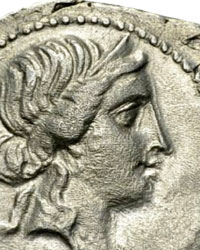
Roman Empire. Trajan (AD 98-117). Denarius Rome - Concordia seated (No Reserve Price)


01
day
16
hours
57
minutes
46
seconds

22 other people are watching this object
 Bidder 1403 Bidder 1403 | €24 | |
|---|---|---|
 Bidder 8655 Bidder 8655 | €15 | |
| Bidder 2334 | €10 | |
Catawiki Buyer Protection
Your payment’s safe with us until you receive your object.View details
Trustpilot 4.4 | 122115 reviews
Rated Excellent on Trustpilot.
AR denarius minted under Trajan in Rome, 101–102 AD, obverse IMP CAES NERVA TRAIAN AVG GERM; reverse Vesta seated, diameter about 19 mm, weight 3.28 g, with a nice patina and mirror-like surfaces; condition: uncertified.
AI-assisted summary
Description from the seller
AR denarius, minted under Trajan, Rome, 101–102 AD.
Diameter approx. 19 mm, weight 3.28 g, stamp position 7 o'clock.
Rating: Beautiful patina with reflective surfaces.
Obverse: Legend IMP CAES NERVA TRAIAN AVG GERM; laurel-wreathed portrait facing right.
Reverse: P M TR P COS IIII P P; Vesta sits facing left, holds a patera in her outstretched right hand and carries a double torch in the crook of her left arm.
Reference: RIC II 53.
Historical context (
Marcus Ulpius Traianus – better known as Trajan – is one of the most outstanding rulers of the Roman Empire. The son of a respected senator who served under Vespasian, he embarked on a military career early on, gaining experience in various provincial posts. Shortly before his accession to the throne, he received the honorary title Germanicus for successful campaigns on the Germanic frontier. After the death of the elderly Nerva in 98 AD, Trajan succeeded him to the throne.
During his reign, the Roman Empire reached its greatest territorial extent. The Dacian Wars, in particular, yielded valuable resources and strategic advantages. Trajan also expanded Rome's influence in the east, gaining territories such as Armenia and Mesopotamia. Alongside his military successes, he significantly promoted infrastructure and construction: roads, bridges, and aqueducts were renovated or newly built. Monuments such as Trajan's Column and Trajan's Forum in Rome still bear witness to this building activity.
Trajan's reign is considered the pinnacle of the Roman Empire – characterized by stability, prosperity, and expansion. Due to his achievements, the Senate bestowed upon him the honorary title Optimus, and later emperors were ushered into office with the wish that they might be "happier than Augustus and better than Trajan."
Seller's Story
Kleinunternehmen
AR denarius, minted under Trajan, Rome, 101–102 AD.
Diameter approx. 19 mm, weight 3.28 g, stamp position 7 o'clock.
Rating: Beautiful patina with reflective surfaces.
Obverse: Legend IMP CAES NERVA TRAIAN AVG GERM; laurel-wreathed portrait facing right.
Reverse: P M TR P COS IIII P P; Vesta sits facing left, holds a patera in her outstretched right hand and carries a double torch in the crook of her left arm.
Reference: RIC II 53.
Historical context (
Marcus Ulpius Traianus – better known as Trajan – is one of the most outstanding rulers of the Roman Empire. The son of a respected senator who served under Vespasian, he embarked on a military career early on, gaining experience in various provincial posts. Shortly before his accession to the throne, he received the honorary title Germanicus for successful campaigns on the Germanic frontier. After the death of the elderly Nerva in 98 AD, Trajan succeeded him to the throne.
During his reign, the Roman Empire reached its greatest territorial extent. The Dacian Wars, in particular, yielded valuable resources and strategic advantages. Trajan also expanded Rome's influence in the east, gaining territories such as Armenia and Mesopotamia. Alongside his military successes, he significantly promoted infrastructure and construction: roads, bridges, and aqueducts were renovated or newly built. Monuments such as Trajan's Column and Trajan's Forum in Rome still bear witness to this building activity.
Trajan's reign is considered the pinnacle of the Roman Empire – characterized by stability, prosperity, and expansion. Due to his achievements, the Senate bestowed upon him the honorary title Optimus, and later emperors were ushered into office with the wish that they might be "happier than Augustus and better than Trajan."
Seller's Story
Kleinunternehmen
Details
Era
Before 1400
Culture/region
Roman Empire
Year/Period and Variation
Rome - Concordia seated
Ruler
Trajan (AD 98-117)
Denomination
Denarius
Metal
AR
Condition
Ungraded
Sold by