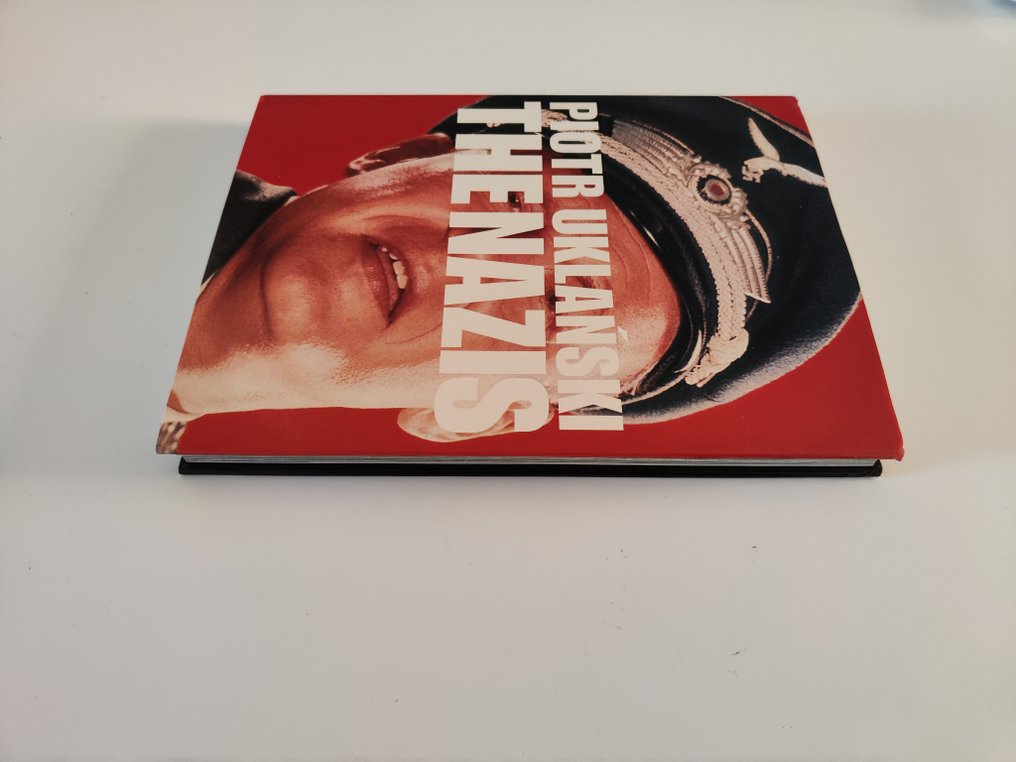
Piotr Uklański - The Nazis - 1999


13
days
13
hours
12
minutes
24
seconds
Current bid
€ 4
Reserve price not met

Expert
Selected by Sebastian Hau
Founded and directed two French book fairs; nearly 20 years of experience in contemporary books.
Estimate € 230 - € 280
5 other people are watching this object
 Bidder 0438 Bidder 0438 | €4 |
|---|
Catawiki Buyer Protection
Your payment’s safe with us until you receive your object.View details
Trustpilot 4.4 | 121899 reviews
Rated Excellent on Trustpilot.
Description from the seller
Piotr Uklański: The Nazis is one of the most provocative and widely discussed art books of the early 2000s. Built around Uklański’s controversial photographic series, the volume collects hundreds of film stills depicting actors—famous and obscure—portrayed as Nazis in cinema. By assembling these images without commentary, Uklański invites readers to confront the strange tension between historical atrocity and its stylized representation in popular culture. The book raises difficult questions about the aesthetics of evil, the seductive power of the cinematic image, and the way history is mythologized through entertainment. Published in a relatively small print run, the book was never widely distributed, and many copies were quickly absorbed into private collections or institutional archives. As a result, copies have become increasingly scarce, especially those in good condition with intact dust jackets and clean interiors. Over time, The Nazis has gained a reputation not only as a significant piece of conceptual art publishing but also as a high-value collector’s item, sought after by enthusiasts of contemporary art, photography, and charged visual culture. For collectors, the book represents a fascinating and provocative artifact—one that is as challenging in its content as it is desirable for its rarity.
Seller's Story
Books are my great passion, which I have been collecting privately for decades with great love. I keep a vast assortment of thousands of volumes on photography, avant-garde, erotica, fashion and counterculture.
Translated by Google TranslatePiotr Uklański: The Nazis is one of the most provocative and widely discussed art books of the early 2000s. Built around Uklański’s controversial photographic series, the volume collects hundreds of film stills depicting actors—famous and obscure—portrayed as Nazis in cinema. By assembling these images without commentary, Uklański invites readers to confront the strange tension between historical atrocity and its stylized representation in popular culture. The book raises difficult questions about the aesthetics of evil, the seductive power of the cinematic image, and the way history is mythologized through entertainment. Published in a relatively small print run, the book was never widely distributed, and many copies were quickly absorbed into private collections or institutional archives. As a result, copies have become increasingly scarce, especially those in good condition with intact dust jackets and clean interiors. Over time, The Nazis has gained a reputation not only as a significant piece of conceptual art publishing but also as a high-value collector’s item, sought after by enthusiasts of contemporary art, photography, and charged visual culture. For collectors, the book represents a fascinating and provocative artifact—one that is as challenging in its content as it is desirable for its rarity.
Seller's Story
Books are my great passion, which I have been collecting privately for decades with great love. I keep a vast assortment of thousands of volumes on photography, avant-garde, erotica, fashion and counterculture.
Translated by Google TranslateDetails
Number of Books
1
Subject
Art, Photography, War history
Book Title
The Nazis
Author/ Illustrator
Piotr Uklański
Condition
Fine
Publication year oldest item
1999
Edition
1st Edition
Language
English
Original language
Yes
Binding/ Material
Hardback
Number of pages
180